USAAAO 2020, II кръг — Задача 11
2020 National Astronomy Competition · 30 т.
Instructions (Please Read Carefully)
The top 5 eligible scorers on the NAC will be invited to represent USA at the next IOAA. The next 5 eligible scorers will be invited to join the USA guest team at the next IOAA. In order to qualify for the national team, you must be a high school student with US citizenship or permanent residency.
This exam consists of 3 parts: Short Questions, Medium Questions and Long Questions.
The test must be completed within 2.5 hours (150 minutes).
Please solve each problem on a blank piece of paper and mark the number of the problem at the top of the page. The contestant’s full name in capital letters should appear at the top of each solution page. If the contestant uses scratch papers, those should be labeled with the contestant’s name as well and marked as “scratch paper” at the top of the page. Scratch paper will not be graded. Partial credit will be available given that correct and legible work was displayed in the solution.
This is a written exam. Contestants can only use a scientific calculator for this exam. A table of physical constants will be provided. Discussing the problems with other people is strictly prohibited in any way until the end of the examination period on April 5th. Receiving any external help during the exam is strictly prohibited. This means that the only allowed items are: a scientific calculator, the provided table of constants, a pencil (or pen), an eraser, blank sheets of papers, and the exam. No books or notes are allowed during the exam.
Условие
M15 is a globular cluster in the constellation Pegasus. The Hertzsprung–Russell diagram (apparent visual magnitude versus color index) of the cluster is shown in fig. 1. Considering that the mass (M)– luminosity (L) relation for main sequence stars is given by =constant, answer the following questions. In this problem, ignore the interstellar reddening and dust extinction effects.
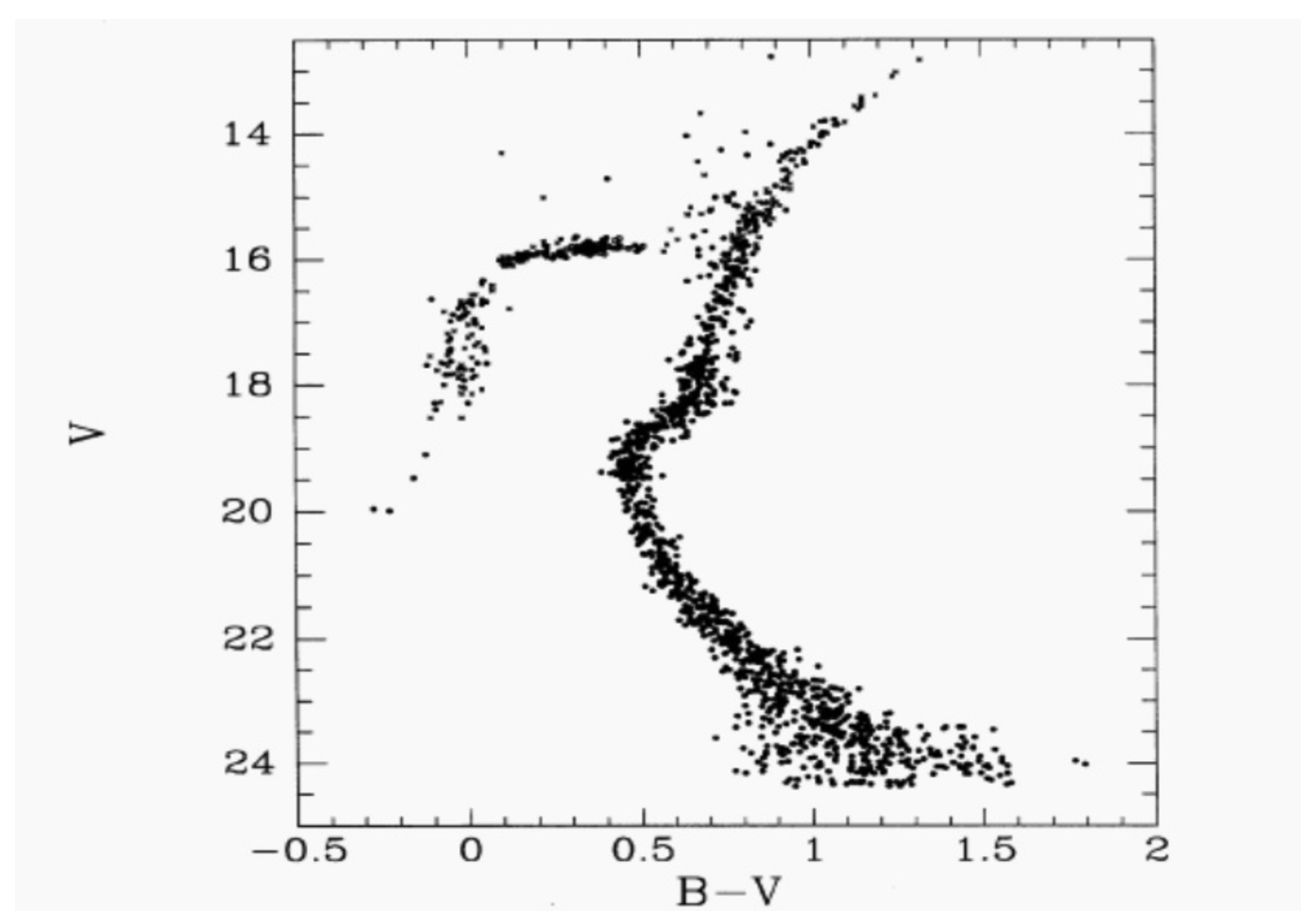
(a) Given that all the stars are formed at the same time, estimate the age of the globular cluster. The color index of the sun () is 0.65 and its life time on the main sequence is 10 billion years.
(b) Estimate the distance of this globular cluster from the Earth. Give the answer in parsec. The absolute visual magnitude of the Sun is 4.83.
(c) Given that stars spend about 10% of their main-sequence life time in the post main sequence phase, find the mass of the most massive star in the post main sequence stage.
(d) The number of stars in the mass range of can be written as:
where A is a constant, and are in units of solar masses. Assuming that the number of stars in the post main sequence phase is 515, calculate the value of constant A in equation 1.
(e) M15 is one of the most densely packed globular clusters such that in a visual band () image of M15 taken by a telescope with diameter of 10 cm, the stars at the center of cluster cannot be resolved. Estimate the minimum number of stars in this cluster. The angular diameter of M15 is 12.3 arc minutes. Assume that the number density of stars is constant within the cluster.
(f) Use your answers from parts (d) and (e) to estimate the mass of the lowest possible mass star in this cluster. For this part, assume that the mass of the most massive star in the cluster is .
Отговори
- (a) 2.7 billion years
- (b) d ~ 20 kpc
- (c) 2.02 MSun
- (d) A ~ 16945
- (e) Nmin ~ 3.8 × 10⁵
- (f) Mmin ~ 0.1 MSun
Решение
Solution:
(a) Measuring from the H-R diagram, a solar-like star with (=0.65) has apparent visual magnitude . Also, this value is for a star at the turning point of the main sequence. Thus, which gives . It allows us to estimate the life time of the star at the turning point which is the age of the cluster. Life time in the main sequence Age of the cluster billion years=2.7 billion years. M15 is a very metal-poor globular cluster, so its actual age should be larger than this number (should be about the age of the Universe). The main reason for this discrepancy can be explained by a large uncertainty in B-V measurements.
(b) The distance module for the cluster is where is the absolute visual magnitude of the sun which is given, so distance module= 21.4-4.83=16.57. distance module= d 20 . The actual distance of this globular cluster is 10 . Our overestimation in the distance originates from the dust extinction effect that we ignored in this problem.
(c) The most massive star in the post main sequence phase spent billion years on the main sequence. Life time in the main sequence (post main sequence)
(d) The mass of the star at the turning point is . Thus, . This number can be changes based on your normalization for masses ( and ). Here we consider that they are given in solar masses.
(e) Consider a cylinder with a height of 2R (diameter of the cluster) and diameter of the telescope resolution at the center of the cluster. Within this cylinder, we should have at least two stars to observe the stars at the center of the cluster image unresolved. Telescope resolution: .
(f) Using the results from part d and e: .
Оригинал в Архива: usaaao_second_exam_2020__apr4.pdf · официални решения: usaaao_second_exam_2020__apr4sol.pdf