USAAAO 2020, II кръг — Задача 12
2020 National Astronomy Competition · 25 т.
Instructions (Please Read Carefully)
The top 5 eligible scorers on the NAC will be invited to represent USA at the next IOAA. The next 5 eligible scorers will be invited to join the USA guest team at the next IOAA. In order to qualify for the national team, you must be a high school student with US citizenship or permanent residency.
This exam consists of 3 parts: Short Questions, Medium Questions and Long Questions.
The test must be completed within 2.5 hours (150 minutes).
Please solve each problem on a blank piece of paper and mark the number of the problem at the top of the page. The contestant’s full name in capital letters should appear at the top of each solution page. If the contestant uses scratch papers, those should be labeled with the contestant’s name as well and marked as “scratch paper” at the top of the page. Scratch paper will not be graded. Partial credit will be available given that correct and legible work was displayed in the solution.
This is a written exam. Contestants can only use a scientific calculator for this exam. A table of physical constants will be provided. Discussing the problems with other people is strictly prohibited in any way until the end of the examination period on April 5th. Receiving any external help during the exam is strictly prohibited. This means that the only allowed items are: a scientific calculator, the provided table of constants, a pencil (or pen), an eraser, blank sheets of papers, and the exam. No books or notes are allowed during the exam.
Условие
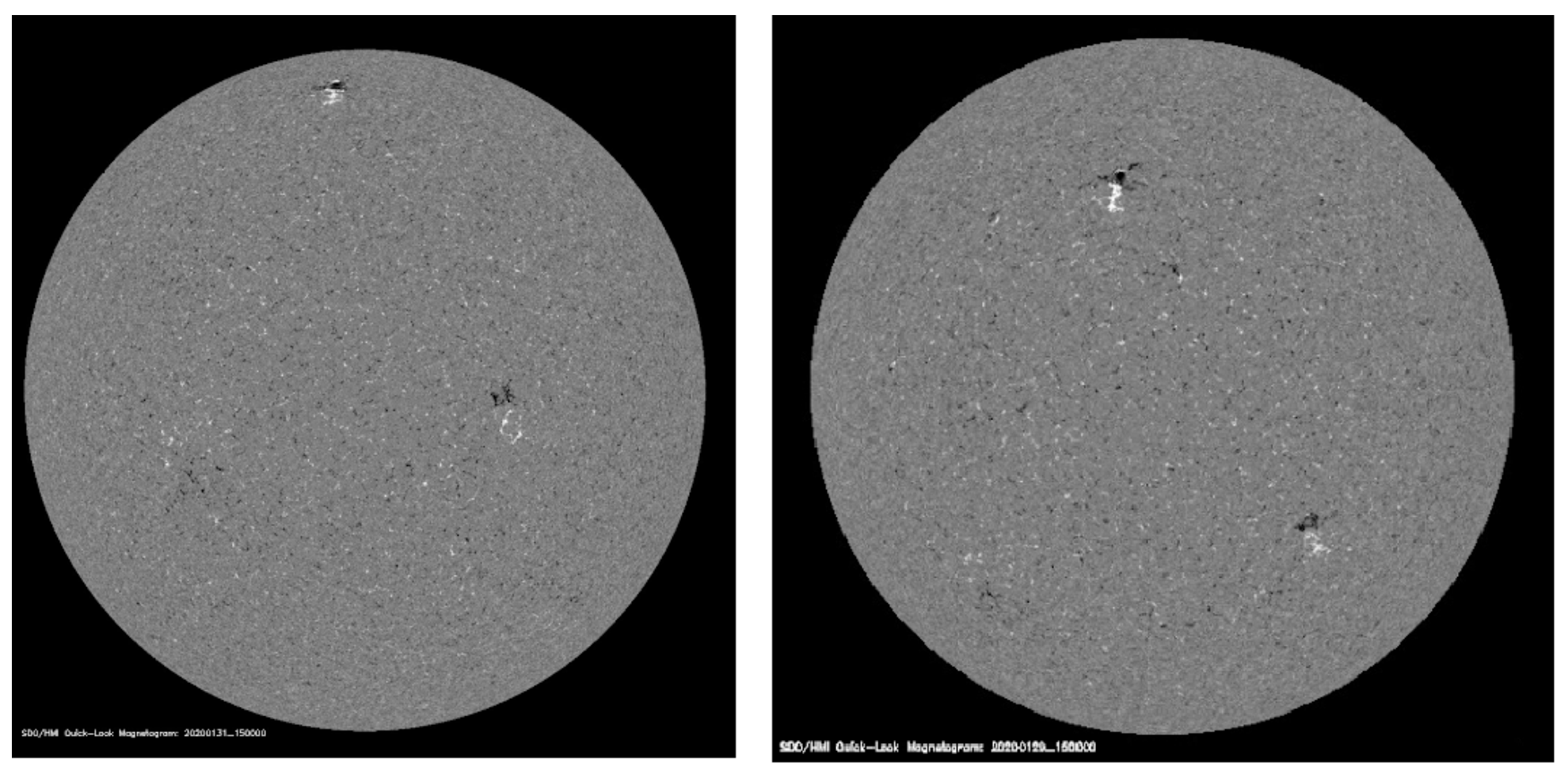
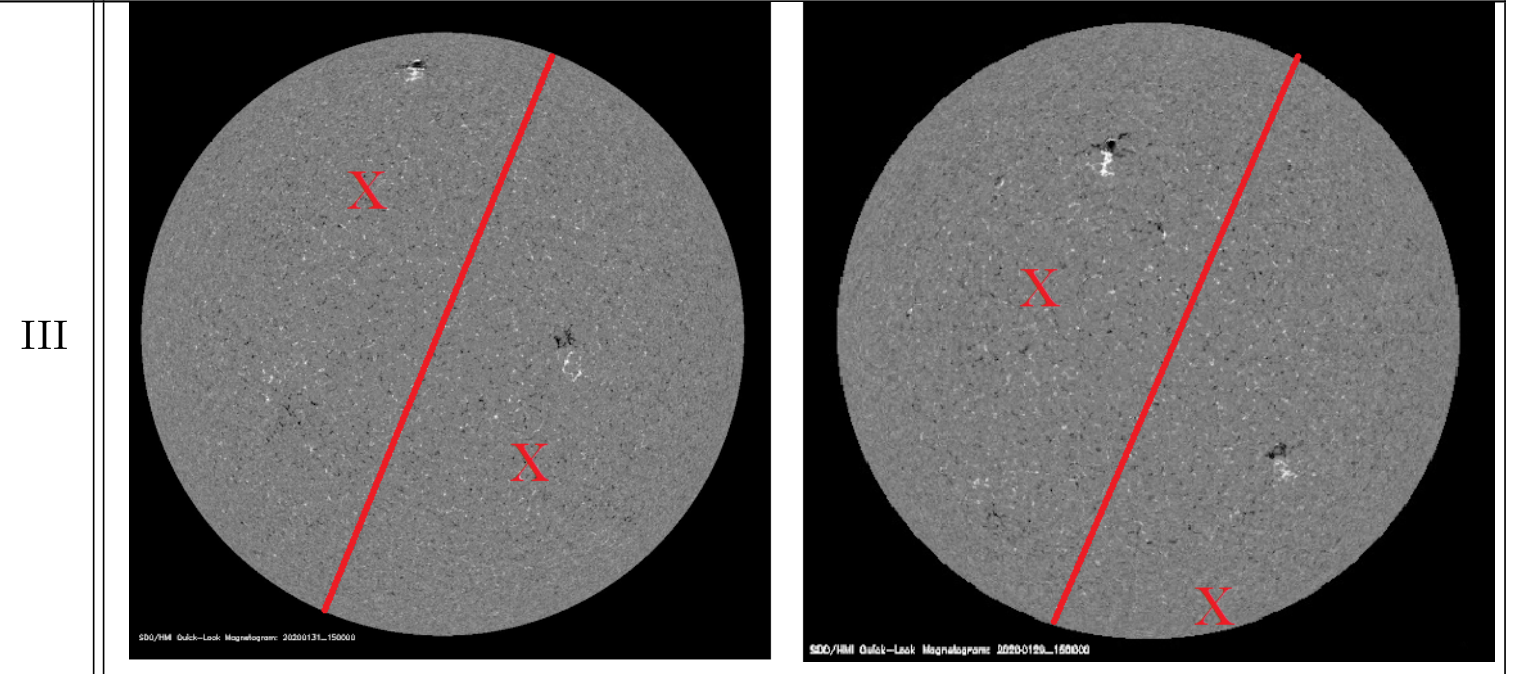
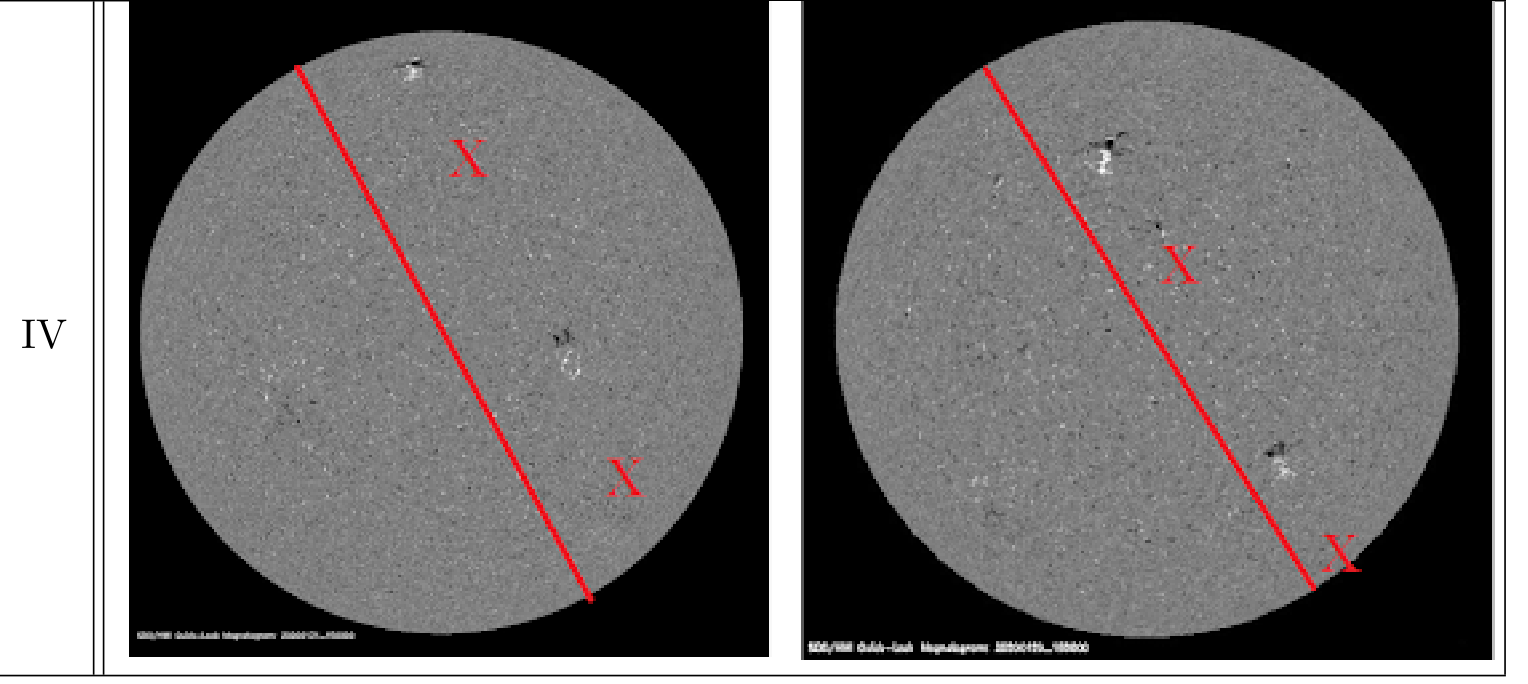
Fig. 2 shows two magnetograms of the Sun taken with the Heliseismic and Magnetic Imager (HMI) at the Solar Dynamics Observatory (SDO) towards the end of January 2020. The picture on the left was taken three days after the image on the right.
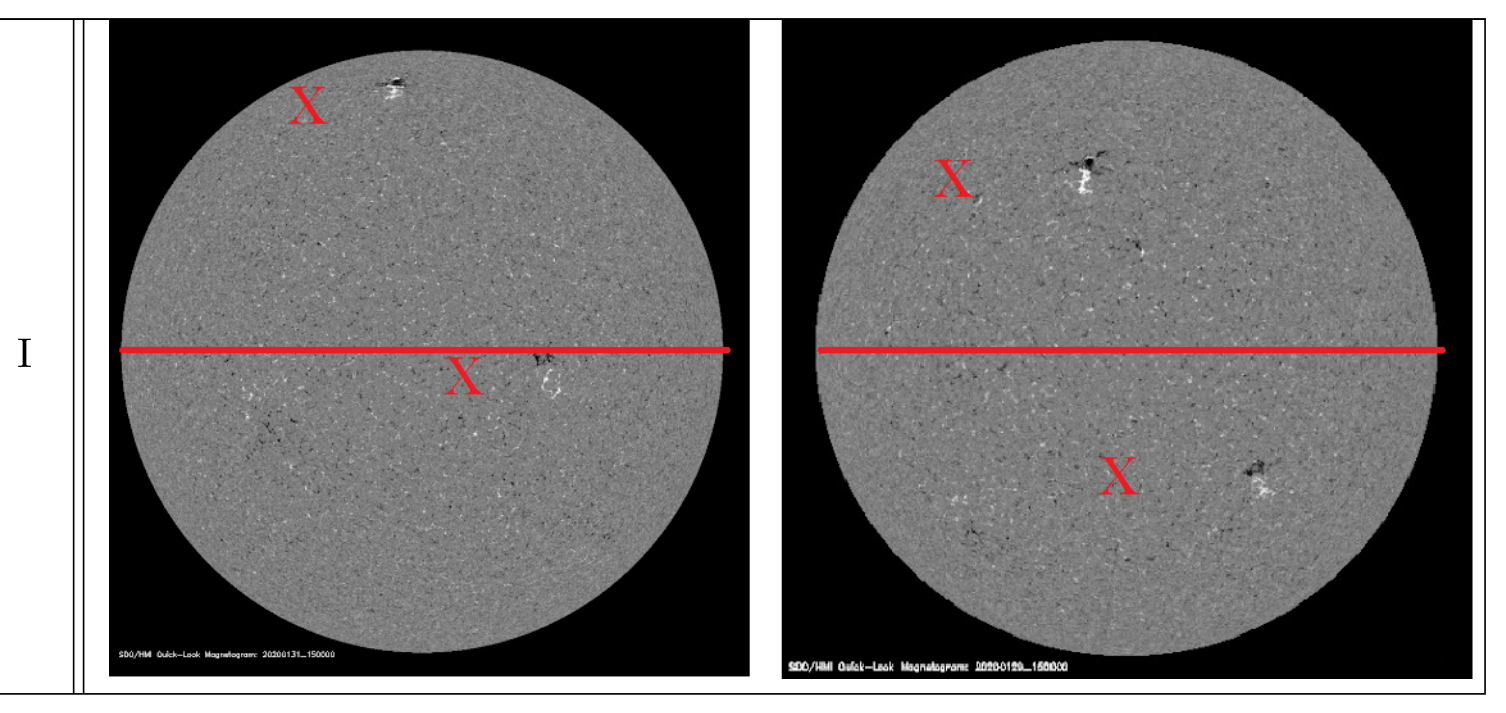
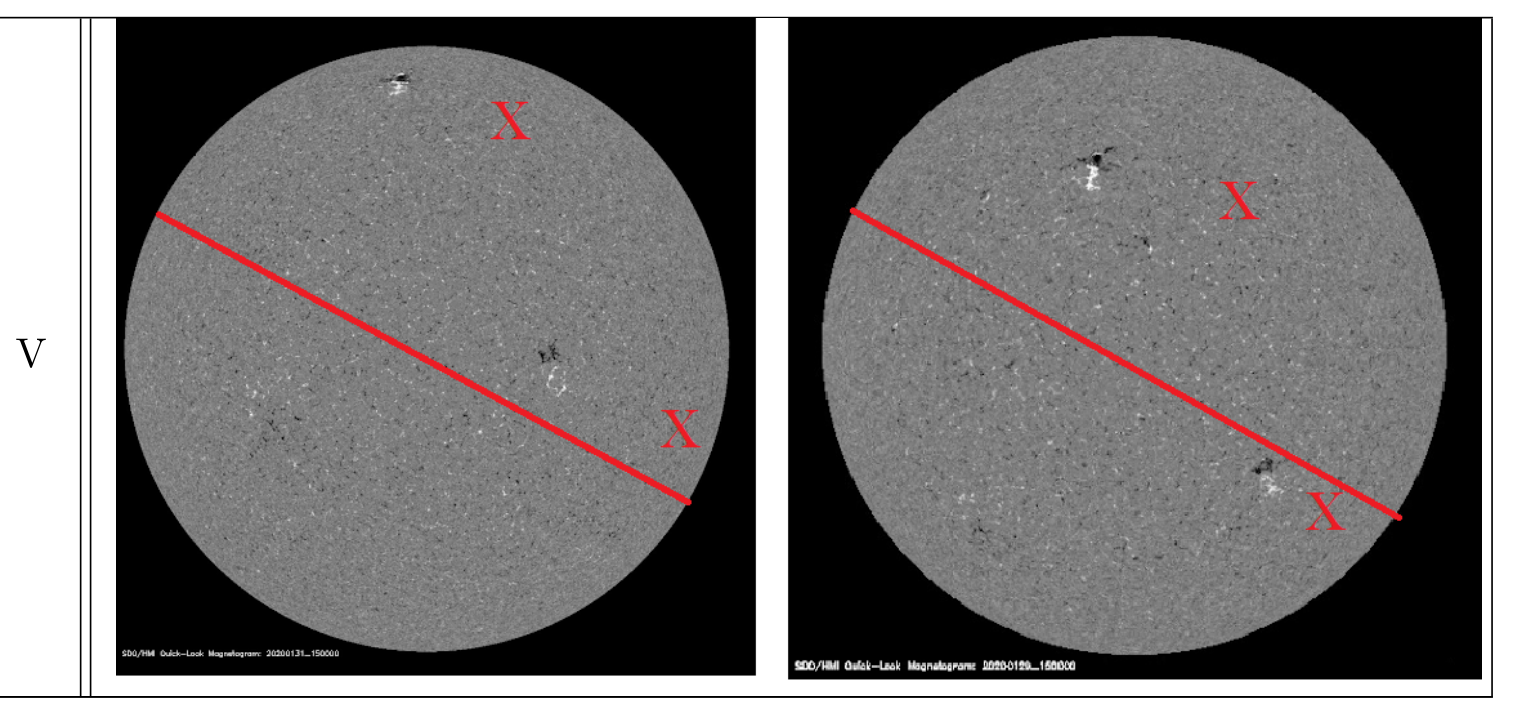
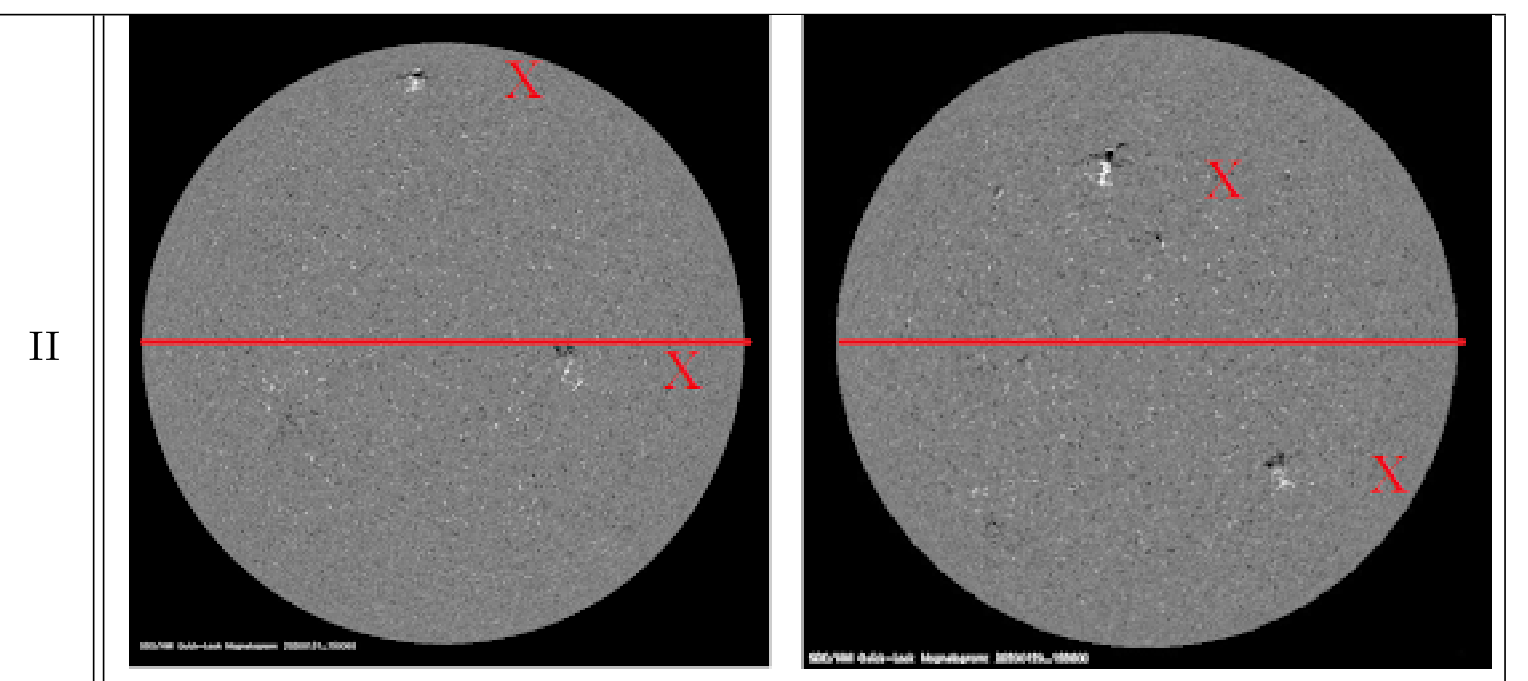
(a) Select the pair of images (numbered from I to V) in which the lines are drawn at the Sun’s Equator and the Xs correspond to the position of each sunspot 4 days before the pictures were taken.
(b) Estimate the absolute value of the latitude of both Sunspots in Figure 2.
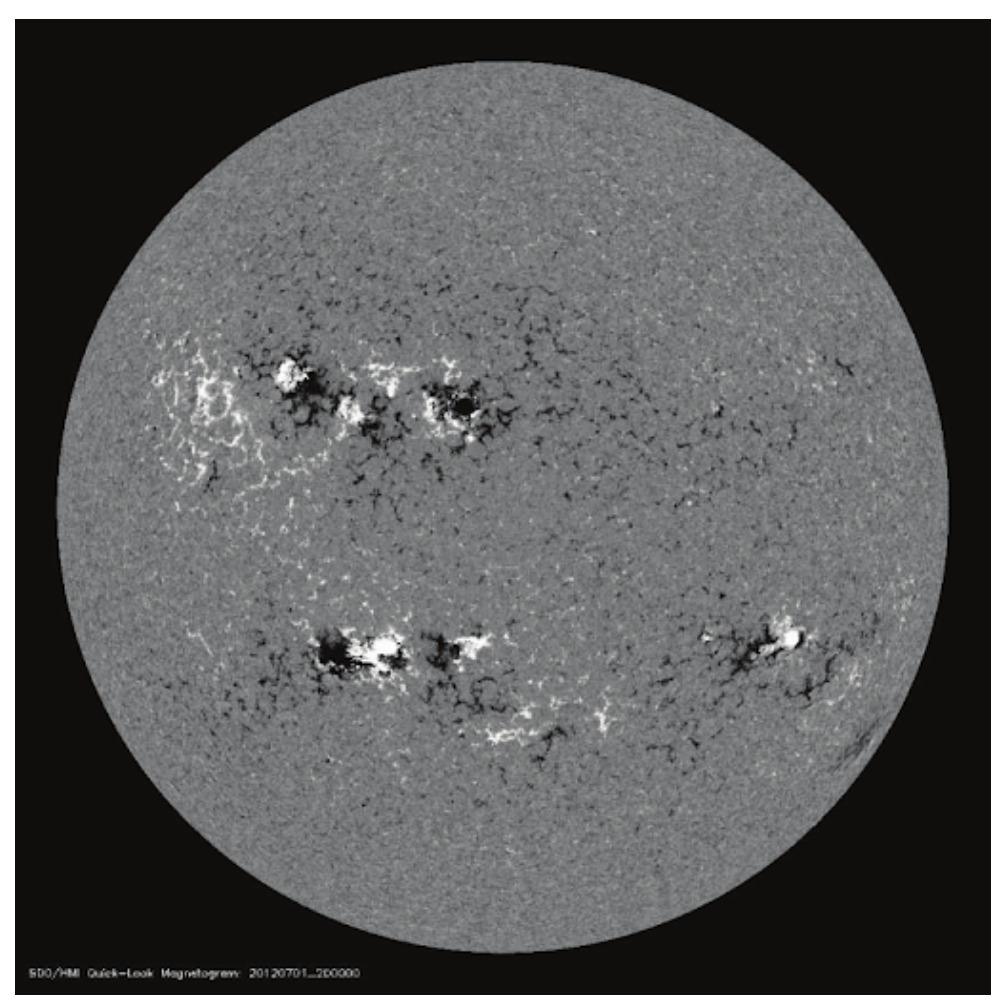
(c) Fig. 3 is a magnetogram of the Sun in normal activity. It is possible to notice that the sunspots have different orientations in different hemispheres. In one of the hemispheres, each spot has the white part on the left and the black one on the right, and vice-versa. However, this is not the case for the images presented in fig. 2. Suggest an explanation for the anomaly on the images in fig. 2.
(d) Assume for the sake of simplicity that a specific sunspot has a shape very similar to that of a spherical triangle. The sides of the triangle are equal to , , and . Calculate the value of the three internal angles in degrees.
For the following parts, assume that this sunspot is centered at South and East of the center of the Solar disk for an observer on Earth.
(e) For an observer on Earth, what is the ratio between the area of the Solar disk and the observed area of the sunspot? Note that the required ratio is between the areas observed by someone on Earth, not the ratio between the actual areas. The area of a spherical triangle is equal to , in which the spherical excess (E) in (deg) is equal to the sum of the internal angles minus and is the radius of the sphere on which the spherical triangle lies.
(f) If an observer on Earth uses a huge f/5 telescope with a focal length of 13 m to look at this sunspot, will it be possible to resolve it? Visible light is centered at 550 nm.
(g) The Sun generates its luminosity by converting Hydrogen into Helium in the proton-proton chain. In the most energetic branch of the chain, 4 protons fuse into a helium nucleus. Considering that only 10% of the solar mass can be converted into energy, calculate the time that the Sun spends in the Main Sequence.
Отговори
(a) III
(b) 26° to 29° (full credit); 25° or 30° half credit
(d) A = 61.11699°, B = 89.67051°, C = 29.21265°
(e)
The official solution gives the sunspot-to-disk ratio r = 5.16 × 10⁻⁷ (5.13 × 10⁻⁷ with the flat-triangle approximation), i.e. the inverse of the ratio worded in the question.
(f) Yes: α = 4.89 × 10⁻⁶ rad > θ = 2.58 × 10⁻⁷ rad
(g) Δt = 3.213 × 10¹⁷ s ≈ 10 billion years
Решение
Solution:
(a) The correct answer is III.
(b) The acceptable range will be to for full credit, and or to half of the punctuation.
It is useful to know that sunspots always come in pairs and have the same absolute value of latitude (one is positive and the other negative).
(c) Every 11 years (the period of the Schwabe Cycle), the Solar magnetosphere flips its orientation. Therefore, the orientation of the sunspots on each hemisphere is reversed. The pictures on item A were likely taken while the Sun was going through this transition, which explains their anomaly.
(d) A, B, and C are the internal angles of the spherical triangle.
Using the Law of the Cosines for spherical triangles:
Using the Law of the Sines for spherical triangles:
Using the Law of the Sines for spherical triangles to calculate the last internal angle:
(e) First, it is necessary to calculate the spherical excess:
Then, it is possible to calculate the area of the spherical triangle:
Since the question asks about the observed area it is necessary to correct it with the inclination of the tangential plane.
Inclination of the tangential plane (Law of the Cosines with a right spherical triangle containing both coordinates):
Now, it is possible to correct the observed area with the inclination:
Considering that the area of the Solar disk is , it is possible to calculate the ratio between the areas observed:
It is important to consider that small rounding errors will lead to huge differences in the spherical excess, so students won’t be penalized if their answer is different than expected due to rounding errors. In fact, if students notice that the spherical excess is so small that the triangle is basically flat, they will also get full credit for this item. In this case, the calculations for the value of r would be the following (it is possible to use any pair of sides in the triangle and the angle in between them):
(f) First, it is necessary to calculate the diameter of the telescope:
Then, it is possible to calculate the angular resolution of the telescope:
It is possible to use the smallest side of the triangle to see if it will be resolved by the telescope. Length of the smallest size of the triangle:
Correcting it for the inclination:
Angle that corresponds to this length:
Since , it is possible to resolve the sunspot.
(g) Variation in mass per reaction:
Fraction of mass converted:
Mass converted into energy while the Sun is in the Main Sequence:
Total energy converted:
Time in the main sequence:
Оригинал в Архива: usaaao_second_exam_2020__apr4.pdf · официални решения: usaaao_second_exam_2020__apr4sol.pdf