USAAAO 2021, II кръг — Medium 1
2021 National Astronomy Competition · 20 т.
Внимание: Бележка към темата
All ten whole original Short/Medium/Long problems, 30 lettered parts, 9 nested roman requests and 7 numbered satellite quantities, all original worked keys and marking notes are retained. Printed scientific discrepancies are preserved in attributed local source notes. Medium 3 original calls both masses m; its key introduces a distinct M for the station and assumes . A separate undated common archive constants/reference table is fully included with its own source identity; its use as the exact 2021 provided attachment is not established, and its constants do not replace native exam values. The native cover specifies blank paper and a signed declaration. March 20th is the end of the examination period, not an established single sitting date.
1 Instructions (Please Read Carefully)
The top 5 eligible scorers on the NAC will be invited to represent USA at the next IOAA. In order to qualify for the national team, you must be a high school student with US citizenship or permanent residency.
This exam consists of 3 parts: Short Questions, Medium Questions and Long Questions.
The maximum number of points is 180.
The test must be completed within 2.5 hours (150 minutes).
Please solve each problem on a blank piece of paper and mark the number of the problem at the top of the page. The contestant’s full name in capital letters should appear at the top of each solution page. If the contestant uses scratch papers, those should be labeled with the contestant’s name as well and marked as “scratch paper” at the top of the page. Scratch paper will not be graded. Partial credit will be available given that correct and legible work was displayed in the solution.
This is a written exam. Contestants can only use a scientific or graphing calculator for this exam. A table of physical constants will be provided. Discussing the problems with other people is strictly prohibited in any way until the end of the examination period on March 20th. Receiving any external help during the exam is strictly prohibited. This means that the only allowed items are: a calculator, the provided table of constants, a pencil (or pen), an eraser, blank sheets of papers, and the exam. No books or notes are allowed during the exam. Exam is proctored and recorded. You are expected to have your video on at all times.
After reading the instructions, please make sure to sign, affirming that:
- All work on this exam is mine.
- I did not receive any external aids besides the materials provided.
- I am not allowed to discuss the test with others throughout the period of this examination.
- Failure to follow these rules will lead to disqualification from the exam.
Signed: ____________________
Common archive reference — Table of Physical Constants
This separate common USAAAO archive reference is undated in the catalogue. Its use as the exact 2021 exam attachment is not established.
| Quantity | Symbol | Value |
|---|---|---|
| Electron rest mass | ||
| Proton rest mass | ||
| Electronic charge | ||
| Speed of light in free space | ||
| Permeability of free space | ||
| Permittivity of free space | ||
| Planck’s constant | ||
| Reduced Planck’s constant | ||
| Boltzmann’s constant | ||
| Gas constant | ||
| Molar gas constant | ||
| Avogadro’s number | ||
| Standard molar volume | ||
| Unified atomic mass unit ( scale) | ||
| Mass of hydrogen atom | ||
| Bohr magneton | or | |
| Nuclear magneton | or | |
| Proton magnetic moment | ||
| Neutron magnetic moment | ||
| Bohr radius | ||
| Fine structure constant | ||
| Compton wavelength of electron | ||
| Rydberg’s constant | ||
| Stefan-Boltzmann constant | ||
| Radiation density constant | ||
| Gravitational constant |
Rest masses of some leptons and hadrons in :
0.5110, 105.66, 1777, 134.98, 139.57, 493.7, 497.7, 547, 1865, 1869, p 938.3, n 939.6, 1115.7, 1189, 1193, 1197, 1315, 1321, 1672, , .
| Quark | Charge | Mass () | |||||
|---|---|---|---|---|---|---|---|
| u | 0 | 0 | 0 | 0 | |||
| d | 0 | 0 | 0 | 0 | |||
| c | 0 | 0 | +1 | 0 | 0 | ||
| s | 0 | -1 | 0 | 0 | 0 | ||
| t | 0 | 0 | 0 | 0 | +1 | 174.3 | |
| b | 0 | 0 | 0 | -1 | 0 | 4.2 |
Common archive reference — Astrophysical Data and identities
Astrophysical Data
| Quantity | Symbol | Value |
|---|---|---|
| 1 astronomical unit | AU | |
| 1 parsec | pc | |
| Luminosity of Sun | ||
| Mass of Sun | ||
| Radius of Sun | ||
| Mass of Earth | ||
| Radius of Earth |
Other data and conversion factors
| Quantity | Symbol | Value |
|---|---|---|
| 1 ångstrom | Å | |
| 1 fermi | fm | |
| 1 barn | b | |
| 1 pascal | Pa | |
| 1 standard atmosphere | ||
| Standard acceleration due to gravity | ||
| 1 electron volt | eV | |
| Wavelength of 1 eV photon |
Trigonometrical identities
In a triangle ABC,
and
Prefixes
| Prefix | Name | Factor |
|---|---|---|
| T | tera | |
| G | giga | |
| M | mega | |
| k | kilo | |
| c | centi | |
| m | milli | |
| micro | ||
| n | nano | |
| p | pico | |
| f | femto |
Условие
3 Medium Questions
To measure the time accurately outside the Earth, the engineers build a special clock, with the design as follows: there is a source of light that sends light particles (photons) straight to the reflector that is located at the distance away from the source. The reflector sends the photons back to their starting point, where there is a detector. This can measure the time accurately, because the speed of light is constant everywhere. Then a group of engineers built a spaceship with this special clock inside. This spaceship with a clock started to move really fast at the speed . While the observer in the spaceship reported no issues with the clock inside the spaceship, the observer on the Earth has noticed that the clock is functioning differently in a fast moving spaceship than it is on Earth.
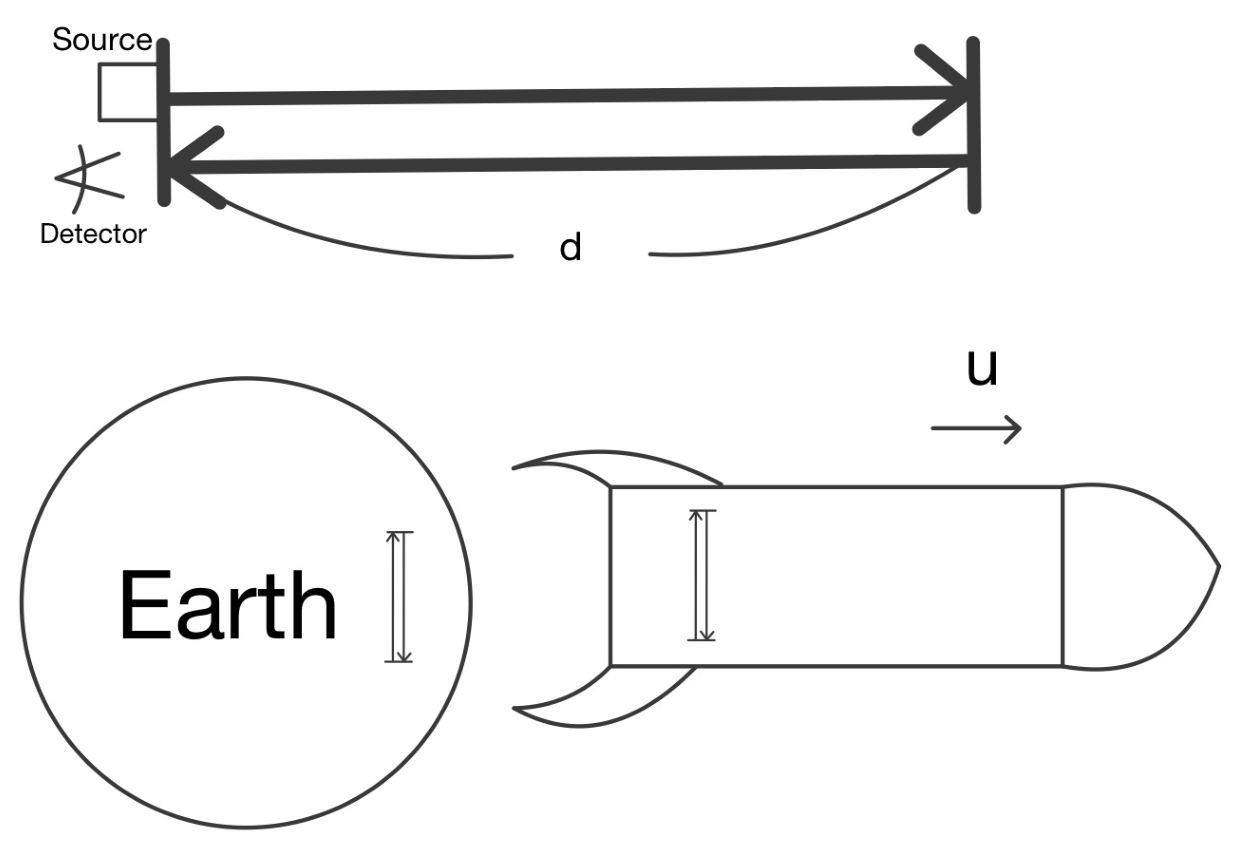
(a) Given that the clock is at rest, what is the total traveling time () of a photon from its source back to the detector?
(b) What is the total distance traveled by a photon from the source back to the detector on the spaceship moving at the speed away from the Earth? (Here, we denote that the total traveling time of the photon as )
(c) What is the total time of a photon as it travels from the source to the detector on the moving spaceship? Answer in terms of , , and .
(d) If we relate (non-moving frame) to (moving frame), as follows: , what does equal to? What is significant about the range of ?
(e) So far, we have only analyzed the motion on the perspective of an observer on the Earth. From the perspective of an observer on the moving spaceship, how do the time on the spaceship and the time on the Earth relate to each other?
(f) What can we conclude about the relative passing on time on two different frames that are relatively in motion to one another?
Отговори
- (a)
- (b)
- (c)
- (d) ; printed range greater than 1.
- (e)
- (f) Time moves slower in a moving frame when observed from a frame at rest.
Решение
(a) .
(b) While the photon travels from the source to the reflector, the spaceship moves by . The distance from the source to the reflector can be then obtained by Pythagorean theorem.
. Therefore,
(c) The speed of light is constant everywhere. Therefore, the distance traveled by light during is .
From the last section,
which equals to
or
(d)
Since no other speed can exceed the speed of light , is always less than 1. Therefore is always greater than 1.
(e)
Time moves slower on the Earth, because by relativity, the “moving spaceship” observer thinks that the Earth is flying away with a speed .
(f) Time moves slower in a moving frame when observed from a frame at rest.
Source note: The question defines speed u but writes beta=v/c. The key switches the photon distance from d_gamma to d_S and retains both v/u notations in the same derivation. Its printed gamma greater than 1 claim remains literal.
Теми и трудност
Оценена трудност: 3/5.
Съвременна физика · Специална теория на относителността
Предпоставки: Гимназиална подготовка, Разширена олимпиадна подготовка
Оригинал в Архива: usaaao_second_exam_2021_final.pdf · официални решения: usaaao_second_exam_2021_solutions.pdf · допълнителни данни: physical-constants.pdf