USAAAO 2021, II кръг — Medium 2
2021 National Astronomy Competition · 30 т.
Внимание: Бележка към темата
All ten whole original Short/Medium/Long problems, 30 lettered parts, 9 nested roman requests and 7 numbered satellite quantities, all original worked keys and marking notes are retained. Printed scientific discrepancies are preserved in attributed local source notes. Medium 3 original calls both masses m; its key introduces a distinct M for the station and assumes . A separate undated common archive constants/reference table is fully included with its own source identity; its use as the exact 2021 provided attachment is not established, and its constants do not replace native exam values. The native cover specifies blank paper and a signed declaration. March 20th is the end of the examination period, not an established single sitting date.
1 Instructions (Please Read Carefully)
The top 5 eligible scorers on the NAC will be invited to represent USA at the next IOAA. In order to qualify for the national team, you must be a high school student with US citizenship or permanent residency.
This exam consists of 3 parts: Short Questions, Medium Questions and Long Questions.
The maximum number of points is 180.
The test must be completed within 2.5 hours (150 minutes).
Please solve each problem on a blank piece of paper and mark the number of the problem at the top of the page. The contestant’s full name in capital letters should appear at the top of each solution page. If the contestant uses scratch papers, those should be labeled with the contestant’s name as well and marked as “scratch paper” at the top of the page. Scratch paper will not be graded. Partial credit will be available given that correct and legible work was displayed in the solution.
This is a written exam. Contestants can only use a scientific or graphing calculator for this exam. A table of physical constants will be provided. Discussing the problems with other people is strictly prohibited in any way until the end of the examination period on March 20th. Receiving any external help during the exam is strictly prohibited. This means that the only allowed items are: a calculator, the provided table of constants, a pencil (or pen), an eraser, blank sheets of papers, and the exam. No books or notes are allowed during the exam. Exam is proctored and recorded. You are expected to have your video on at all times.
After reading the instructions, please make sure to sign, affirming that:
- All work on this exam is mine.
- I did not receive any external aids besides the materials provided.
- I am not allowed to discuss the test with others throughout the period of this examination.
- Failure to follow these rules will lead to disqualification from the exam.
Signed: ____________________
Common archive reference — Table of Physical Constants
This separate common USAAAO archive reference is undated in the catalogue. Its use as the exact 2021 exam attachment is not established.
| Quantity | Symbol | Value |
|---|---|---|
| Electron rest mass | ||
| Proton rest mass | ||
| Electronic charge | ||
| Speed of light in free space | ||
| Permeability of free space | ||
| Permittivity of free space | ||
| Planck’s constant | ||
| Reduced Planck’s constant | ||
| Boltzmann’s constant | ||
| Gas constant | ||
| Molar gas constant | ||
| Avogadro’s number | ||
| Standard molar volume | ||
| Unified atomic mass unit ( scale) | ||
| Mass of hydrogen atom | ||
| Bohr magneton | or | |
| Nuclear magneton | or | |
| Proton magnetic moment | ||
| Neutron magnetic moment | ||
| Bohr radius | ||
| Fine structure constant | ||
| Compton wavelength of electron | ||
| Rydberg’s constant | ||
| Stefan-Boltzmann constant | ||
| Radiation density constant | ||
| Gravitational constant |
Rest masses of some leptons and hadrons in :
0.5110, 105.66, 1777, 134.98, 139.57, 493.7, 497.7, 547, 1865, 1869, p 938.3, n 939.6, 1115.7, 1189, 1193, 1197, 1315, 1321, 1672, , .
| Quark | Charge | Mass () | |||||
|---|---|---|---|---|---|---|---|
| u | 0 | 0 | 0 | 0 | |||
| d | 0 | 0 | 0 | 0 | |||
| c | 0 | 0 | +1 | 0 | 0 | ||
| s | 0 | -1 | 0 | 0 | 0 | ||
| t | 0 | 0 | 0 | 0 | +1 | 174.3 | |
| b | 0 | 0 | 0 | -1 | 0 | 4.2 |
Common archive reference — Astrophysical Data and identities
Astrophysical Data
| Quantity | Symbol | Value |
|---|---|---|
| 1 astronomical unit | AU | |
| 1 parsec | pc | |
| Luminosity of Sun | ||
| Mass of Sun | ||
| Radius of Sun | ||
| Mass of Earth | ||
| Radius of Earth |
Other data and conversion factors
| Quantity | Symbol | Value |
|---|---|---|
| 1 ångstrom | Å | |
| 1 fermi | fm | |
| 1 barn | b | |
| 1 pascal | Pa | |
| 1 standard atmosphere | ||
| Standard acceleration due to gravity | ||
| 1 electron volt | eV | |
| Wavelength of 1 eV photon |
Trigonometrical identities
In a triangle ABC,
and
Prefixes
| Prefix | Name | Factor |
|---|---|---|
| T | tera | |
| G | giga | |
| M | mega | |
| k | kilo | |
| c | centi | |
| m | milli | |
| micro | ||
| n | nano | |
| p | pico | |
| f | femto |
Условие
You want to send a rocket with an instrument to analyze the atmosphere of Jupiter. In order to get there, you decide to use a Hohmann transfer orbit. and represent the radii of Earth’s and Jupiter’s circular orbits around the Sun, respectively. , , , and represent the masses of your rocket, Earth, Jupiter, and Sun, respectively. Ignore planetary gravitational influences. You may use any other variables you would like if you clearly define them first. Refer to the figures at the end of the question. Show your work for all derivations.
(a) Explain which two (relevant) physical quantities are conserved during this transfer orbit. Write down their statements mathematically.
(b) How long will it take to reach Jupiter?
(c) Halfway through its path to Jupiter, an unrealistic comet passes right next to your rocket and its icy tail freezes your rocket fuel. What is the maximum amount of time that you can afford to pass until you need the fuel to be once again unfrozen?
(d) Knowing that this comet will come in the way, your colleague suggests a bi-elliptic transfer orbit instead, with a peak distance of . Write equations describing how long it will now take to reach Jupiter. Will this solution always avoid the comet?
Now that you’ve compared the orbital times, you want to try and calculate the difference in efficiency.
(e) Derive the for each orbital transition in the Hohmann transfer, and sum them to find the total .
(f) Derive the for each orbital transition in the Bi-elliptic transfer, and sum them to find the total .
(g) Factoring in all your previous results, which transfer would you like to use? Why?
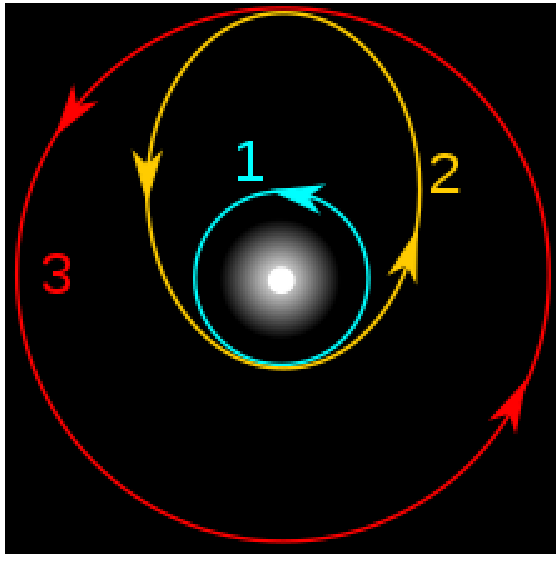
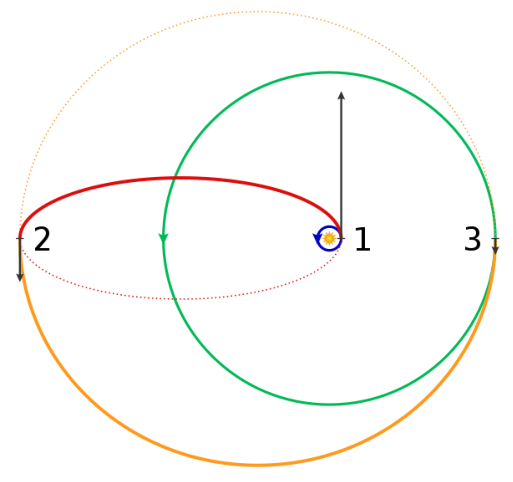
Отговори
- (a) Energy and angular momentum: , .
- (b) years.
- (c) An unlimited amount of time.
- (d) , , ; it will not always avoid the comet.
- (e)
- (g) The Hohmann transfer is both faster and more efficient in terms of energy use (δv).
Решение
(a) The relevant preserved quantities are energy and angular momentum.
Preservation of angular momentum is given by the following: where represents the rocket velocity at the Earth and at Jupiter. More generally, .
Preservation of energy is given by the following: . More generally, .
(b) This can be calculated by first specifying the parameters of the rocket’s elliptical orbit, and then using Kepler’s third law.
Key: use Kepler’s third law. The semi-major axis is the average of the minimum and maximum distances from the sun. . If this is specified in AU, we can use where is in years. Thus, . However, we only want to take half of this orbital period, since we are stopping at Jupiter rather than coming all the way back to Earth’s orbital radius. Thus, we simply take half of this value:
.
(c) You can take an unlimited amount of time to wait for the fuel to unfreeze. This is because we are ignoring gravitational effects from planets, and thus the rocket will constantly stay in the elliptical orbit with Jupiter’s orbit at apoapsis and Earth’s orbit at periapsis. Whenever the fuel unfreezes, we would wait from that point on for the rocket to reach apoapsis before firing engines for .
(d) Remember that a bi-elliptic transfer has one free parameter: the joint apoapsis X AU from the sun, or the max distance from the sun the rocket will reach. Thus, we immediately know this solution will not always avoid the comet. If we set the joint apoapsis to be just barely greater than Jupiter’s orbit, the first elliptical orbit will be almost identical to the Hohmann transfer orbit.
Using similar logic from part b, the time to reach Jupiter would be .
(e) Key: use the vis-viva equation.
Vis-viva equation:
Circular orbit 1 radius:
Semi-major axis of elliptical orbit:
Circular orbit 2 radius:
Thus, Velocity at Earth in circular orbit =
Velocity at Earth in elliptical orbit =
Velocity at Jupiter in elliptical orbit =
Velocity at Jupiter in circular orbit =
Now, to find the at each stage, compute the differences in velocities between each interface between the elliptical and circular orbits.
(f) Key: use the vis-viva equation.
Vis-viva equation:
Semi-major axis of ellipse 1:
Semi-major axis of ellipse 2:
Velocity at Earth in Earth’s orbit:
Velocity at Earth in elliptical orbit 1:
Velocity at joint apoapsis in elliptical orbit 1:
Velocity at joint apoapsis in elliptical orbit 2:
Velocity at Jupiter in elliptical orbit 2:
Velocity at Jupiter in Jupiter’s orbit:
Using the above equations, we can write all the ’s.
Speed boost to enter elliptical orbit 1:
Speed boost to enter elliptical orbit 2:
Speed reduction to enter Jupiter’s orbit:
Total , replacing :
(g) This could be algebraically solved. Much more simply, plug in and to the time and velocity equations. The Hohmann transfer is both faster and more efficient in terms of energy use ().
Теми и трудност
Оценена трудност: 4/5.
Небесна механика · Орбитална енергия и напускане · Закони на Кеплер · Орбитално движение
Предпоставки: Гимназиална подготовка, Разширена олимпиадна подготовка
Оригинал в Архива: usaaao_second_exam_2021_final.pdf · официални решения: usaaao_second_exam_2021_solutions.pdf · допълнителни данни: physical-constants.pdf