USAAAO 2023, II кръг — Задача 7. Long 1 · The Sundial II
2023 National Astronomy Competition · 45 т.
Внимание: Бележка към темата
The separately attributed physical-constants.pdf is an undated common USAAAO archive reference; its identity as the table supplied for this exam is unproven. Printed question/key inconsistencies are preserved, including Medium 3 P5 radius and graph slope, Long 1 cosine denominator, and Long 2 exit-coordinate term and proper-motion magnitude.
Instructions (Please Read Carefully)
2023 National Astronomy Competition
1 Instructions (Please Read Carefully)
The top 5 eligible scorers on the NAC will be invited to represent USA at the next IOAA. In order to qualify for the national team, you must be a high school student with US citizenship or permanent residency.
This exam consists of 3 parts: Short Questions, Medium Questions and Long Questions.
The maximum number of points is 240 points.
The test must be completed within 2.5 hours (150 minutes).
Please solve each problem on a blank piece of paper and mark the number of the problem at the top of the page. The contestant’s full name in capital letters should appear at the top of each solution page. If the contestant uses scratch papers, those should be labeled with the contestant’s name as well and marked as “scratch paper” at the top of the page. Scratch paper will not be graded. Partial credit will be available given that correct and legible work was displayed in the solution.
This is a written exam. Contestants can only use a scientific or graphing calculator for this exam. A table of physical constants will be provided. Discussing the problems with other people is strictly prohibited in any way until the end of the examination period on April 1st. Receiving any external help during the exam is strictly prohibited. This means that the only allowed items are: a calculator, the provided table of constants, a pencil (or pen), an eraser, blank sheets of papers, and the exam. No books or notes are allowed during the exam. Exam is proctored and recorded. You are expected to have your video on at all times.
We acknowledge the following people for their contributions to this year’s exam:
Wesley Antônio Machado Andrade de Aguiar, Erez Abrams, Lucas Pinheiro, Sahil Pontula, Joe McCarty, Hagan Hensley, Leo Yao, and Andrew Liu.
Undated common archive reference · Table of Physical Constants
Table of Physical Constants
| Quantity | Symbol | Value |
|---|---|---|
| Electron rest mass | ||
| Proton rest mass | ||
| Electronic charge | ||
| Speed of light in free space | ||
| Permeability of free space | ||
| Permittivity of free space | ||
| Planck’s constant | ||
| Reduced Planck’s constant | ||
| Boltzmann’s constant | ||
| Gas constant | ||
| Molar gas constant | ||
| Avogadro’s number | ||
| Standard molar volume | ||
| Unified atomic mass unit ( scale) | ||
| Mass of hydrogen atom | ||
| Bohr magneton | or | |
| Nuclear magneton | or | |
| Proton magnetic moment | ||
| Neutron magnetic moment | ||
| Bohr radius | ||
| Fine structure constant | ||
| Compton wavelength of electron | ||
| Rydberg’s constant | ||
| Stefan-Boltzmann constant | ||
| Radiation density constant | ||
| Gravitational constant |
Rest masses of some leptons and hadrons in :
0.5110, 105.66, 1777, 134.98, 139.57, 493.7, 497.7, 547, 1865, 1869, p 938.3, n 939.6, 1115.7, 1189, 1193, 1197, 1315, 1321, 1672, , .
| Quark | Charge | Mass () | |||||
|---|---|---|---|---|---|---|---|
| u | 0 | 0 | 0 | 0 | |||
| d | 0 | 0 | 0 | 0 | |||
| c | 0 | 0 | +1 | 0 | 0 | ||
| s | 0 | -1 | 0 | 0 | 0 | ||
| t | 0 | 0 | 0 | 0 | +1 | 174.3 | |
| b | 0 | 0 | 0 | -1 | 0 | 4.2 |
Undated common archive reference · Astrophysical Data and Conversion Factors
Astrophysical Data
| Quantity | Symbol | Value |
|---|---|---|
| 1 astronomical unit | AU | |
| 1 parsec | pc | |
| Luminosity of Sun | ||
| Mass of Sun | ||
| Radius of Sun | ||
| Mass of Earth | ||
| Radius of Earth |
Other data and conversion factors
| Quantity | Symbol | Value |
|---|---|---|
| 1 ångstrom | Å | |
| 1 fermi | fm | |
| 1 barn | b | |
| 1 pascal | Pa | |
| 1 standard atmosphere | ||
| Standard acceleration due to gravity | ||
| 1 electron volt | eV | |
| Wavelength of 1 eV photon |
Trigonometrical identities
In a triangle ABC,
and
Prefixes
| T = tera = | c = centi = |
| G = giga = | m = milli = |
| M = mega = | = micro = |
| k = kilo = | n = nano = |
| p = pico = | |
| f = femto = |
Условие
(45 points) The Sundial II
After gaining an understanding of a sundial, and how the path of the shadow is a straight line on the equinoxes running from due West to due East, Leo now wants to create his own.
At 6am on March 20th, as the Sun is rising, Leo, who is at , plants a (straight) stick vertically on the ground. At that moment, he marks out a (finite) line on the ground in the direction of the shadow of the stick at that moment, labeling it with the current time. Every hour afterwards, on the hour, he marks out a new line in the current direction of the shadow.
For the following two parts, either show a calculation or explain your answer for credit. Calculating specific values is not necessary, but may help with later parts.
(10 points)
(a) Is the angle between the lines corresponding to 12pm and 1pm greater than, equal to, or less than ?
(b) Is the angle between the lines corresponding to 5pm and 6pm greater than, equal to, or less than ?
At 6pm, after drawing his last line, the sun sets. Leo starts cleaning up his setup, taking down the stick. To check his calculations against experiment, Leo measures the angles between pairs of lines on the ground. Using a very precise protractor, he gets the following values (rolling sums are also provided):
| Lines | Angle (degrees) | From 6am (degrees) |
|---|---|---|
| 6am-7am | 9.00570 | 9.00570 |
| 7am-8am | 9.48468 | 18.49038 |
| 8am-9am | 10.90026 | 29.39064 |
| 9am-10am | 13.56767 | 42.95832 |
| 10am-11am | 17.77405 | 60.73237 |
| 11am-12pm | 22.66646 | 83.39883 |
| 12pm-1pm | 24.81144 | 108.21027 |
| 1pm-2pm | 21.90336 | 130.11363 |
| 2pm-3pm | 16.95555 | 147.06918 |
| 3pm-4pm | 13.00713 | 160.07630 |
| 4pm-5pm | 10.58101 | 170.65731 |
| 5pm-6pm | 9.34269 | 180.00000 |
Notably, he finds that they deviate from the values he expects! After frantically checking his calculations and measurements and finding no discrepancies, Leo suspects that the stick might have been slightly tilted. Unfortunately, he took down the stick already, and so can no longer measure it directly.
To help Leo out, we’d like to reconstruct the parameters of the stick tilt. As you work through the following parts, keep in mind this overall goal; it may help to think through all the steps first before proceeding. Ignore atmospheric refraction and the equation of time.
(35 points)
(c) To start, define a 2-D coordinate system for the ground, where the -axis points due North and the -axis points due East. Choose and clearly indicate an appropriate origin.
(d) Choose a specific time during the day when the Sun is above the horizon. In your coordinate system, compute the coordinates of the tip of the shadow. Clearly indicate the chosen time and any assumptions made, and justify assumptions if they are not general.
(e) From these coordinates and other information, find a condition on the location of the other end of the stick. Provide your answer as a linear equation in the form for some .
(f) Determine more conditions as necessary, and solve to find the coordinates of the other end of the stick.
(g) Determine the angle, from the vertical, that the stick was tilted, and in what direction.
Depending on method chosen, points on subparts may vary. Due to small values involved, it is recommended to carry calculations to at least 4 decimal places. Answers to the final part will be integers. No credit given for guesses without justification.
Решение
Solution
(a) The first important observation to make is, because the stick is vertical and perpendicular to the ground, the line of the shadow points in a direction directly opposite the azimuth of the Sun at that moment. Therefore, we can compare angles between lines by comparing changes in azimuth of the Sun between two times.
As March 20th is the spring equinox (which can also be deduced as the problem mentions the Sun rising at 6am and setting at 6pm), the Sun travels along a great circle in the sky at a constant rate of per hour. Let be points along the great circle where the Sun is at 12pm, 1pm, 5pm, 6pm respectively. As the Sun rises at 6am and sets at 6pm, we know solar time corresponds with local time (which is also confirmed as is perfectly in the center of the UTC-5 time zone). Therefore, the Sun is on the meridian at 12pm and on the horizon due west at 6pm.
Extend the arcs from through to meet the horizon at . Then changes in azimuth correspond to arcs along the horizon. The arc is the angle between 12pm and 1pm and has length , and the arc is the angle between 5pm and 6pm and has length . The arc lengths also are the same as the corresponding angles from .
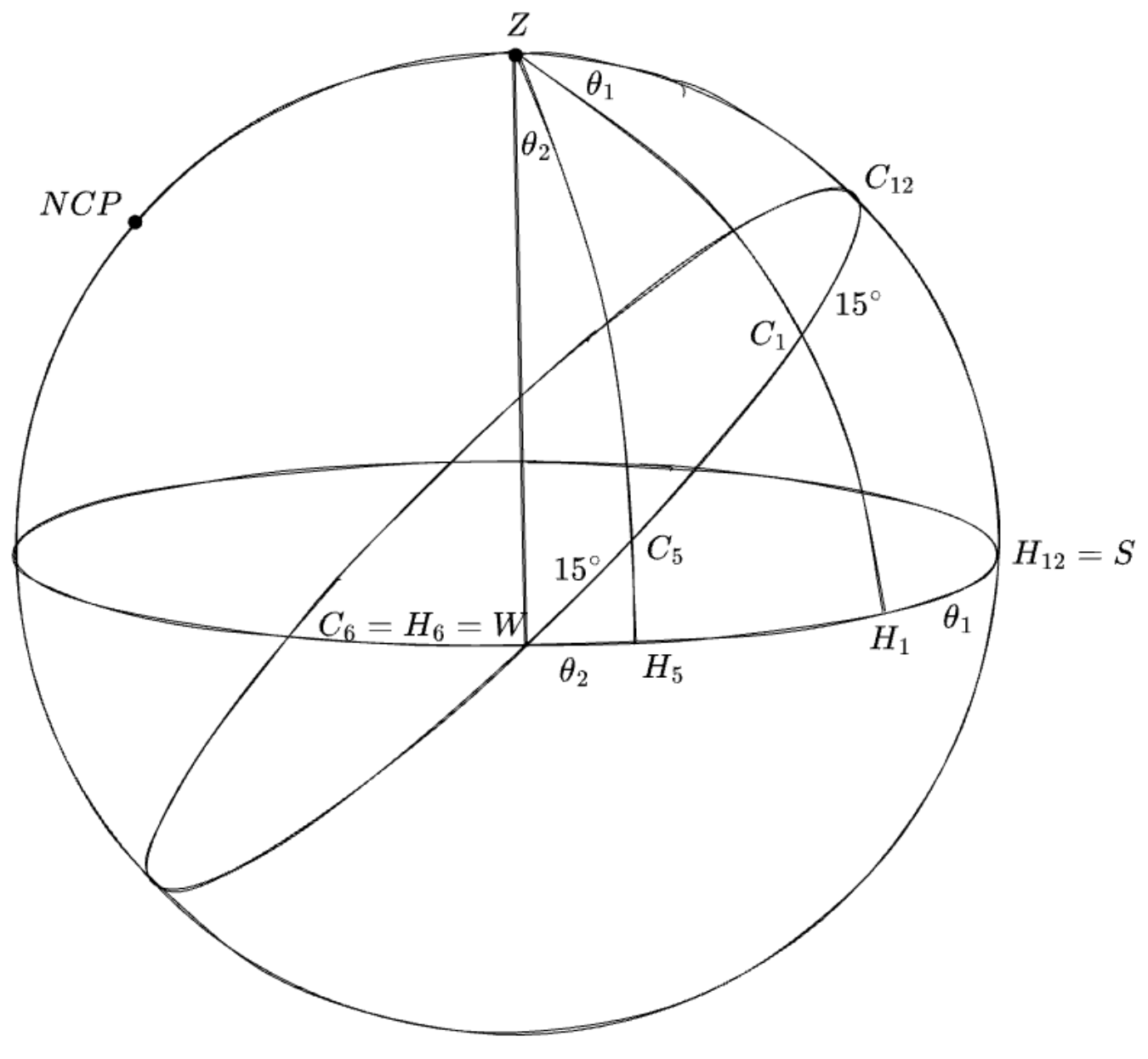
As one possible solution, consider the triangle . As , then by the spherical law of sines:
But as and , we have that the right-hand side is greater than 1 and therefore .
Many other solutions involving spherical triangles are possible (arguments from other parts of the solution can also be adapted to this part).
(b) As one possible solution, consider the triangle . As , then by the spherical law of cosines:
But as , we then have and therefore .
Again, other choices of spherical triangles leading to a correct solution are possible.
(c) From this point onwards, there are two similar but slightly different ways to solve the problem, depending on choice of origin. Points on subparts differ between the methods, but the overall amount of work needed is about the same. We will be calling these methods ”Tip of stick” and ”Base of stick”.
Tip of stick: Drop a perpendicular from the tip of the stick to the ground, and set the point directly below the tip of the stick to be the origin.
While this definition initially seems more contrived, note that the position of the tip of the shadow depends only on the position of the tip of the stick, and the Sun. Therefore, we can directly write down positions in our coordinate system of tips of shadows.
Base of stick: Set the base of the stick to be the origin.
This may be the more immediately apparent choice, and has the advantage that we immediately know what directions shadows point in. However, this method is more difficult to follow through with; an astute observation is needed later to make progress.
(d) Tip of stick:
In order to determine lengths of shadows of the ground, we first need to know the height of the stick tip. Therefore, introduce a variable for the height of the tip of the stick above the ground.
We will carry through for the rest of the solution. However, note that the problem is invariant under rescaling (no specific lengths are given, and divides out at the end). Therefore, it is valid to set to an arbitrary positive value, as long as it is divided out at the end.
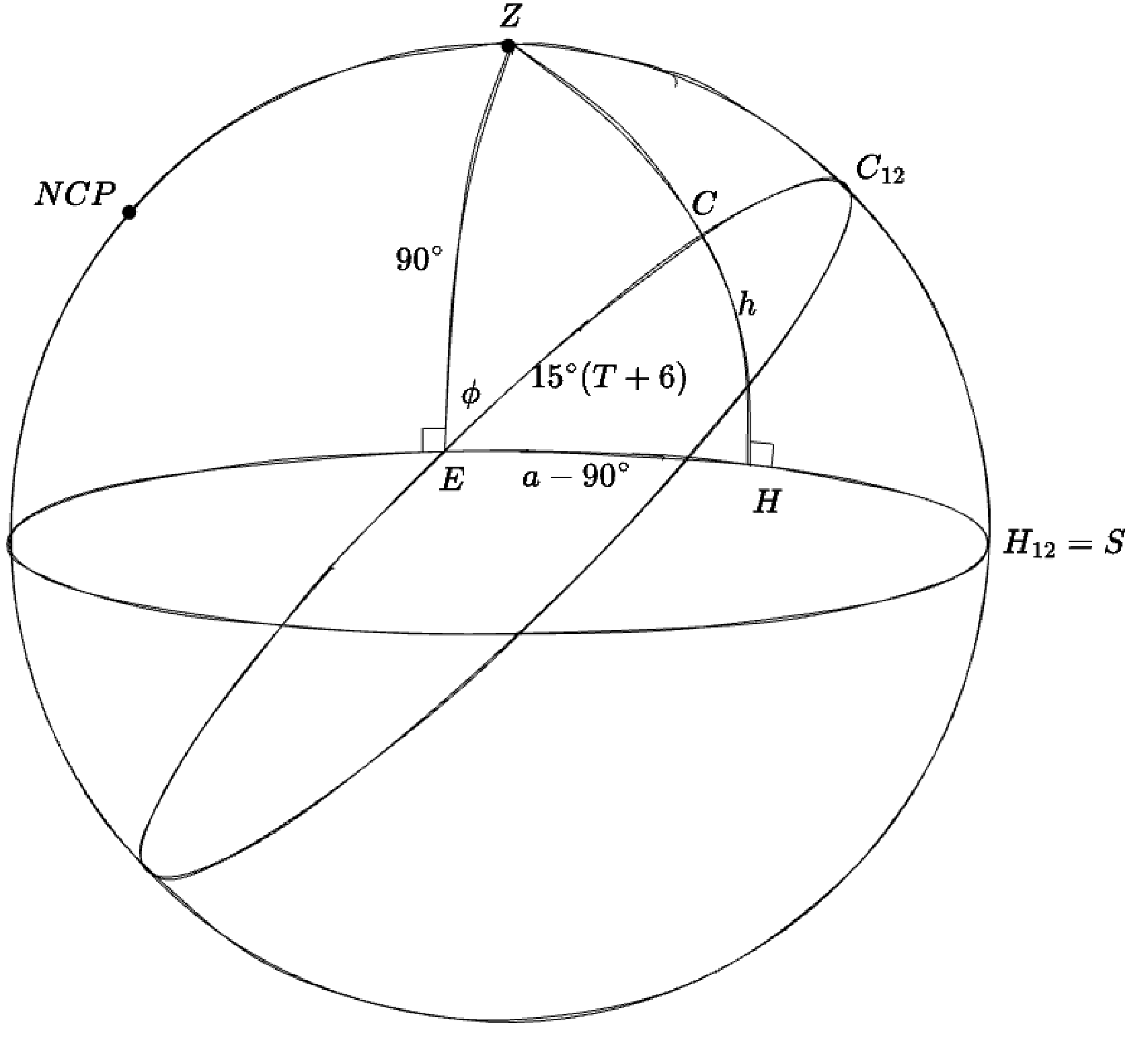
Start by computing the altitude and azimuth of the Sun at a given time. For some time hours after noon, where : Let be the position of the Sun (along the celestial equator) at the time. Then, as the Sun passes of angle per hour, we have:
As angle subtends arc where , we must have . Then, we can apply the spherical law of cosines on triangle :
To get the angle of arc . Then, the altitude is just minus this angle:
To find the altitude, use spherical triangle , where we extend to meet the horizon at . As is right, the term in the spherical law of cosines disappears, so we just have:
Then:
And as is the arc along the horizon starting from an azimuth of , we have .
As the data given in the problem is given for every hour of the day, any integer choice of where the Sun is above the horizon is valid. As one example, evaluating these equations through for hour after noon gives .
If the stick were perfectly vertical, the base of the stick would be at the origin, and the length of the shadow on the ground would be given by:
where is the height of the stick tip, and is the altitude of the Sun.
For the specific coordinate axes given, where the -axis points due North and the -axis points due East, azimuths correspond perfectly with angles from the -axis, first rotating towards the -axis. Therefore, to convert between azimuths and (cartesian) coordinates, no angle offset is necessary.
Then, as the shadow is directed opposite the Sun, the coordinates of the shadow tip would be:
But this holds regardless of where the base of the stick is! Then we have, for the coordinates of the shadow tip:
Which for hour after noon gives:
Base of stick:
As the shadow is a projection of a line (the stick) onto the plane of the ground, it must be a straight line. In addition, the line of the shadow must contain the base of the stick (which is on the ground) and the tip of the shadow.
Again, by a rescaling argument, we introduce a length of a shadow on the ground. The shadow on the ground has an angle given by the data: as the 6am line points due west, the azimuth of the shadow is given by the angle from 6am in the last column of the table, less 90 degrees. Then for an angle from 6am measurement , the shadow coordinates are:
Then for hour after noon gives:
(e) Tip of stick:
Again, shadows are straight lines on the ground having an angle given by the data. Just as azimuths can be converted directly to polar coordinates, they can also be converted directly to slopes:
Then, to find the intercept , we just need to substitute in our known coordinate of the shadow tip :
Values for hour after noon:
Base of stick:
To work towards finding the actual tilt, consider an ideal stick, with the same tip, but standing perfectly vertical. Then the ideal shadows cast would have the same tip as our stick, but would be at a different angle on the ground. These shadows would intersect at a different point, the base of the ideal stick. As the base of the ideal stick is directly below the tip of the ideal (and our) stick, this gives us the means to find the tip of the stick in our coordinates.
We therefore want the angle of the ideal shadows. However, this is just an azimuth calculation (described in the previous part)! Therefore:
Values for hour after noon:
(f) Tip of stick:
In order to solve for the coordinates , we need a second condition. At this point, we could just choose another time during the day, compute altitude and azimuth using the same process, and find the coordinates of another shadow tip. However, there are some clever choices and ideas that we can use to avoid fully running through another calculation.
Consider the position of the Sun at noon, or . Then the Sun is on the meridian, implying that it is due South. As it is also still on the celestial equator, we can immediately write down horizontal coordinates for the Sun:
Again converting this to shadow tip coordinates:
The -coordinate is 0 as expected, as the shadow should have no deviation in the East-West direction when the Sun faces due South. However, note that the -coordinate is the same as before! It turns out (and is noted at the start of the problem text) this holds true for any choice of : the tip of shadows trace out a straight line running West to East on the equinoxes! (for more details as well as a proof, see last year’s second round problem with a very similar name, where this was the core concept tested!)
Then finding the slope and line for :
Now that we have a pair of linear equations, we can solve for . As they are already in slope-intercept form, it is easiest to eliminate; doing so and substituting in gives:
Base of stick:
In order to solve for the coordinates , we need a second condition. Again, we can use the data to get an angle for the shadow on the ground. However, in order to find the coordinates of the tip, we need the length of the second shadow, which we somehow need to relate to the length of the first.
But this is where the ”shadow tips draw out a straight line” property proves useful! Regardless of coordinate origin, for coordinate axes aligned the same way, the -coordinate of the shadow tip remains constant. As we know shadows are drawn from the origin at an angle given by the data, this gives us enough information to find the tip of another shadow.
Taking from earlier and taking the Sun’s position at noon :
Then the azimuth of the Sun at noon is simply , and the ideal shadow runs perfectly North-South. Then, the base of the ideal stick must have the same -coordinate (no East-West deviation). This gives:
At this point, we can substitute our known value of into the previous equation, giving the solution:
(g) Tip of stick:
We now have the coordinates of the stick base, when the stick tip is at the origin. To get a base to tip vector, we must first invert this vector:
Then, the direction of tilt is just the azimuth of this vector, or .
To compute the angle o f tilt from the vertical, first compute the length of the deviation on the ground:
Then, as is the vertical height of the tip, we get the tilt from the vertical:
Base of stick:
We now have the coordinates of the stick tip, where the stick base is at the origin. Again, we can just take the azimuth of the base to tip vector to get the tilt direction, which gives the same answer of .
The stick tilt is a bit more difficult, as we don’t yet have , the height of the stick; we have , the length of a real shadow. To compute the height of stick, we first need the length of an ideal shadow at some time. This computation is easiest for noon, or :
Then stick height:
Finally, we compute the length of the deviation on the ground:
And the tilt from the vertical, which gives the same answer:
Оригинал в Архива: second_exam_2023-1.pdf · официални решения: second_exam_2023_sols-1.pdf · допълнителни данни: physical-constants.pdf