USAAAO 2023, II кръг — Задача 8. Long 2
2023 National Astronomy Competition · 40 т.
Внимание: Бележка към темата
The separately attributed physical-constants.pdf is an undated common USAAAO archive reference; its identity as the table supplied for this exam is unproven. Printed question/key inconsistencies are preserved, including Medium 3 P5 radius and graph slope, Long 1 cosine denominator, and Long 2 exit-coordinate term and proper-motion magnitude.
Instructions (Please Read Carefully)
2023 National Astronomy Competition
1 Instructions (Please Read Carefully)
The top 5 eligible scorers on the NAC will be invited to represent USA at the next IOAA. In order to qualify for the national team, you must be a high school student with US citizenship or permanent residency.
This exam consists of 3 parts: Short Questions, Medium Questions and Long Questions.
The maximum number of points is 240 points.
The test must be completed within 2.5 hours (150 minutes).
Please solve each problem on a blank piece of paper and mark the number of the problem at the top of the page. The contestant’s full name in capital letters should appear at the top of each solution page. If the contestant uses scratch papers, those should be labeled with the contestant’s name as well and marked as “scratch paper” at the top of the page. Scratch paper will not be graded. Partial credit will be available given that correct and legible work was displayed in the solution.
This is a written exam. Contestants can only use a scientific or graphing calculator for this exam. A table of physical constants will be provided. Discussing the problems with other people is strictly prohibited in any way until the end of the examination period on April 1st. Receiving any external help during the exam is strictly prohibited. This means that the only allowed items are: a calculator, the provided table of constants, a pencil (or pen), an eraser, blank sheets of papers, and the exam. No books or notes are allowed during the exam. Exam is proctored and recorded. You are expected to have your video on at all times.
We acknowledge the following people for their contributions to this year’s exam:
Wesley Antônio Machado Andrade de Aguiar, Erez Abrams, Lucas Pinheiro, Sahil Pontula, Joe McCarty, Hagan Hensley, Leo Yao, and Andrew Liu.
Undated common archive reference · Table of Physical Constants
Table of Physical Constants
| Quantity | Symbol | Value |
|---|---|---|
| Electron rest mass | ||
| Proton rest mass | ||
| Electronic charge | ||
| Speed of light in free space | ||
| Permeability of free space | ||
| Permittivity of free space | ||
| Planck’s constant | ||
| Reduced Planck’s constant | ||
| Boltzmann’s constant | ||
| Gas constant | ||
| Molar gas constant | ||
| Avogadro’s number | ||
| Standard molar volume | ||
| Unified atomic mass unit ( scale) | ||
| Mass of hydrogen atom | ||
| Bohr magneton | or | |
| Nuclear magneton | or | |
| Proton magnetic moment | ||
| Neutron magnetic moment | ||
| Bohr radius | ||
| Fine structure constant | ||
| Compton wavelength of electron | ||
| Rydberg’s constant | ||
| Stefan-Boltzmann constant | ||
| Radiation density constant | ||
| Gravitational constant |
Rest masses of some leptons and hadrons in :
0.5110, 105.66, 1777, 134.98, 139.57, 493.7, 497.7, 547, 1865, 1869, p 938.3, n 939.6, 1115.7, 1189, 1193, 1197, 1315, 1321, 1672, , .
| Quark | Charge | Mass () | |||||
|---|---|---|---|---|---|---|---|
| u | 0 | 0 | 0 | 0 | |||
| d | 0 | 0 | 0 | 0 | |||
| c | 0 | 0 | +1 | 0 | 0 | ||
| s | 0 | -1 | 0 | 0 | 0 | ||
| t | 0 | 0 | 0 | 0 | +1 | 174.3 | |
| b | 0 | 0 | 0 | -1 | 0 | 4.2 |
Undated common archive reference · Astrophysical Data and Conversion Factors
Astrophysical Data
| Quantity | Symbol | Value |
|---|---|---|
| 1 astronomical unit | AU | |
| 1 parsec | pc | |
| Luminosity of Sun | ||
| Mass of Sun | ||
| Radius of Sun | ||
| Mass of Earth | ||
| Radius of Earth |
Other data and conversion factors
| Quantity | Symbol | Value |
|---|---|---|
| 1 ångstrom | Å | |
| 1 fermi | fm | |
| 1 barn | b | |
| 1 pascal | Pa | |
| 1 standard atmosphere | ||
| Standard acceleration due to gravity | ||
| 1 electron volt | eV | |
| Wavelength of 1 eV photon |
Trigonometrical identities
In a triangle ABC,
and
Prefixes
| T = tera = | c = centi = |
| G = giga = | m = milli = |
| M = mega = | = micro = |
| k = kilo = | n = nano = |
| p = pico = | |
| f = femto = |
Условие
(40 points) A new interstellar comet is about to enter the solar system and Erez is really excited to calculate some Keplerian elements on its approach and figure out where it’s going! The comet, dubbed Scratcher Crab by the astronomical community (for no particular reason), is approaching the solar system with a velocity of 29.8km/s from the direction of Altair, which has equatorial coordinates . If the comet were to continue traveling in a straight line with its current velocity, its closest approach to the sun would be at a distance of 1au, and on March 21st, the comet would briefly be in superior conjunction.
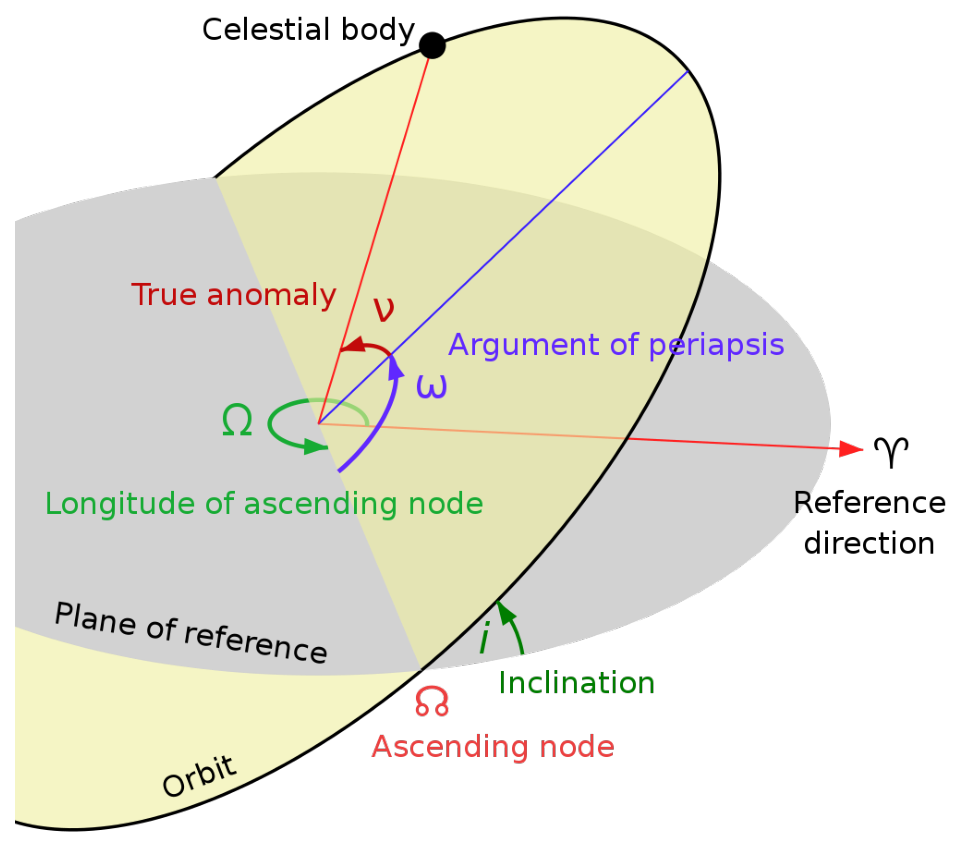
For reference, here is a diagram of orbital elements. Note that the longitude of the ascending node is measured from Aries and the argument of the periapsis is measured from the ascending node:
(a) (6 points) What are the eccentricity and semi-major axis of the orbit?
(b) (6 points) What are the inclination of the orbit and the longitude of the ascending node, both measured with reference to the equatorial plane (not the ecliptic)?
(c) (6 points) What is the angular distance between the incoming and outgoing trajectories of the comet?
(d) (6 points) What is the argument of the periapsis?
(e) (6 points) What are the exit coordinates of the comet (in equatorial coordinates)?
(f) (10 points) Erez wants to check his calculations by making some observations when the comet crosses the plane of the ecliptic. At this time, what is the proper motion of the comet in the sun’s frame of reference (not the Earth’s)? Give your answer in its equatorial components .
Решение
Solution
Whenever the semi-major axis appears in this solution, the convention of for hyperbolas is chosen, but both signs should be accepted as correct. The choice of sign will lead to sign differences in formulae involving as well. Most answers should have three significant figures, but an additional figure will be included in parentheses in this solution.
(a) There are a few ways we can get the eccentricity and SMA. The first is to use the vis-viva equation to get the specific orbital energy:
We can then combine this with the knowledge that the impact parameter equals the semi-minor axis and use conic relations to get (noting sign changes because of hyperbola conventions):
An alternative way to arrive at is to use the specific angular momentum relation instead as in problem 26 of the first round. Also, instead of doing the eccentricity calculation explicitly, we could note that the problem has been set up so that to immediately arrive at (this answer, 1.41, and 1.42 should all be accepted as correct).
(b) Orbits are planar. This is a very useful fact, because it allows us to deduce that the orbit should lie in the same plane as the unique plane that contains both the sun and the straight-line trajectory described in the problem. If on the straight-line trajectory, on March 21st the comet is behind the sun (at Aries, since this is the equinox), this means that there is a point in time on the straight-line trajectory where the comet has equatorial coordinates . Thus, the orbit lies in the unique plane through the origin, Altair, and Aries. First, this means that the descending node is at Aries, i.e. the longitude of the ascending node is exactly . Second, this allows us to deduce the inclination by four-parts on the spherical triangle with Altair, Aries, and the projection of Aries onto the equatorial plane:
(c) We can use the polar equation of a conic:
We seek the asymptotes of the hyperbola, so :
An answer of is also acceptable. Alternatively, one could note that a rectangular hyperbola has eccentricity of , and that is the eccentricity of this hyperbola, so the angle is immediately .
(d) From part (c), the argument of the periapsis is just the argument of incoming trajectory (the argument of Altair) plus . Noting that the argument should be measured from the ascending node, which is at , we can simply find the great circle distance from to Altair with Law of Cosines:
So the argument of the periapsis is . It is quite easy to accidentally measure from the wrong point and get or even ; these answers have errors which will propagate to the next part as well.
(e) From part (c) again, we know that the argument of the exit point is , which means that the exit point is in the northern hemisphere. Thus, we can use Law of Sines on the spherical triangle with the ascending node, the exit point, and the projection of the exit point onto the equatorial plane:
And we can use Law of Cosines on the same triangle to get:
(f) We can use the conic polar equation to get the orbital distance at the descending node:
From which the velocity perpendicular to the radius is (from angular momentum):
So the proper motion (angular velocity) is:
Since at the descending node we know the direction of the velocity matches the inclination:
Оригинал в Архива: second_exam_2023-1.pdf · официални решения: second_exam_2023_sols-1.pdf · допълнителни данни: physical-constants.pdf