USAAAO 2023, II кръг — Задача 9. Long 3 · Finding Friends
2023 National Astronomy Competition · 55 т.
Внимание: Бележка към темата
The separately attributed physical-constants.pdf is an undated common USAAAO archive reference; its identity as the table supplied for this exam is unproven. Printed question/key inconsistencies are preserved, including Medium 3 P5 radius and graph slope, Long 1 cosine denominator, and Long 2 exit-coordinate term and proper-motion magnitude.
Instructions (Please Read Carefully)
2023 National Astronomy Competition
1 Instructions (Please Read Carefully)
The top 5 eligible scorers on the NAC will be invited to represent USA at the next IOAA. In order to qualify for the national team, you must be a high school student with US citizenship or permanent residency.
This exam consists of 3 parts: Short Questions, Medium Questions and Long Questions.
The maximum number of points is 240 points.
The test must be completed within 2.5 hours (150 minutes).
Please solve each problem on a blank piece of paper and mark the number of the problem at the top of the page. The contestant’s full name in capital letters should appear at the top of each solution page. If the contestant uses scratch papers, those should be labeled with the contestant’s name as well and marked as “scratch paper” at the top of the page. Scratch paper will not be graded. Partial credit will be available given that correct and legible work was displayed in the solution.
This is a written exam. Contestants can only use a scientific or graphing calculator for this exam. A table of physical constants will be provided. Discussing the problems with other people is strictly prohibited in any way until the end of the examination period on April 1st. Receiving any external help during the exam is strictly prohibited. This means that the only allowed items are: a calculator, the provided table of constants, a pencil (or pen), an eraser, blank sheets of papers, and the exam. No books or notes are allowed during the exam. Exam is proctored and recorded. You are expected to have your video on at all times.
We acknowledge the following people for their contributions to this year’s exam:
Wesley Antônio Machado Andrade de Aguiar, Erez Abrams, Lucas Pinheiro, Sahil Pontula, Joe McCarty, Hagan Hensley, Leo Yao, and Andrew Liu.
Undated common archive reference · Table of Physical Constants
Table of Physical Constants
| Quantity | Symbol | Value |
|---|---|---|
| Electron rest mass | ||
| Proton rest mass | ||
| Electronic charge | ||
| Speed of light in free space | ||
| Permeability of free space | ||
| Permittivity of free space | ||
| Planck’s constant | ||
| Reduced Planck’s constant | ||
| Boltzmann’s constant | ||
| Gas constant | ||
| Molar gas constant | ||
| Avogadro’s number | ||
| Standard molar volume | ||
| Unified atomic mass unit ( scale) | ||
| Mass of hydrogen atom | ||
| Bohr magneton | or | |
| Nuclear magneton | or | |
| Proton magnetic moment | ||
| Neutron magnetic moment | ||
| Bohr radius | ||
| Fine structure constant | ||
| Compton wavelength of electron | ||
| Rydberg’s constant | ||
| Stefan-Boltzmann constant | ||
| Radiation density constant | ||
| Gravitational constant |
Rest masses of some leptons and hadrons in :
0.5110, 105.66, 1777, 134.98, 139.57, 493.7, 497.7, 547, 1865, 1869, p 938.3, n 939.6, 1115.7, 1189, 1193, 1197, 1315, 1321, 1672, , .
| Quark | Charge | Mass () | |||||
|---|---|---|---|---|---|---|---|
| u | 0 | 0 | 0 | 0 | |||
| d | 0 | 0 | 0 | 0 | |||
| c | 0 | 0 | +1 | 0 | 0 | ||
| s | 0 | -1 | 0 | 0 | 0 | ||
| t | 0 | 0 | 0 | 0 | +1 | 174.3 | |
| b | 0 | 0 | 0 | -1 | 0 | 4.2 |
Undated common archive reference · Astrophysical Data and Conversion Factors
Astrophysical Data
| Quantity | Symbol | Value |
|---|---|---|
| 1 astronomical unit | AU | |
| 1 parsec | pc | |
| Luminosity of Sun | ||
| Mass of Sun | ||
| Radius of Sun | ||
| Mass of Earth | ||
| Radius of Earth |
Other data and conversion factors
| Quantity | Symbol | Value |
|---|---|---|
| 1 ångstrom | Å | |
| 1 fermi | fm | |
| 1 barn | b | |
| 1 pascal | Pa | |
| 1 standard atmosphere | ||
| Standard acceleration due to gravity | ||
| 1 electron volt | eV | |
| Wavelength of 1 eV photon |
Trigonometrical identities
In a triangle ABC,
and
Prefixes
| T = tera = | c = centi = |
| G = giga = | m = milli = |
| M = mega = | = micro = |
| k = kilo = | n = nano = |
| p = pico = | |
| f = femto = |
Условие
(55 points) Finding Friends
In the future, Earth is perfectly spherical and completely covered with water. Sailor Andrew is on a boat initially positioned at the equator in such that a way that , the vernal equinox, is directly overhead. He observes a star with right ascension and declination . He wants to chase , and he needs your help.
You may assume the following numerical values for each constant:
- is Earth’s radius (same as the current day value).
- is Earth’s angular frequency.
- His boat is very fast; its maximum speed is .
- The vernal equinox has celestial coordinates .
- .
(a) (2 points) Calculate the angular distance between and . Express your answer in degrees.
In his starting position, is somewhere above his horizon. As he sails to different parts of the planet and time passes, moves around his night sky. He wants sail his boat in order to get as close to his zenith as possible. To make sure he is as efficient as possible, he wants to make a few calculations first.
(b) (2 points) If he does not move his boat from his starting position, calculate the minimum zenith distance that reaches. Express your answer in degrees.
Note: zenith distance is defined as the angular distance to the zenith.
Now, he considers what would happen if he sails straight north at all times.
(c) (3 points) Starting from his initial position when is overhead, he directs his boat straight north and starts sailing with speed . Does first cross his north-south meridian or east-west meridian? Briefly explain why this is the case.
(d) (3 points) Calculate the zenith distance of when it first crosses his north-south meridian. Express your answer in degrees.
(e) (15 points) Calculate the zenith distance of when it first crosses his east-west meridian. Express your answer in degrees.
Let be the point in his trajectory (in the celestial sphere) at which reaches his minimum zenith distance, and be the north celestial pole. Note that is a point in the celestial sphere, and not Earth.
(f) (6 points) Argue that , where both angles are spherical angles. Then, calculate . Express your answer in degrees.
Note: For this part only, you may assume that the declination of is small, hence the approximation.
(g) (15 points) Calculate the minimum zenith distance that reaches. Express your answer in degrees.
For this problem:
- You may no longer assume that the declination of is small. However, you may use the value of derived in part (f).
- You are given that the right-ascension of is within .
- His trajectory in the celestial sphere is not necessarily a great circle. Be careful when computing angles and lengths!
He is not satisfied with these results. He feels there should be an optimal way to get directly overhead, as fast as possible. Help him figure out the fastest way to get to his zenith.
(h) (2 points) Given that he is allowed to maneuver his boat however he wants throughout the duration of his journey, and that he starts from his initial position with overhead, show that cannot be at his zenith the first time it culminates, i.e., crosses his north-south meridian.
(i) (7 points) Let be the fastest time he can get to his zenith. Compute the quantity , in seconds.
Решение
Solution
(a) Let be the north celestial pole and be our desired distance. Then, the spherical law of cosines in gives
which implies .
(b) Since is to his east, it has not yet culminated. Also, since he is not moving, achieves its minimum zenith distance as it culminates.
One way to figure out this minimum zenith distance is to consider the view from his horizon. moves through the small circle representing the declination line at . Since he is located on the equator, the celestial equator from his perspective passes through the zenith. Therefore, the minimum zenith distance is the distance between the declination line at , and the celestial equator, which is .
An alternative approach is to consider his movement through the celestial sphere. Culmination occurs when his location and have the same right ascension. At this point, their distance is , so this is the minimum zenith distance.
(c) starts in the northeastern quadrant of the sky. When crosses the north-south meridian, it changes from the east to west hemisphere. When crosses the the east-west meridian, it changes from the north to south hemisphere.
At time , his location in the celestial sphere is given by , so is a point in his trajectory. Since , culminates in his northern sky. Thus, passes the north-south meridian before passing the east-west meridian.
(d) culminates when it has the same right ascension as Andrew, so . So, the zenith distance is given by
(e) Let be his position in the celestial sphere. When first crosses the east-west meridian, must satisfy , as shown in the diagram below. The red line in the diagram represents his trajectory in the celestial sphere (this trajectory is not a great circle, so we cannot use it in our calculations).
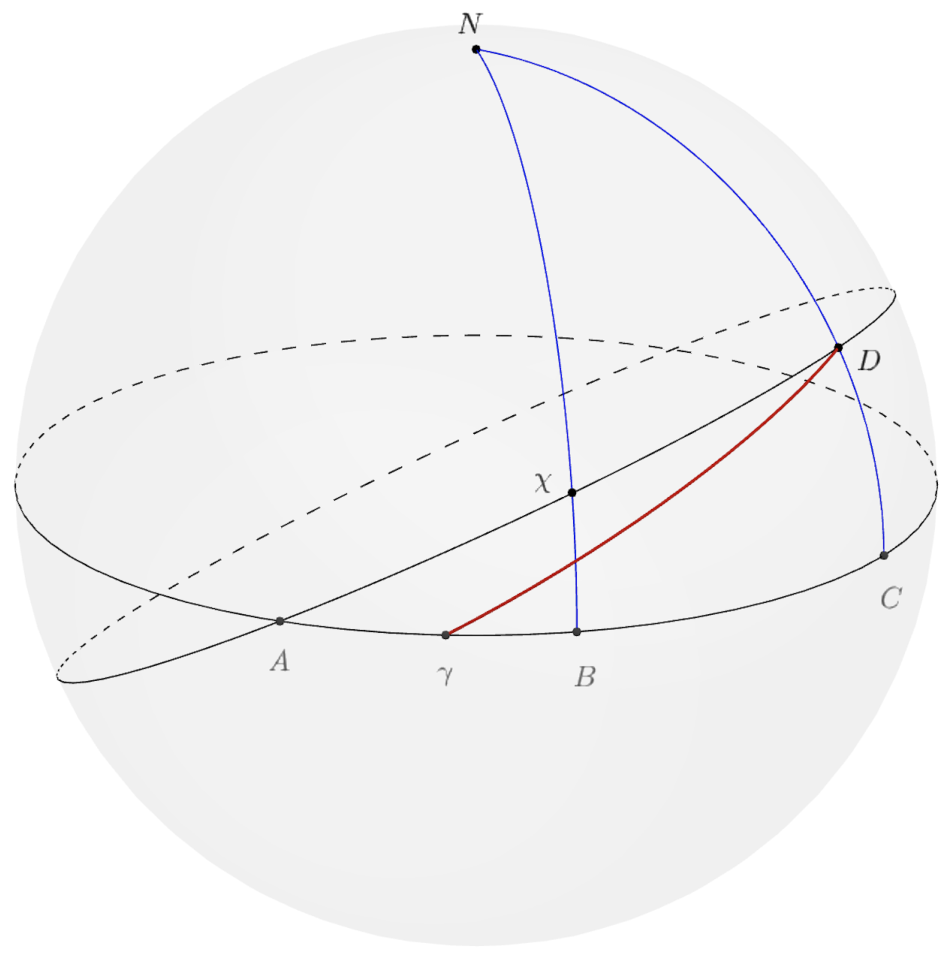
Now, chasing angles:
- The perpendicular condition implies that is the apex of another great circle (call ) that passes through both and . intersects the equator at a point , such that .
- As labelled in the diagram, let and be the feet of and from , respectively (so that ). Since is the apex of , .
- We know and , so .
- We also know that , and .
Our goal is to find the zenith distance, which is . To find this arc, we'll need , which will let us solve for the right ascension of . Let . The four-parts formula in both and gives
Substituting known values, this reduces to the equation
We can use this to numerically iterate for . Our initial guess does not need to be good; any value from around to converges in a few iterations, giving us .
Finally, a few more angles:
- .
- .
- .
These are all known values. The spherical law of cosines in now gives
(f) The zenith distance is minimized when . Let be the foot of from , so that . Then, if we let :
- lie on the same great circle, , which implies .
- Since the latitude of is small, and is right, we can say that , so . This approximation is valid since , so can be approximated by a flat right triangle.
- Since , and add to , as desired.
To compute , we can use our approximation of as a flat right triangle to say that , so .
(g) Consider . We know the lengths of two sides, and , and the values of a nested and adjacent angle, and . We want to find the length of the zenith angle, which is . Unfortunately, we can't directly solve for , but we may first try solving for using the information we already have, which will give us enough information about the triangle to solve for .
Applying the four parts formula:
As in part (e), we can isolate and try to solve this equation with numerical iteration:
Unfortunately, this diverges for most values. Luckily, we're given that is within , which is a good enough range for us to still find a solution at .
Finally, the law of sines in gives
(h) In order for to be directly overhead, he needs to have the same declination and right ascension as .
The amount of time he needs to increase his latitude to is bounded below by
which is when he travels straight north at all times.
On the other hand, the amount of time it takes him to have the same right ascension is bounded above by
which is when he travels straight west at all times. Since , he cannot get to his zenith when it first culminates.
(i) From part (h), he cannot get directly overhead the first time it culminates. Therefore, his best strategy is to try to get to his zenith the next time it appears above his horizon. After time , the change in his right ascension due to the rotation of the earth is . Therefore, to optimize his distance travelled, he should travel along a great circle (defined on the surface of the Earth) that increases his longitude by , and increases his latitude by .
Let be the north celestial pole, and be his stopping point, which has coordinates . Note that the coordinates of are his longitude and latitude on Earth, and not in the celestial sphere. Also, , since the maximum speed his boat can travel is .
Now, the spherical law of cosines in gives
so
Now we can numerically iterate. Using as a first guess, we get , which gives . To account for approximation errors, a large range of values in this general vicinity are acceptable.
Оригинал в Архива: second_exam_2023-1.pdf · официални решения: second_exam_2023_sols-1.pdf · допълнителни данни: physical-constants.pdf