USAAAO 2024, II кръг — Medium 1. Solar eclipse
2024 National Astronomy Competition · 30 т.
Внимание: Бележка към темата
All eight whole original problems, their native sections, lettered parts, three roman subparts of Long 1(f), full official worked keys and original marking/acceptance notes are retained. Printed scientific discrepancies are preserved in local source notes. The official key adds a Friedmann-variable clarification and a solar apparent magnitude assumption absent from the question booklet, and changes Long1(f)(iii) from a factor to a percentage; these source variants are explicitly attributed. A separate undated common archive constants/reference table is included with its own source identity; its use as the exact 2024 provided attachment is not established, and its constants are not substituted into the printed key. The native cover specifies blank paper rather than a designated answer sheet. April 13th is the end of the examination period, not an established single sitting date.
1 Instructions (Please Read Carefully)
The top 5 eligible scorers on the NAC will be invited to represent USA at the next IOAA. In order to qualify for the national team, you must be a high school student with US citizenship or permanent residency.
This exam consists of 3 parts: Short Questions, Medium Questions and Long Questions.
The maximum number of points is 225 points.
The test must be completed within 2.5 hours (150 minutes).
Please solve each problem on a blank piece of paper and mark the number of the problem at the top of the page. The contestant’s full name in capital letters should appear at the top of each solution page. If the contestant uses scratch papers, those should be labeled with the contestant’s name as well and marked as “scratch paper” at the top of the page. Scratch paper will not be graded. Partial credit will be available given that correct and legible work was displayed in the solution.
This is a written exam. Contestants can only use a scientific or graphing calculator for this exam. A table of physical constants will be provided. Discussing the problems with other people is strictly prohibited in any way until the end of the examination period on April 13th. Receiving any external help during the exam is strictly prohibited. This means that the only allowed items are: a calculator, the provided table of constants, a pencil (or pen), an eraser, blank sheets of papers, and the exam. No books or notes are allowed during the exam. Exam is proctored and recorded. You are expected to have your video on at all times.
We acknowledge the following people for their contributions to this year’s exam:
Abhay Bestrapalli, Orion Foo, Hagan Hensley, David Lee, Sandesh Kalantre, Andrew Liu, Joe McCarty, Leo Yao
Common archive reference — Table of Physical Constants
This separate common USAAAO archive reference is undated in the catalogue. Its use as the exact 2024 exam attachment is not established.
| Quantity | Symbol | Value |
|---|---|---|
| Electron rest mass | ||
| Proton rest mass | ||
| Electronic charge | ||
| Speed of light in free space | ||
| Permeability of free space | ||
| Permittivity of free space | ||
| Planck’s constant | ||
| Reduced Planck’s constant | ||
| Boltzmann’s constant | ||
| Gas constant | ||
| Molar gas constant | ||
| Avogadro’s number | ||
| Standard molar volume | ||
| Unified atomic mass unit ( scale) | ||
| Mass of hydrogen atom | ||
| Bohr magneton | or | |
| Nuclear magneton | or | |
| Proton magnetic moment | ||
| Neutron magnetic moment | ||
| Bohr radius | ||
| Fine structure constant | ||
| Compton wavelength of electron | ||
| Rydberg’s constant | ||
| Stefan-Boltzmann constant | ||
| Radiation density constant | ||
| Gravitational constant |
Rest masses of some leptons and hadrons in :
0.5110, 105.66, 1777, 134.98, 139.57, 493.7, 497.7, 547, 1865, 1869, p 938.3, n 939.6, 1115.7, 1189, 1193, 1197, 1315, 1321, 1672, , .
| Quark | Charge | Mass () | |||||
|---|---|---|---|---|---|---|---|
| u | 0 | 0 | 0 | 0 | |||
| d | 0 | 0 | 0 | 0 | |||
| c | 0 | 0 | +1 | 0 | 0 | ||
| s | 0 | -1 | 0 | 0 | 0 | ||
| t | 0 | 0 | 0 | 0 | +1 | 174.3 | |
| b | 0 | 0 | 0 | -1 | 0 | 4.2 |
Common archive reference — Astrophysical Data and identities
Astrophysical Data
| Quantity | Symbol | Value |
|---|---|---|
| 1 astronomical unit | AU | |
| 1 parsec | pc | |
| Luminosity of Sun | ||
| Mass of Sun | ||
| Radius of Sun | ||
| Mass of Earth | ||
| Radius of Earth |
Other data and conversion factors
| Quantity | Symbol | Value |
|---|---|---|
| 1 ångstrom | Å | |
| 1 fermi | fm | |
| 1 barn | b | |
| 1 pascal | Pa | |
| 1 standard atmosphere | ||
| Standard acceleration due to gravity | ||
| 1 electron volt | eV | |
| Wavelength of 1 eV photon |
Trigonometrical identities
In a triangle ABC,
and
Prefixes
| Prefix | Name | Factor |
|---|---|---|
| T | tera | |
| G | giga | |
| M | mega | |
| k | kilo | |
| c | centi | |
| m | milli | |
| micro | ||
| n | nano | |
| p | pico | |
| f | femto |
Source note: This undated common table prints , and . The 2024 eclipse key instead uses , Earth mass and Earth radius . Both original sets of values are preserved separately; this reference is not an established exact dated 2024 attachment.
Условие
3 Medium Questions
Throughout this question, you can use that the eccentricity of the Moon’s orbit is . We will use the simplifying assumptions that the Earth’s orbit is circular with a radius of 1 AU, the Earth has no axial tilt (i.e., the equator and ecliptic coincide), and the Moon’s orbit lies exactly on the ecliptic.
(a) (7 points) Calculate the maximum distance of the Moon from the center of the Earth for a total solar eclipse to happen. Also calculate the distance of the Moon at perigee and apogee, and compare these three numbers.
(b) (3 points) The Moon is slowly moving away from the Earth due to tidal effects, with its semimajor axis increasing at 38 mm per year. Assuming its eccentricity remains the same, how many years in the future will total solar eclipses become impossible?
(c) (5 points) Assume there is a new moon at perigee. What is the Moon’s speed relative to the Earth and the fixed background stars? You may neglect the mass of the Moon in comparison with the Earth.
For the remainder of this problem, consider an observer on the equator for whom the Sun is eclipsed at noon, and the Moon is at perigee.
(d) (3 points) The answer from (c) is the speed of the Moon in the geocentric frame in which the Earth and the background stars are fixed. However, for an eclipse, we are interested in the Moon’s motion relative to the Sun instead of the background stars. What is the Moon’s speed in a geocentric frame in which the Earth and the Sun are fixed? Hint: rotate the previous frame by the apparent angular velocity of the Sun.
(e) (6 points) What is the diameter of the Moon’s shadow on the observer?
(f) (6 points) What is the duration of totality for the observer?
Отговори
(a) Maximum 3.73×10⁸ m (3.80×10⁸ m also accepted); perigee 3.63×10⁸ m; apogee 4.06×10⁸ m.
(b) years
The key also accepts 4.6–4.7×10⁸ years when using its alternate Earth-surface eclipse limit.
(c) 1080 m/s
(d) 1000 m/s
(e) 150 km
(f) 4.7 min
The final formula reuses vp for the Sun-fixed 1004 m/s from part(d), rather than the background-fixed speed from part(c).
Решение
(a) We can use the similarity of the triangles and . (2 points)
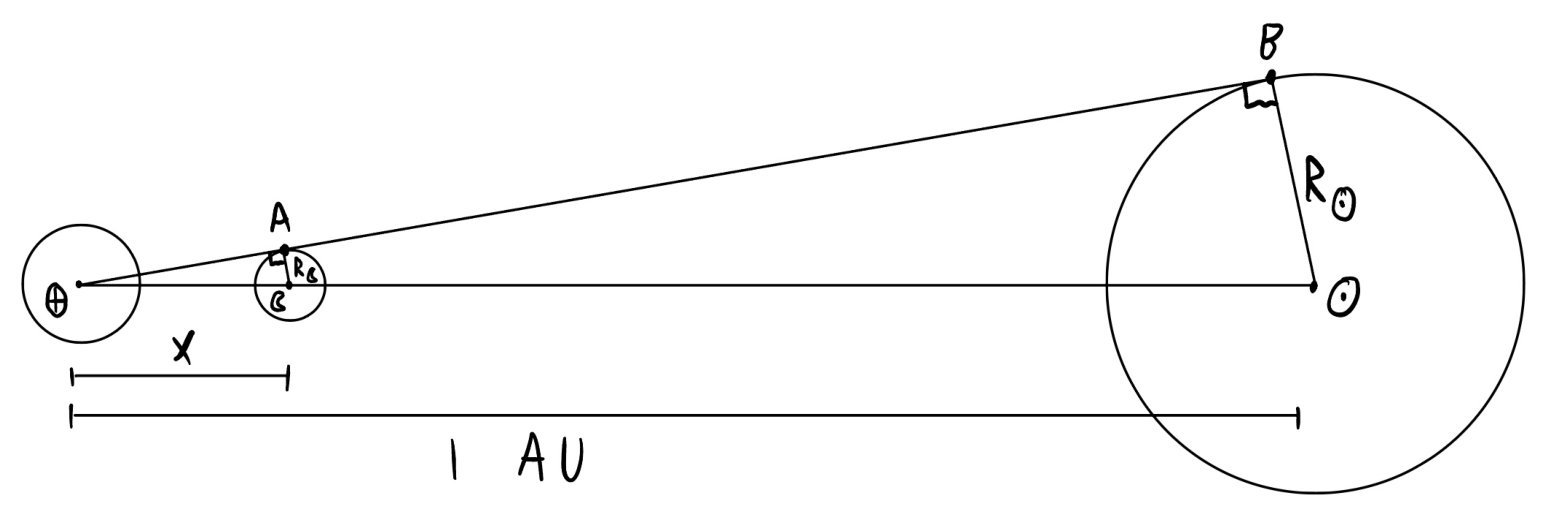
The Moon’s full shadow ends at 1 AU when the distance of the Moon from the center of the Earth is
(2 points)
The Moon can actually be slightly further away for an eclipse to occur at noon, because the shadow can converge at the Earth’s surface instead of its center. Subtracting from 1 AU in the above expression and adding it back at the end (to give the distance from the Moon to the center of the Earth) gives , which should be accepted as well.
Perigee: . (1 point)
Apogee: . (1 point)
So the marginal distance for a total solar eclipse to occur is between the perigee and apogee distances, corroborating the fact that there are both total and annular solar eclipses. (1 point)
(b) Total solar eclipses will become impossible when the Moon’s perigee is further than the maximum distance found in part (a). Using the value of gives a semimajor axis of
(1 point)
Subtracting the current value of the Moon’s semimajor axis, , means that the Moon needs to move further away by . At a rate of 38 mm per year this will take . (2 points)
Instead using the value for the maximum perigee of gives an answer of – years, which should also be accepted.
(c) By conservation of energy for the Moon’s orbit,
so at perigee,
(3 points)
(2 points)
(d) The apparent angular velocity of the Sun is . (1 point)
At new moon, this is in the same direction as the motion of the Moon, so we need to subtract this angular velocity times the distance to the Moon (1 point):
(1 point)
(e) We can use the similarity of the triangles and . (2 points)
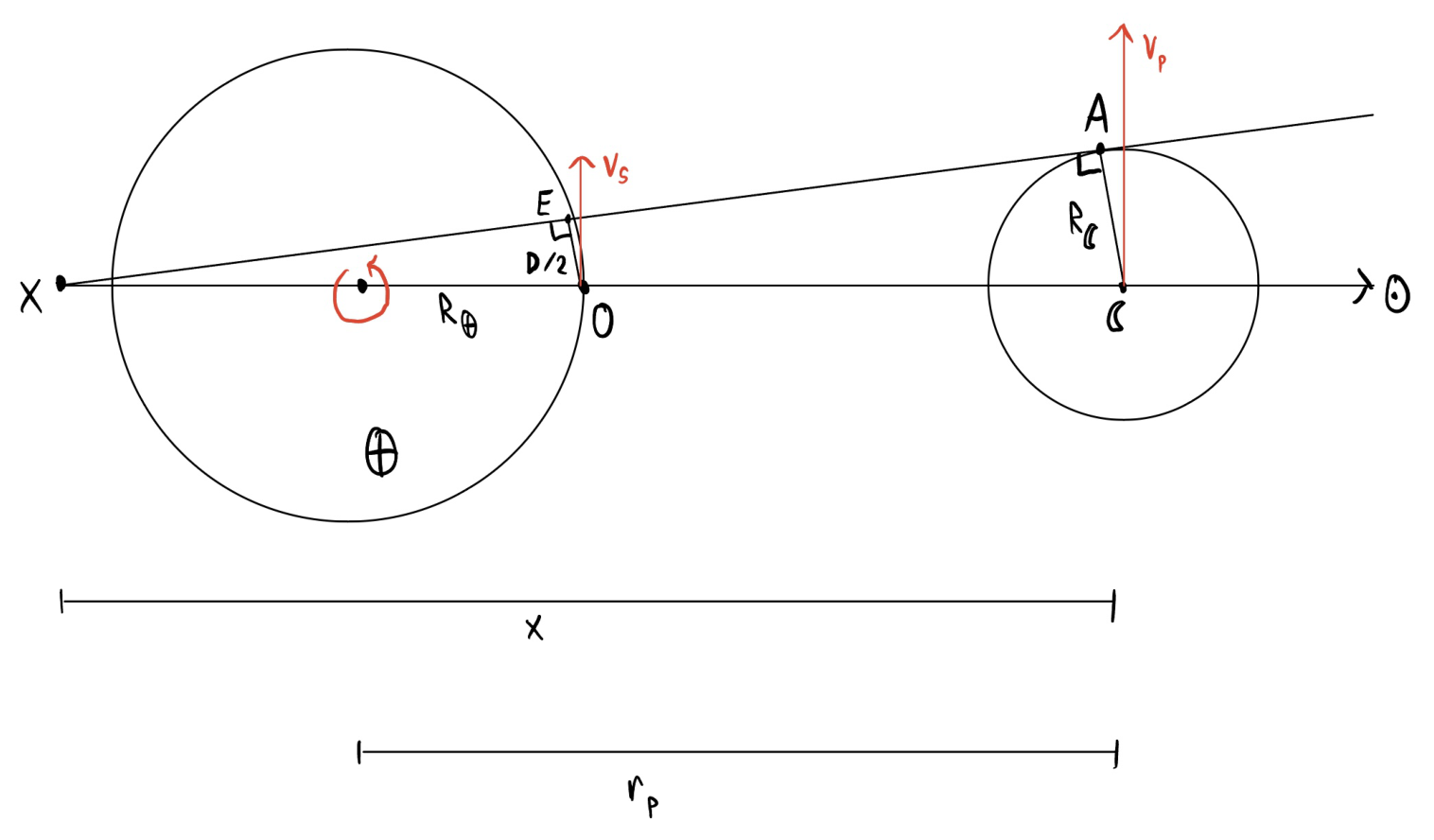
The diameter of the shadow (i.e., twice the length of ) is
(2 points)
(2 points)
We can neglect the curvature of the Earth in this calculation because this distance is much less than the radius of the Earth. Note also that the segment is at an angle so we could actually multiply this by the cosine of the angle (i.e., roughly the angular size of the Moon and Sun), but the angle is small enough that the cosine is essentially 1.
(f) We can simply divide the diameter of the shadow by the relative speed of the Moon and the observer on the surface. (2 points)
The observer on the surface moves at speed . (1 point)
Approximating the motion of both the Moon and the observer as straight lines as shown in the previous drawing (which we can do because the timescales involved are much shorter than a day) (1 point), this gives
(2 points)
This is similar to the length of the recent April 8th, 2024 total solar eclipse through North America! It is possible for eclipses to be longer than this because the Earth can be further than 1 AU from the Sun, which would increase the size of the shadow.
Source note: The final formula uses v_p for 1004 m/s after part(c) gave v_p=1076.3 m/s in a different frame. The distinct printed numeric constants are retained; G, Earth mass and Earth radius differ slightly from the separately attributed undated common reference.
Теми и трудност
Оценена трудност: 4/5.
Слънчева система · Небесна механика · Затъмнения и покрития · Орбитална енергия и напускане · Орбитално движение
Предпоставки: Гимназиална подготовка, Разширена олимпиадна подготовка
Оригинал в Архива: second_exam_2024.pdf · официални решения: second_exam_2024-solutions.pdf · допълнителни данни: physical-constants.pdf