USAAAO 2024, II кръг — Long 2. The Analemma
2024 National Astronomy Competition · 50 т.
Внимание: Бележка към темата
All eight whole original problems, their native sections, lettered parts, three roman subparts of Long 1(f), full official worked keys and original marking/acceptance notes are retained. Printed scientific discrepancies are preserved in local source notes. The official key adds a Friedmann-variable clarification and a solar apparent magnitude assumption absent from the question booklet, and changes Long1(f)(iii) from a factor to a percentage; these source variants are explicitly attributed. A separate undated common archive constants/reference table is included with its own source identity; its use as the exact 2024 provided attachment is not established, and its constants are not substituted into the printed key. The native cover specifies blank paper rather than a designated answer sheet. April 13th is the end of the examination period, not an established single sitting date.
1 Instructions (Please Read Carefully)
The top 5 eligible scorers on the NAC will be invited to represent USA at the next IOAA. In order to qualify for the national team, you must be a high school student with US citizenship or permanent residency.
This exam consists of 3 parts: Short Questions, Medium Questions and Long Questions.
The maximum number of points is 225 points.
The test must be completed within 2.5 hours (150 minutes).
Please solve each problem on a blank piece of paper and mark the number of the problem at the top of the page. The contestant’s full name in capital letters should appear at the top of each solution page. If the contestant uses scratch papers, those should be labeled with the contestant’s name as well and marked as “scratch paper” at the top of the page. Scratch paper will not be graded. Partial credit will be available given that correct and legible work was displayed in the solution.
This is a written exam. Contestants can only use a scientific or graphing calculator for this exam. A table of physical constants will be provided. Discussing the problems with other people is strictly prohibited in any way until the end of the examination period on April 13th. Receiving any external help during the exam is strictly prohibited. This means that the only allowed items are: a calculator, the provided table of constants, a pencil (or pen), an eraser, blank sheets of papers, and the exam. No books or notes are allowed during the exam. Exam is proctored and recorded. You are expected to have your video on at all times.
We acknowledge the following people for their contributions to this year’s exam:
Abhay Bestrapalli, Orion Foo, Hagan Hensley, David Lee, Sandesh Kalantre, Andrew Liu, Joe McCarty, Leo Yao
Common archive reference — Table of Physical Constants
This separate common USAAAO archive reference is undated in the catalogue. Its use as the exact 2024 exam attachment is not established.
| Quantity | Symbol | Value |
|---|---|---|
| Electron rest mass | ||
| Proton rest mass | ||
| Electronic charge | ||
| Speed of light in free space | ||
| Permeability of free space | ||
| Permittivity of free space | ||
| Planck’s constant | ||
| Reduced Planck’s constant | ||
| Boltzmann’s constant | ||
| Gas constant | ||
| Molar gas constant | ||
| Avogadro’s number | ||
| Standard molar volume | ||
| Unified atomic mass unit ( scale) | ||
| Mass of hydrogen atom | ||
| Bohr magneton | or | |
| Nuclear magneton | or | |
| Proton magnetic moment | ||
| Neutron magnetic moment | ||
| Bohr radius | ||
| Fine structure constant | ||
| Compton wavelength of electron | ||
| Rydberg’s constant | ||
| Stefan-Boltzmann constant | ||
| Radiation density constant | ||
| Gravitational constant |
Rest masses of some leptons and hadrons in :
0.5110, 105.66, 1777, 134.98, 139.57, 493.7, 497.7, 547, 1865, 1869, p 938.3, n 939.6, 1115.7, 1189, 1193, 1197, 1315, 1321, 1672, , .
| Quark | Charge | Mass () | |||||
|---|---|---|---|---|---|---|---|
| u | 0 | 0 | 0 | 0 | |||
| d | 0 | 0 | 0 | 0 | |||
| c | 0 | 0 | +1 | 0 | 0 | ||
| s | 0 | -1 | 0 | 0 | 0 | ||
| t | 0 | 0 | 0 | 0 | +1 | 174.3 | |
| b | 0 | 0 | 0 | -1 | 0 | 4.2 |
Common archive reference — Astrophysical Data and identities
Astrophysical Data
| Quantity | Symbol | Value |
|---|---|---|
| 1 astronomical unit | AU | |
| 1 parsec | pc | |
| Luminosity of Sun | ||
| Mass of Sun | ||
| Radius of Sun | ||
| Mass of Earth | ||
| Radius of Earth |
Other data and conversion factors
| Quantity | Symbol | Value |
|---|---|---|
| 1 ångstrom | Å | |
| 1 fermi | fm | |
| 1 barn | b | |
| 1 pascal | Pa | |
| 1 standard atmosphere | ||
| Standard acceleration due to gravity | ||
| 1 electron volt | eV | |
| Wavelength of 1 eV photon |
Trigonometrical identities
In a triangle ABC,
and
Prefixes
| Prefix | Name | Factor |
|---|---|---|
| T | tera | |
| G | giga | |
| M | mega | |
| k | kilo | |
| c | centi | |
| m | milli | |
| micro | ||
| n | nano | |
| p | pico | |
| f | femto |
Source note: This undated common table prints , and . The 2024 eclipse key instead uses , Earth mass and Earth radius . Both original sets of values are preserved separately; this reference is not an established exact dated 2024 attachment.
Условие
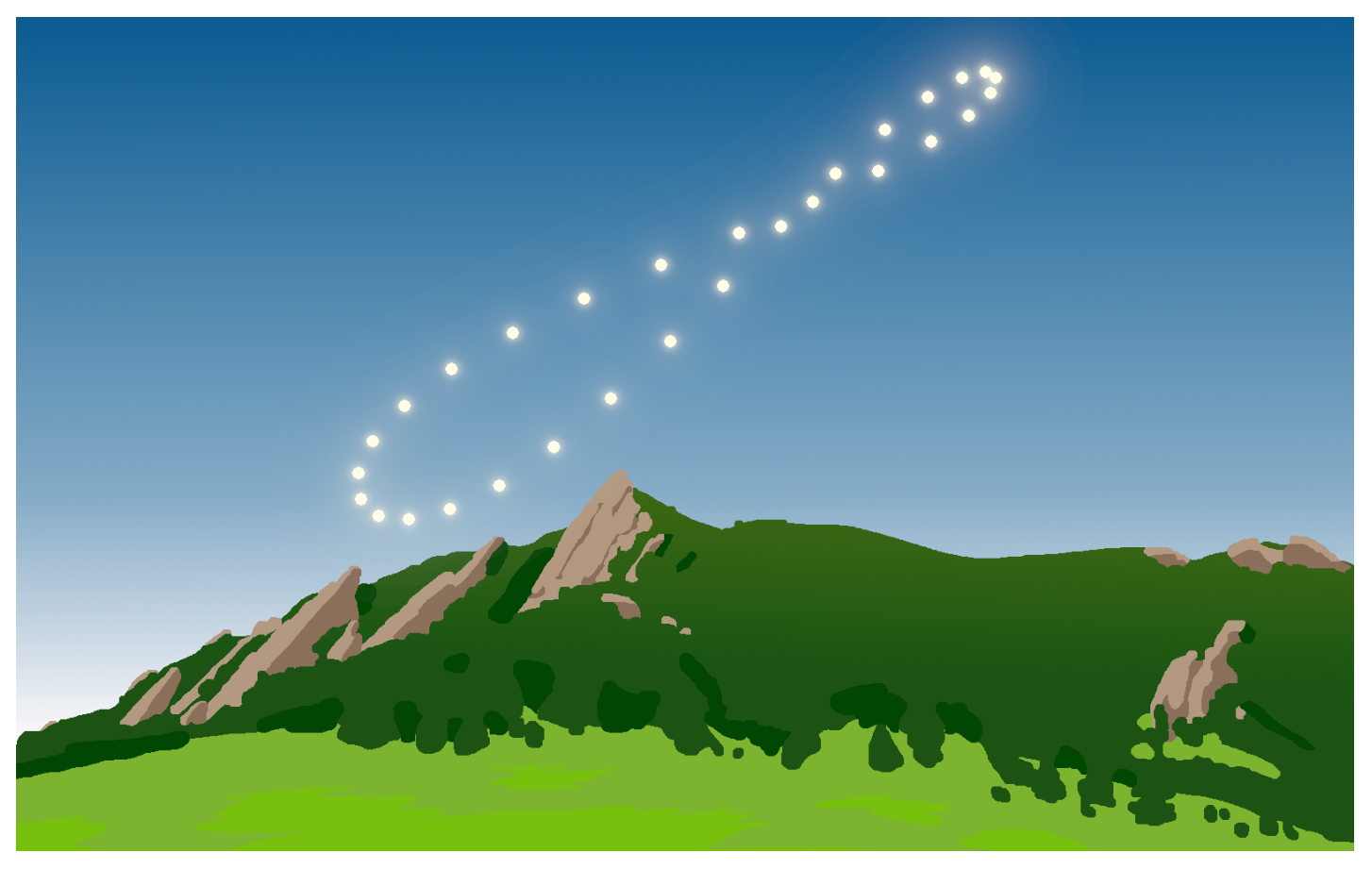
If you take a picture of the Sun at the same time every day over the course of the year, you will see it traverse a famous figure-8 pattern known as the analemma. You can think of this as happening because the Sun’s right ascension and declination vary over the course of the year relative to a “hypothetical sun” that travels at a constant speed along the celestial equator, and would appear to stay in place if observed at the same time each day.
In this problem, we will derive an expression for the shape of the analemma. Assume throughout this problem that , where is the Earth’s eccentricity and is the Earth’s axial tilt. Use the small-angle approximation wherever it is justified - you’ll need it often (sometimes in conjunction with other trig identities).
(a) (20 points) We conventionally parameterize the time of year in terms of the “mean anomaly” , which starts at 0 at Earth’s perihelion, and increases from 0 to (radians) at a constant rate over the course of a year.
Since perihelion does not occur at the same time as the vernal equinox, we define the angle to be equal to the mean anomaly at the time of the vernal equinox. For convenience define another variable: the “mean longitude” , which is equal to the longitude of the “hypothetical sun” mentioned above.
Write down an expression (valid for ) for the ecliptic longitude of the Sun, as a function of and . Hint: you can apply Kepler’s second law to calculate at a few specific points along Earth’s orbit, and then make an educated guess of the general form from there.
We can describe the analemma as a parametric function of , in terms of its right-ascension and declination components:
where is the declination of the Sun, and is the equation of time, defined as the difference in right ascension between the real Sun and the mean longitude.
(b) (10 points) Using spherical trigonometry and your expression for , write down an expression for . Remember to use the small-angle approximation!
(c) (15 points) Making the same assumptions as before, find an expression for . Be careful: there will be a term that depends on , and a term that depends on - they’re approximately equal in magnitude (for Earth), so you need to include them both.
You’ll need couple of useful approximations, both of which hold for any :
(d) (5 points) Based on the results of parts (b) and (c), explain qualitatively why the analemma looks like a figure-8 curve.
(If you’re curious, after the exam, you can try to graph or sketch a parametric plot of against . For Earth in 2024, , and . The result should look familiar.)
Отговори
(a)
(b)
(c)
Native intermediate lines mix M and L; they remain literal in the worked key.
(d) The sin(2L) term produces a six-month component in Δα while δ oscillates annually, giving the figure-8.
Решение
(a) A convenient variable to define (though you don’t have to) is the true anomaly , such that we’d expect for a circular orbit. The quantity we want to know is the difference between and , or , which should be small in the limit where the orbit is nearly circular.
We can find it carefully by expanding Kepler’s equation in small , but that’s an unnecessarily complex approach if we just want the lowest order term of the expansion. I’ll adopt the strategy of just making an educated guess based on a few points in the orbit. We can think of as a function of , and guess the form of this function .
First we should come up with a qualitative expectation/“ansatz” of what the answer will be. must be periodic in with period , so the answer should be built out of trig functions. As the Earth is passing perihelion, its angular velocity about the sun is a little higher than its average angular velocity over the full orbit, so we’d expect to be increasing. As the Earth is passing aphelion, by the same logic, we’d expect to be decreasing. Thus, a reasonable guess is , where is some coefficient to be determined.
At perihelion (), by definition , so .
At aphelion (), by the symmetry of the orbit we must have , so again.
The other two points to consider are along the semi-minor axis. Specifically, let’s consider the point along the semi-minor axis where Earth is moving from perihelion to aphelion. By Kepler’s second law, the mean anomaly is
If we draw a triangle through the Earth, the center of the orbit, and the Sun (see the figure), it is a right triangle with base and height . The area swept out by Earth is the area of the ellipse, minus this triangle, which is . Thus
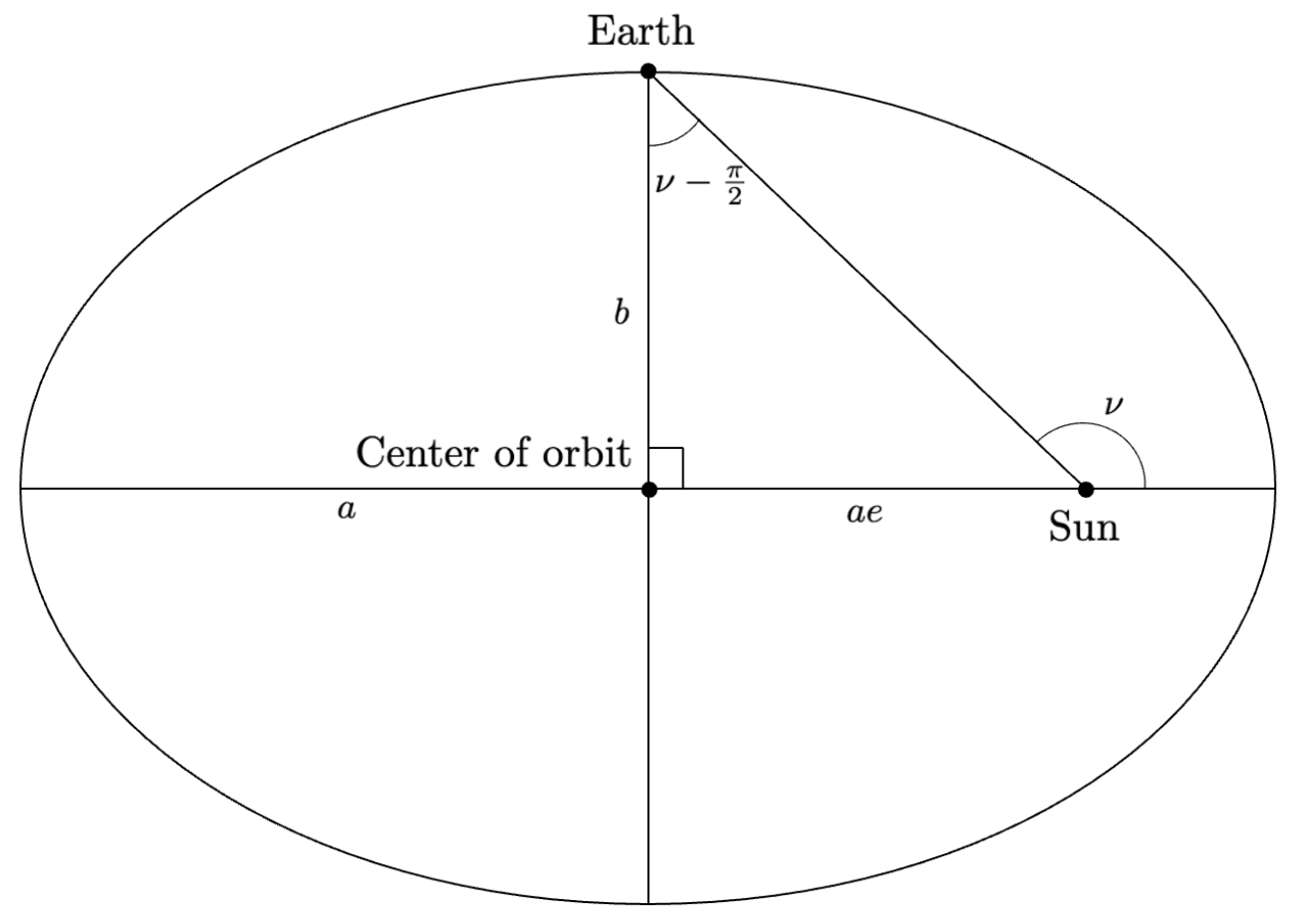
The true anomaly is given by the Earth-Sun-perihelion angle, which using the small-angle approximation is . For a nearly-circular orbit we can say is close to 1, so
This gives . At the opposite point in the orbit along the semi-minor axis, we can carry out a very similar argument to show .
Considering all four of these points, as well as our guess for the form of , we get
which turns out to be correct in the small limit. (For non-small there is no closed-form solution; we would have to write it as an infinite series with higher order terms like , etc.) We can rewrite this as
Finally plugging in the definitions of in terms of :
(b) We can get as a function of from spherical trigonometry. Draw a spherical triangle with the ecliptic and celestial equator as two sides, and the projection of the sun’s position onto the celestial equator giving a right angle. Then the spherical law of sines gives
Since is small we can apply the small angle approximation:
But we want as a function of . To get this, plug in the expression for from part (a):
Since is much smaller than 1, we might want to use the small angle approximation here. However, this isn’t quite the right form for it. The trick is to first apply the trig identity for the sine of a sum of two angles:
and we can now apply a small-angle approximation in on both of the resulting terms:
(If you’re familiar with calculus, you may also recognize that you can get this from a first-order Taylor series expansion.)
The second term here is proportional to , while the first term is just proportional to . Since we assumed both and are much smaller than 1, we know the term is much smaller than the term, so we can ignore it.
(c) This is the hardest part of the problem. It really just comes down to expanding everything out with trig identities and carefully determining which terms we are allowed to ignore.
We can derive in terms of by drawing the same spherical triangle as before. The spherical law of cosines gives:
Since is small, we can write
(Unlike in the usual small-angle approximation, we have to include the second-order term here, otherwise we’d lose all dependence on !)
Write :
We can assume will be small. Therefore we can do a similar trick as in part (b). Applying the cosine angle addition identity and the small-angle approximation:
Rearranging, and using the other approximation given in the problem:
Plugging in the expression for :
Again using the small-angle approximation trick:
Plugging this back in:
As before, we can ignore the term of order , since we assumed both and were small. However, we shouldn’t ignore the term proportional to since we didn’t assume anything about how and compare! For Earth, it turns out that they are roughly the same size.
(d) The analemma looks like a figure-8 because of the presence of the term, which gives a contribution to that oscillates with a period of 6 months rather than 1 year. Without this term, the analemma would just be an ellipse as both and are oscillating at the same frequency.
If we plug in the parameters for Earth:
we can make a parametric plot of against :
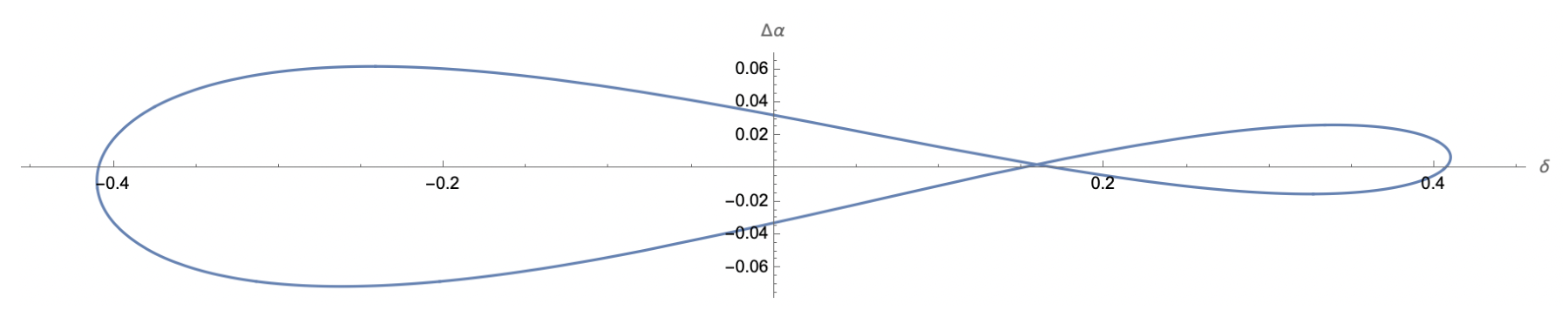
Source note: The aphelion paragraph prints M=π/2 and ν=M=π in the same sentence. Two intermediate part(c) terms print sin M and sin²(M) where adjacent lines use L; native notation and the final boxed expression are retained. The final diagram has horizontal δ and vertical Δα, while the preceding prose says a plot of δ against Δα; the source plot is retained with its original axis labels.
Теми и трудност
Оценена трудност: 5/5.
Време и календари · Небесна сфера и сферична астрономия · Небесна механика · Уравнение на времето · Небесни координати · Закони на Кеплер
Предпоставки: Гимназиална подготовка, Разширена олимпиадна подготовка
Оригинал в Архива: second_exam_2024.pdf · официални решения: second_exam_2024-solutions.pdf · допълнителни данни: physical-constants.pdf