USAAAO 2026, I кръг — Задача 12
USAAAO 2026 - First Round · 9 февруари 2026 г.
Problem writers
Problem writers: Srihari (Hari) Balaji, Vincent Bian, Ferdinand, Hagan Hensley, Elizabeth Lee, Joe McCarty, Lucas Pinheiro, Feodor Yevtushenko
Условие
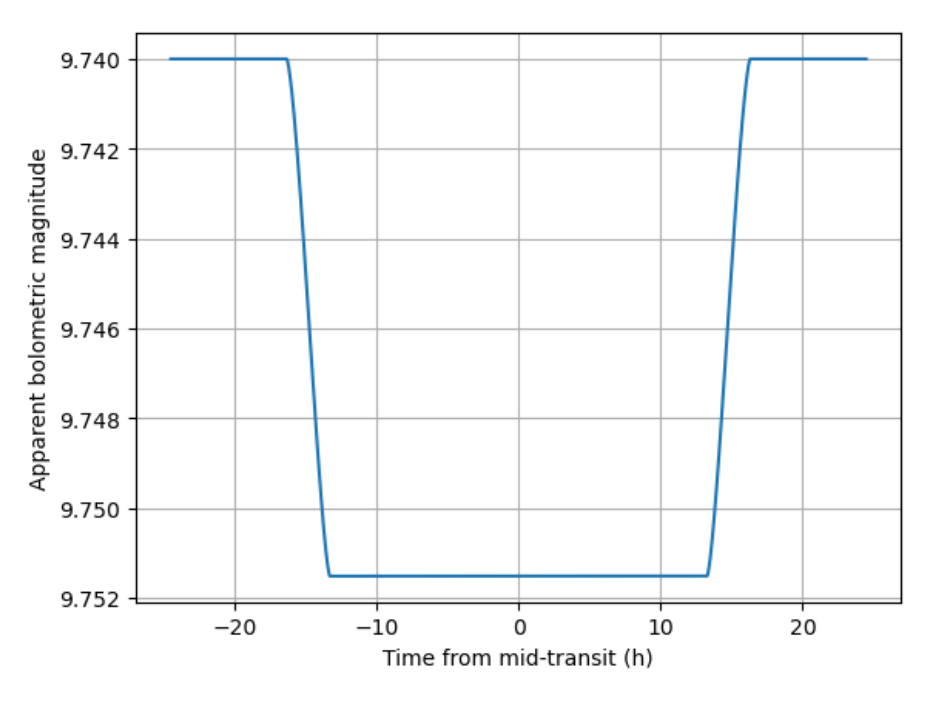
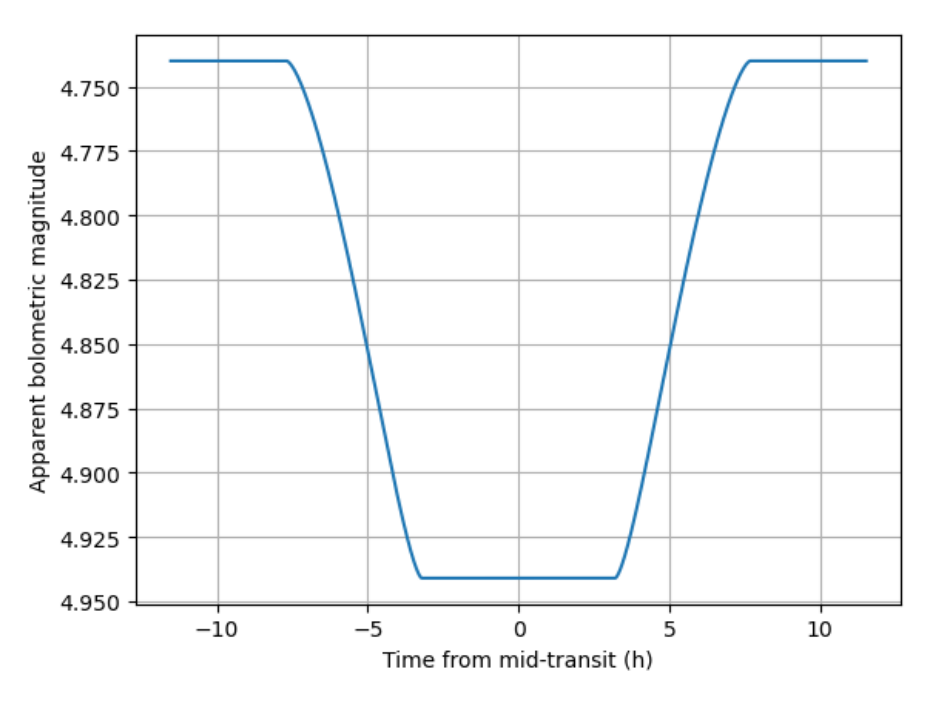
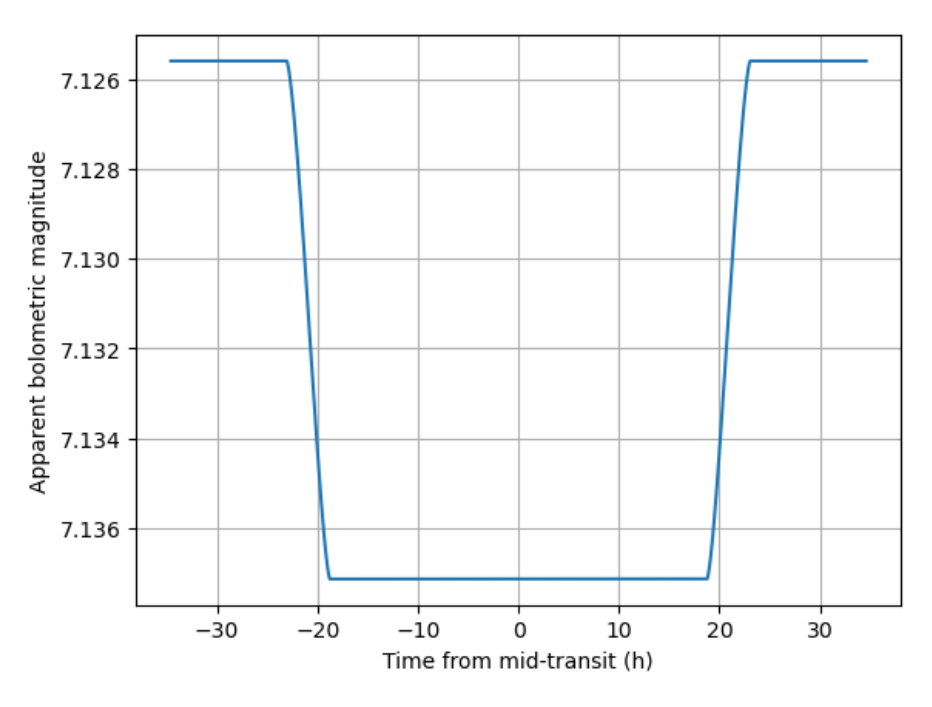
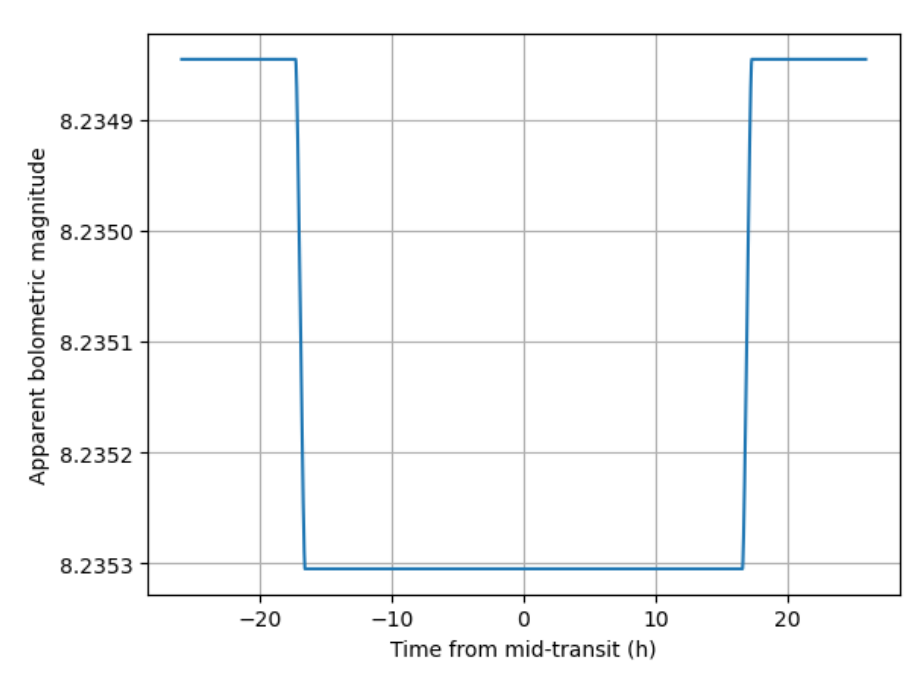
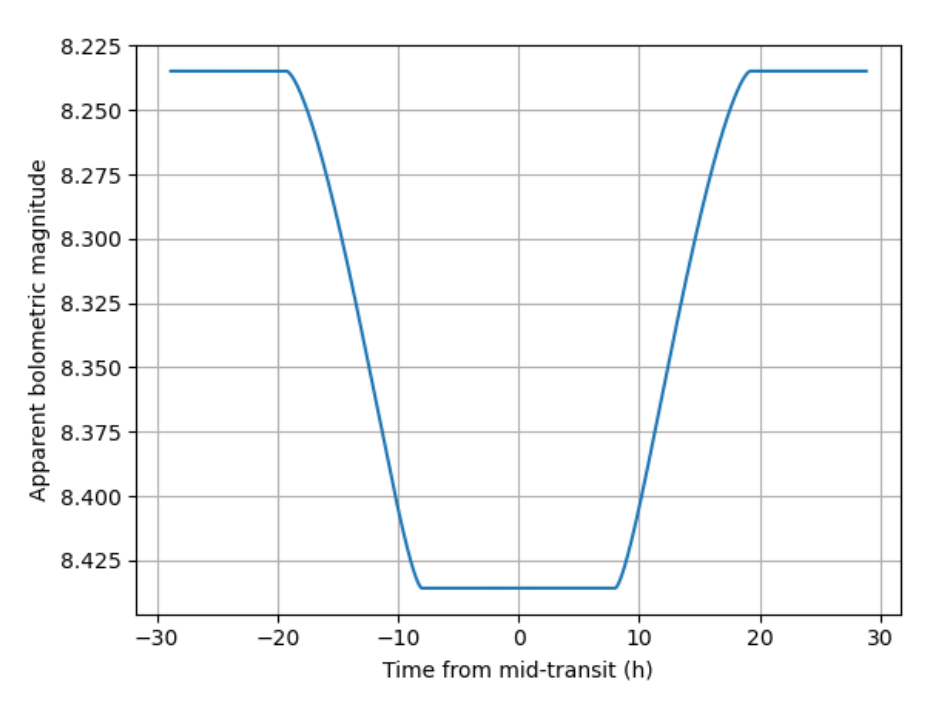
An extraterrestrial form of life from a distant planetary system observed a transit of Jupiter across the Sun. The transit was central, which means that the center of Jupiter’s disk intersected with the center of the Sun’s disk throughout the transit. Neglecting the effect of limb darkening, which of the light curves below could correspond to the transit of Jupiter seen by the extraterrestrial?
The -axis on the plots corresponds to the time difference in hours from the middle of the transit, and the -axis corresponds to the apparent bolometric magnitude of the star.
Отговори
- A
Решение
Solution: There a few main parameters that can be used to determine which of the light curves corresponds to the transit of Jupiter. One of them is the variation in magnitude during the transit, which is caused by the planet blocking part of the star’s disk. Using Pogson’s equation:
Note that the exact magnitudes before and during the transit depend on the distance between the observer and the solar system, and only the variation in magnitude is relevant to determine the correct light curve.
Another important parameter is the duration of the transit (between the first and fourth contacts). In order to calculate that, it is important to first determine the orbital velocity of Jupiter, which can be calculated as follows assuming that the orbit is roughly circular:
Therefore, the interval between the first and fourth contacts is the following:
These two parameters are already enough to determine the correct answer, but another parameter students could choose to calculate is the interval between the first and second contacts of the transit, which can be determined as follows:
This is the same as the interval between the third and fourth contacts. It would also be possible to use the interval between the second and third contacts as a parameter to identify the correct light curve.
Alternative A is the only light curve that has the correct variation in magnitude, transit duration, and intervals between the contacts of the transit.
Answer: A
Оригинал в Архива: usaaao_first_exam_2026.pdf · официални решения: usaaao_first_exam_solutions_2026.pdf