USAAAO 2026, I кръг — Задача 21
USAAAO 2026 - First Round · 9 февруари 2026 г.
Problem writers
Problem writers: Srihari (Hari) Balaji, Vincent Bian, Ferdinand, Hagan Hensley, Elizabeth Lee, Joe McCarty, Lucas Pinheiro, Feodor Yevtushenko
Условие
Use the following information for Questions 21, 22, and 23. Consider the following graph, which shows the mean orbital velocity of stars around a galaxy’s center as a function of distance from the center. The graph also shows the expected orbital velocities (dashed line) from observations of visible matter. The discrepancy between the observed and expected values is assumed to be due to invisible dark matter.
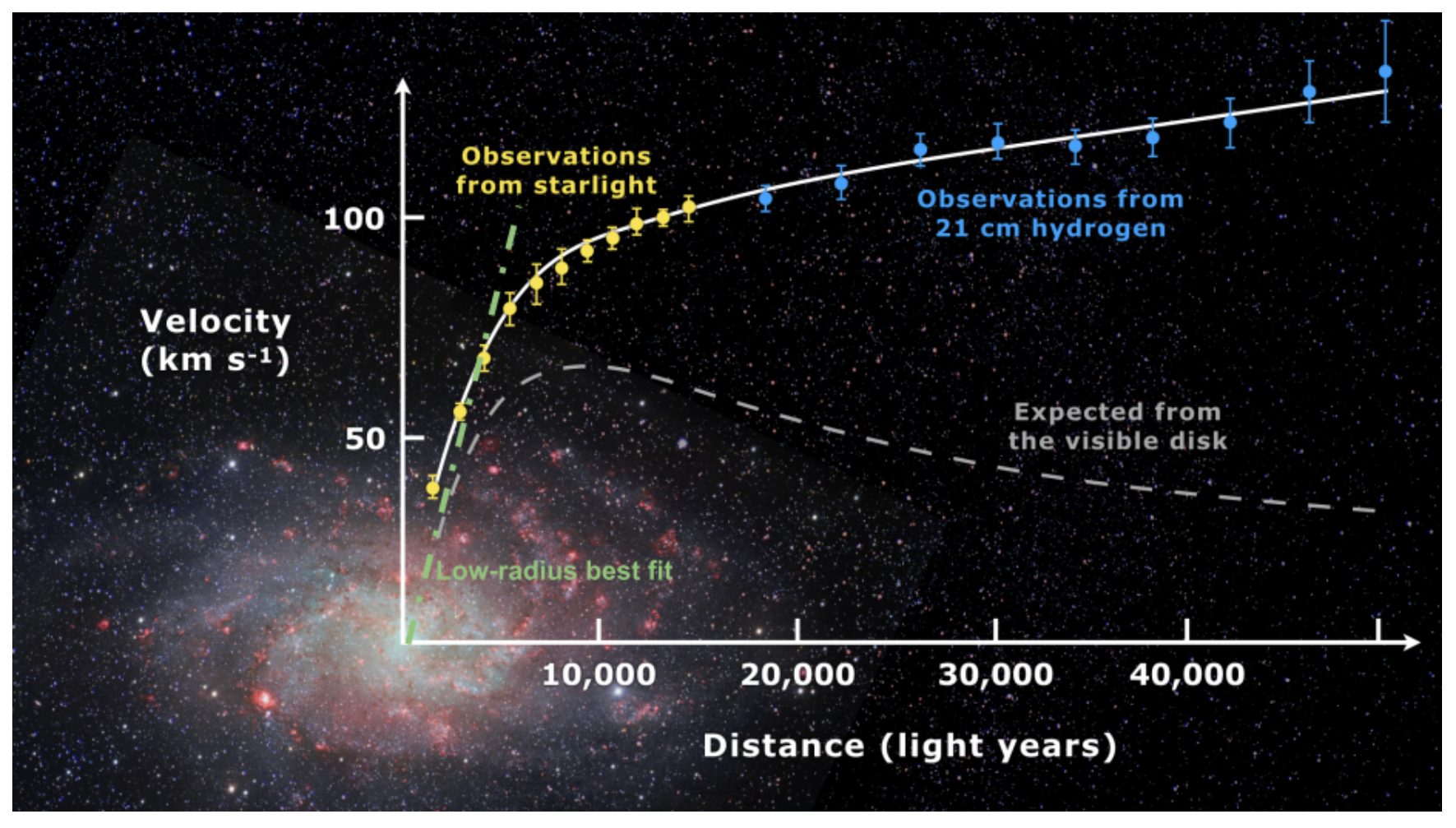
Consider orbital radii within the most luminous part of the disk, at around ly. Let be the total mass (of all forms) enclosed within a distance from the galactic center. Approximating the rotation curve by the low-radius best fit (dot-dash) line, we can infer that is roughly proportional to for some value of (over small ).
In light of the value of , and for ly, which of the following hypotheses is MOST consistent with the data?
(a) Near the galactic center, the mass is concentrated in and is nearly uniform over the 2D galactic plane.
(b) The majority of the contribution to comes from the existence of a supermassive black hole at the galactic center.
(c) Dark energy-based repulsion from the galactic center induces a mass distribution of the form .
(d) Complex gravitational interactions with the dark matter halo make such power laws impossible, with no single value of being consistent with the best fit line.
(e) Gas, dust, and stars are approximately uniformly distributed in 3D space near the galactic center with no significant radius dependence of density.
Отговори
- E
Решение
Solution:
By Newton’s Law of Gravity, considering an object of mass ,
According to the graph, we have for small values of , so . The corresponding values of for the answer choices are as follows:
(A): , (B): , (C): , (D): no such , (E): .
Answer: E
Оригинал в Архива: usaaao_first_exam_2026.pdf · официални решения: usaaao_first_exam_solutions_2026.pdf