USAAAO 2026, I кръг — Задача 23
USAAAO 2026 - First Round · 9 февруари 2026 г.
Problem writers
Problem writers: Srihari (Hari) Balaji, Vincent Bian, Ferdinand, Hagan Hensley, Elizabeth Lee, Joe McCarty, Lucas Pinheiro, Feodor Yevtushenko
Условие
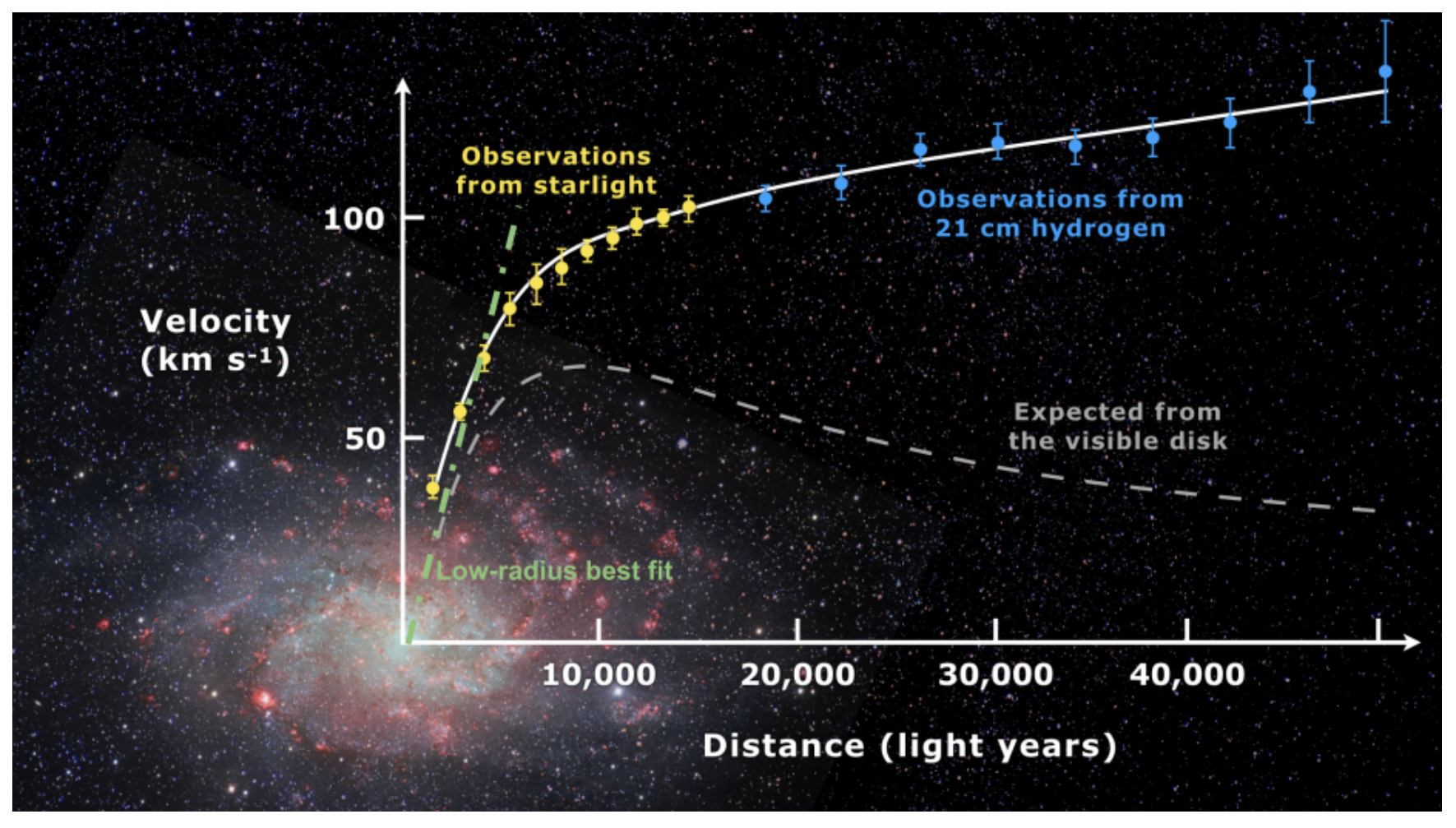
Use the following information for Questions 21, 22, and 23. Consider the following graph, which shows the mean orbital velocity of stars around a galaxy’s center as a function of distance from the center. The graph also shows the expected orbital velocities (dashed line) from observations of visible matter. The discrepancy between the observed and expected values is assumed to be due to invisible dark matter.
Consider the following three assertions related to the techniques used to measure the overall rotation curve, in the context of the aforementioned figure:
(I) Interstellar dust is colder at lower values of , making the dust obscure less starlight.
(II) O/B type stars in the spiral arms of galaxies emit significant quantities of UV light, ionizing nearby H-I clouds and thus inhibiting the emission of 21-cm radiation in their vicinities.
(III) The lower star number density for higher values of means that the stars that do exist typically move at relativistic speeds, complicating Doppler-based stellar velocity measurements.
Which of the above are TRUE?
(a) I only
(b) II only
(c) III only
(d) I and II only
(e) None of the above
Отговори
- B
Решение
Solution:
(I) is false because interstellar dust is hotter for lower values of , since the dust that exists is closer to more stars (that are also hotter on average), making the dust hotter overall.
(II) is true and is a direct consequence of the extremely long decay time of the hyperfine hydrogen excited state.
(III) is false because stars orbit at nowhere near relativistic speeds, as can be seen from the fact that the rotational velocity is within an order of magnitude of 100 km/s everywhere, much less than the speed of light. The correct answer is II only.
Answer: B
Оригинал в Архива: usaaao_first_exam_2026.pdf · официални решения: usaaao_first_exam_solutions_2026.pdf