USAAAO 2026, II кръг — Задача 5. Enceladus geysers
2026 National Astronomy Competition · 20 т.
Внимание: Бележка към темата
Questions 3 and 9 refer to designated answer sheets, and question 6 to provided grid paper; these sheets were not obtained in the two native 2026-II PDFs or their two-row same-folder archive catalogue. The separately attributed physical-constants.pdf is an undated common USAAAO archive reference; its identity as the table supplied for this exam is unproven.
Instructions (Please Read Carefully)
2026 National Astronomy Competition
1 Instructions (Please Read Carefully)
The top 15 eligible scorers on the NAC will be invited to the training camp. A third round will be conducted during the camp to select the national team for the IOAA 2026. In order to qualify for camp, you must be a high school student with US citizenship or permanent residency.
The test must be completed within 2.5 hours (150 minutes) and the maximum number of points is 300 points. The point breakdown per problem is as follows.
| Problem | P1 | P2 | P3 | P4 | P5 | P6 | P7 | P8 | P9 | Total |
|---|---|---|---|---|---|---|---|---|---|---|
| Points | 10 | 15 | 15 | 20 | 20 | 40 | 40 | 55 | 85 | 300 |
Please solve each problem on a blank piece of paper and mark the number of the problem at the top of the page. Some problems may require a designated answer sheet; these will be provided. The contestant’s full name in capital letters should appear at the top of each solution page. If the contestant uses scratch papers, those should be labeled with the contestant’s name as well and marked as “scratch paper” at the top of the page. Scratch paper will not be graded. Partial credit will be available given that correct and legible work was displayed in the solution.
This is a written exam. Contestants can only use a scientific calculator (non-programmable and non-graphing) for this exam. A table of physical constants will be provided. Discussing the problems with other people is strictly prohibited in any way until the end of the examination period on April 20, 2026. Receiving any external help during the exam is strictly prohibited. This means that the only allowed items are: a calculator, the provided table of constants, a pencil (or pen), an eraser, blank sheets of papers, and the exam. No books or notes are allowed during the exam. Students must be proctored during the entire duration of the exam.
This exam sheet and your answer sheets (including scratch papers) should be returned to your proctors once the exam ended. Your proctors should upload your answer sheets to the Google Form provided to them.
We acknowledge the following people for their contributions to this year’s exam:
Srihari (Hari) Balaji, Feodor Yevtushenko, Ferdinand, Hagan Hensley, Joe McCarty, Lucas Pinheiro, Vincent Bian, Elizabeth Lee
After reading the instructions, please make sure to sign, affirming that:
- All work on this exam has been completed by me.
- I took this exam under the supervision of a proctor.
- I did not receive any external help beyond the materials provided.
- I will not discuss the contents of this exam with anyone until April 20, 2026.
- Failure to follow these rules will result in disqualification from the exam.
Student Signature: ____________________ Date: ____________________
Undated common archive reference · Table of Physical Constants
Table of Physical Constants
| Quantity | Symbol | Value |
|---|---|---|
| Electron rest mass | ||
| Proton rest mass | ||
| Electronic charge | ||
| Speed of light in free space | ||
| Permeability of free space | ||
| Permittivity of free space | ||
| Planck’s constant | ||
| Reduced Planck’s constant | ||
| Boltzmann’s constant | ||
| Gas constant | ||
| Molar gas constant | ||
| Avogadro’s number | ||
| Standard molar volume | ||
| Unified atomic mass unit ( scale) | ||
| Mass of hydrogen atom | ||
| Bohr magneton | or | |
| Nuclear magneton | or | |
| Proton magnetic moment | ||
| Neutron magnetic moment | ||
| Bohr radius | ||
| Fine structure constant | ||
| Compton wavelength of electron | ||
| Rydberg’s constant | ||
| Stefan-Boltzmann constant | ||
| Radiation density constant | ||
| Gravitational constant |
Rest masses of some leptons and hadrons in :
0.5110, 105.66, 1777, 134.98, 139.57, 493.7, 497.7, 547, 1865, 1869, p 938.3, n 939.6, 1115.7, 1189, 1193, 1197, 1315, 1321, 1672, , .
| Quark | Charge | Mass () | |||||
|---|---|---|---|---|---|---|---|
| u | 0 | 0 | 0 | 0 | |||
| d | 0 | 0 | 0 | 0 | |||
| c | 0 | 0 | +1 | 0 | 0 | ||
| s | 0 | -1 | 0 | 0 | 0 | ||
| t | 0 | 0 | 0 | 0 | +1 | 174.3 | |
| b | 0 | 0 | 0 | -1 | 0 | 4.2 |
Undated common archive reference · Astrophysical Data and Conversion Factors
Astrophysical Data
| Quantity | Symbol | Value |
|---|---|---|
| 1 astronomical unit | AU | |
| 1 parsec | pc | |
| Luminosity of Sun | ||
| Mass of Sun | ||
| Radius of Sun | ||
| Mass of Earth | ||
| Radius of Earth |
Other data and conversion factors
| Quantity | Symbol | Value |
|---|---|---|
| 1 ångstrom | Å | |
| 1 fermi | fm | |
| 1 barn | b | |
| 1 pascal | Pa | |
| 1 standard atmosphere | ||
| Standard acceleration due to gravity | ||
| 1 electron volt | eV | |
| Wavelength of 1 eV photon |
Trigonometrical identities
In a triangle ABC,
and
Prefixes
| T = tera = | c = centi = |
| G = giga = | m = milli = |
| M = mega = | = micro = |
| k = kilo = | n = nano = |
| p = pico = | |
| f = femto = |
Условие
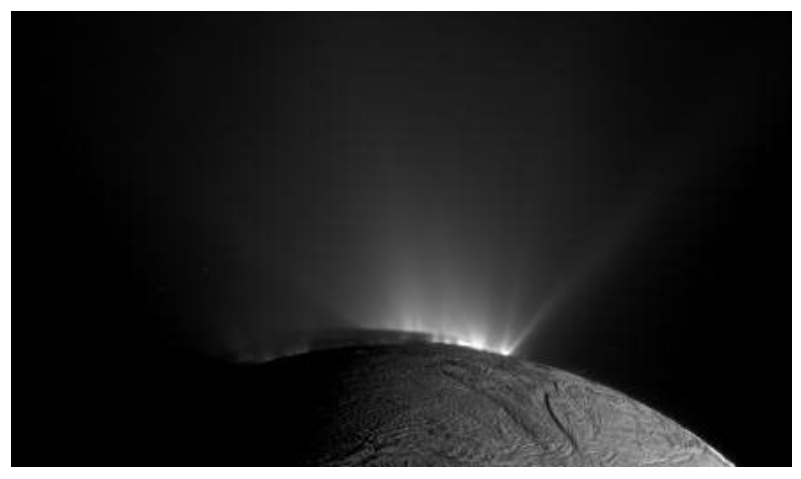
Figure 1: Cassini image of geysers from Enceladus. From NASA.
Enceladus is a moon of Saturn which has an outer crust of ice and is believed to have a subsurface liquid water ocean. Here are some useful physical properties:
- Radius of Enceladus (including the ice shell)
- Ice shell thickness
- Density of ice
- Surface gravity (you can assume this is constant throughout the icy shell to the top of the subsurface ocean)
- Semi-major axis of Enceladus’ orbit around Saturn
- Mass of Saturn
(a) (10 points) The Cassini spacecraft observed that geysers of water erupt from the surface at a speed of relative to Enceladus. Calculate whether this water has sufficient speed to escape the gravitational field of Enceladus. If so, will it remain gravitationally bound to Saturn or escape into solar orbit?
(b) (6 points) Assuming that the water in the geysers starts from rest at the top of the subsurface ocean, calculate the pressure necessary to accelerate the water to at the surface of Enceladus, where there is no ambient pressure. Assume that viscous losses are negligible and the geyser material has a constant density of , ignoring any phase changes.
(c) (4 points) Estimate the hydrostatic pressure due to the weight of the icy shell at the top of the subsurface ocean. Is that pressure sufficient to explain the speed of the geysers?
Решение
Solution:
This question was inspired by a homework problem in Professor Brad Hindman’s fluid dynamics class.
(a) We are not given the mass of Enceladus, but we know that . The escape velocity of Enceladus is (1 point for escape velocity formula, 2 points for rewriting in terms of known quantities, 2 points for calculation)
so (1 point).
The escape velocity of Saturn from Enceladus is (1 point for formula, 1 point for calculation)
so even when added to the orbital speed of Enceladus (which is ) (1 point for some mention that you need to change reference frames), is much too small. (1 point)
This is the source of Saturn’s E ring!
(b) According to Bernoulli’s principle, (2 points)
is a constant. Equating its value for the geyser at the top of the subsurface ocean and the surface of Enceladus, (1 point)
so (2 points for equation for pressure, 1 point for calculation)
(c) The pressure from the icy shell is (2 points for equation for pressure, 1 point for calculation)
which is more than an order of magnitude too small.
An alternative calculation of the pressure (either way receives full points) is
(1 point)
One possibility is that tidal forces from Saturn can lead to cracks in the ice shell and “squeeze” these cracks to accelerate the geyser material. See Kite & Rubin (2016).
Оригинал в Архива: usaaao2026.pdf · официални решения: usaaao2026_sol.pdf · допълнителни данни: physical-constants.pdf