USAAAO 2026, II кръг — Задача 6. Build your Own H-R Diagram
2026 National Astronomy Competition · 40 т.
Внимание: Бележка към темата
Questions 3 and 9 refer to designated answer sheets, and question 6 to provided grid paper; these sheets were not obtained in the two native 2026-II PDFs or their two-row same-folder archive catalogue. The separately attributed physical-constants.pdf is an undated common USAAAO archive reference; its identity as the table supplied for this exam is unproven.
Instructions (Please Read Carefully)
2026 National Astronomy Competition
1 Instructions (Please Read Carefully)
The top 15 eligible scorers on the NAC will be invited to the training camp. A third round will be conducted during the camp to select the national team for the IOAA 2026. In order to qualify for camp, you must be a high school student with US citizenship or permanent residency.
The test must be completed within 2.5 hours (150 minutes) and the maximum number of points is 300 points. The point breakdown per problem is as follows.
| Problem | P1 | P2 | P3 | P4 | P5 | P6 | P7 | P8 | P9 | Total |
|---|---|---|---|---|---|---|---|---|---|---|
| Points | 10 | 15 | 15 | 20 | 20 | 40 | 40 | 55 | 85 | 300 |
Please solve each problem on a blank piece of paper and mark the number of the problem at the top of the page. Some problems may require a designated answer sheet; these will be provided. The contestant’s full name in capital letters should appear at the top of each solution page. If the contestant uses scratch papers, those should be labeled with the contestant’s name as well and marked as “scratch paper” at the top of the page. Scratch paper will not be graded. Partial credit will be available given that correct and legible work was displayed in the solution.
This is a written exam. Contestants can only use a scientific calculator (non-programmable and non-graphing) for this exam. A table of physical constants will be provided. Discussing the problems with other people is strictly prohibited in any way until the end of the examination period on April 20, 2026. Receiving any external help during the exam is strictly prohibited. This means that the only allowed items are: a calculator, the provided table of constants, a pencil (or pen), an eraser, blank sheets of papers, and the exam. No books or notes are allowed during the exam. Students must be proctored during the entire duration of the exam.
This exam sheet and your answer sheets (including scratch papers) should be returned to your proctors once the exam ended. Your proctors should upload your answer sheets to the Google Form provided to them.
We acknowledge the following people for their contributions to this year’s exam:
Srihari (Hari) Balaji, Feodor Yevtushenko, Ferdinand, Hagan Hensley, Joe McCarty, Lucas Pinheiro, Vincent Bian, Elizabeth Lee
After reading the instructions, please make sure to sign, affirming that:
- All work on this exam has been completed by me.
- I took this exam under the supervision of a proctor.
- I did not receive any external help beyond the materials provided.
- I will not discuss the contents of this exam with anyone until April 20, 2026.
- Failure to follow these rules will result in disqualification from the exam.
Student Signature: ____________________ Date: ____________________
Undated common archive reference · Table of Physical Constants
Table of Physical Constants
| Quantity | Symbol | Value |
|---|---|---|
| Electron rest mass | ||
| Proton rest mass | ||
| Electronic charge | ||
| Speed of light in free space | ||
| Permeability of free space | ||
| Permittivity of free space | ||
| Planck’s constant | ||
| Reduced Planck’s constant | ||
| Boltzmann’s constant | ||
| Gas constant | ||
| Molar gas constant | ||
| Avogadro’s number | ||
| Standard molar volume | ||
| Unified atomic mass unit ( scale) | ||
| Mass of hydrogen atom | ||
| Bohr magneton | or | |
| Nuclear magneton | or | |
| Proton magnetic moment | ||
| Neutron magnetic moment | ||
| Bohr radius | ||
| Fine structure constant | ||
| Compton wavelength of electron | ||
| Rydberg’s constant | ||
| Stefan-Boltzmann constant | ||
| Radiation density constant | ||
| Gravitational constant |
Rest masses of some leptons and hadrons in :
0.5110, 105.66, 1777, 134.98, 139.57, 493.7, 497.7, 547, 1865, 1869, p 938.3, n 939.6, 1115.7, 1189, 1193, 1197, 1315, 1321, 1672, , .
| Quark | Charge | Mass () | |||||
|---|---|---|---|---|---|---|---|
| u | 0 | 0 | 0 | 0 | |||
| d | 0 | 0 | 0 | 0 | |||
| c | 0 | 0 | +1 | 0 | 0 | ||
| s | 0 | -1 | 0 | 0 | 0 | ||
| t | 0 | 0 | 0 | 0 | +1 | 174.3 | |
| b | 0 | 0 | 0 | -1 | 0 | 4.2 |
Undated common archive reference · Astrophysical Data and Conversion Factors
Astrophysical Data
| Quantity | Symbol | Value |
|---|---|---|
| 1 astronomical unit | AU | |
| 1 parsec | pc | |
| Luminosity of Sun | ||
| Mass of Sun | ||
| Radius of Sun | ||
| Mass of Earth | ||
| Radius of Earth |
Other data and conversion factors
| Quantity | Symbol | Value |
|---|---|---|
| 1 ångstrom | Å | |
| 1 fermi | fm | |
| 1 barn | b | |
| 1 pascal | Pa | |
| 1 standard atmosphere | ||
| Standard acceleration due to gravity | ||
| 1 electron volt | eV | |
| Wavelength of 1 eV photon |
Trigonometrical identities
In a triangle ABC,
and
Prefixes
| T = tera = | c = centi = |
| G = giga = | m = milli = |
| M = mega = | = micro = |
| k = kilo = | n = nano = |
| p = pico = | |
| f = femto = |
Условие
The following table contains the apparent visual magnitudes and color indices (B-V) for a sample of stars in a cluster.
| Star # | B-V | Star # | B-V | Star # | B-V | Star # | B-V | ||||
|---|---|---|---|---|---|---|---|---|---|---|---|
| 1 | 0.66 | 20.0 | 11 | 0.80 | 20.5 | 21 | 0.93 | 21.0 | 31 | 0.53 | 16.5 |
| 2 | 0.45 | 18.3 | 12 | 0.46 | 16.8 | 22 | 0.39 | 17.0 | 32 | 0.43 | 18.1 |
| 3 | 0.73 | 19.9 | 13 | 0.12 | 21.1 | 23 | 1.01 | 11.9 | 33 | 0.62 | 19.4 |
| 4 | 0.72 | 14.2 | 14 | 0.20 | 13.7 | 24 | 0.60 | 19.5 | 34 | 0.70 | 12.3 |
| 5 | 0.38 | 17.5 | 15 | 0.77 | 20.0 | 25 | -0.03 | 14.3 | 35 | 0.85 | 13.0 |
| 6 | 0.03 | 13.9 | 16 | 0.51 | 19.3 | 26 | 0.65 | 15.5 | 36 | 0.06 | 20.9 |
| 7 | 0.55 | 18.9 | 17 | 0.74 | 13.9 | 27 | 0.49 | 18.9 | 37 | 0.61 | 16.2 |
| 8 | 0.70 | 14.3 | 18 | 0.99 | 12.0 | 28 | 0.61 | 13.2 | 38 | 0.72 | 20.0 |
| 9 | 0.57 | 16.3 | 19 | 0.53 | 13.1 | 29 | 0.62 | 15.0 | 39 | 0.68 | 19.7 |
| 10 | 0.91 | 12.3 | 20 | 0.50 | 16.4 | 30 | 0.53 | 19.0 | 40 | 0.11 | 13.9 |
For the purposes of this problem, the values have been corrected for extinction and reddening from the interstellar medium.
(a) (18 points) Plot the data on an H-R diagram using the provided grid paper. Label at least three of the main features.
Any population of stars that formed together (such as the stars in a cluster) should all be of about the same age and metallicity and should lie along a given curve on the H-R diagram, because their position on the H-R diagram is only a function of their initial mass. These curves are known as isochrones.
The following figure shows a selection of modeled isochrones for different ages and metallicities [Fe/H]. The isochrones range in age from 2 Gyr (lightest) to 14 Gyr (darkest) in 2 Gyr steps.
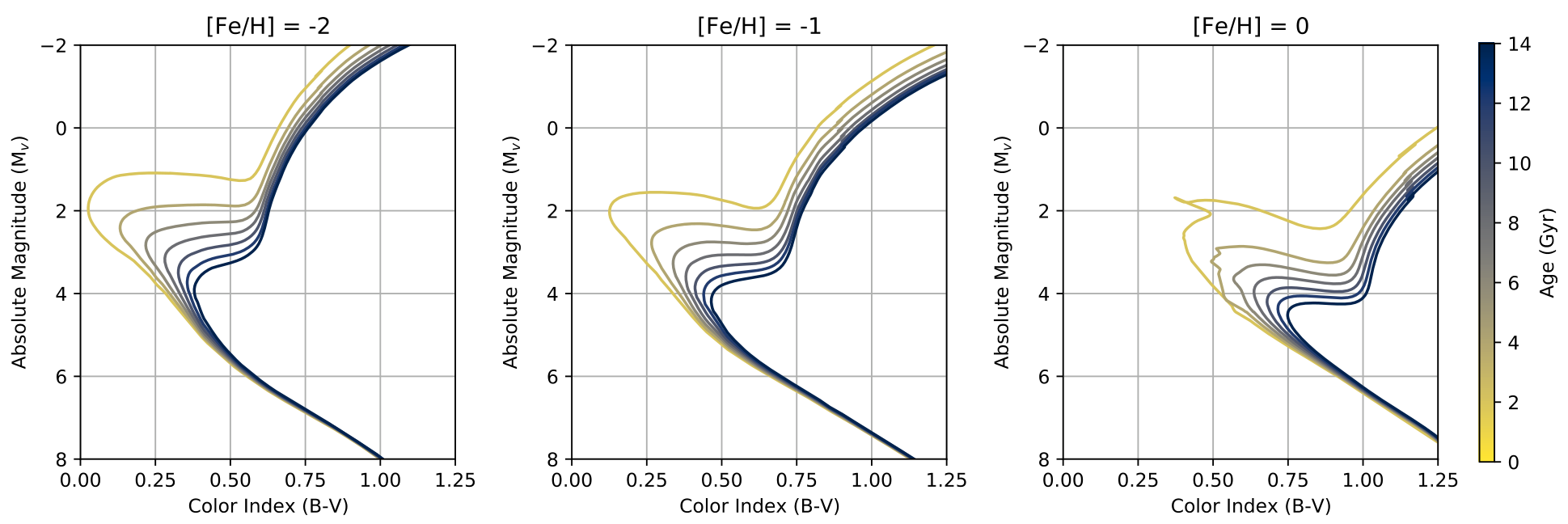
Notes:
- The isochrones plotted here use absolute magnitude on the y-axis, rather than apparent magnitude .
- The isochrones do not include every phase of stellar evolution.
- The data you plotted in part (a) will not perfectly fall along a single curve due to measurement scatter.
(b) (17 points) By comparing your H-R diagram to the isochrones, estimate:
(i) (5 points) the metallicity of the cluster (to the nearest integer).
(ii) (5 points) the age of the cluster (to the nearest Gyr).
(iii) (7 points) the distance to the cluster (to the nearest kpc).
(c) (5 points) Is this cluster more likely to be an open cluster or a globular cluster? Explain your reasoning.
Решение
Solution:
(a) The following scatter plot shows the data on the H-R diagram with several of the main features labeled:
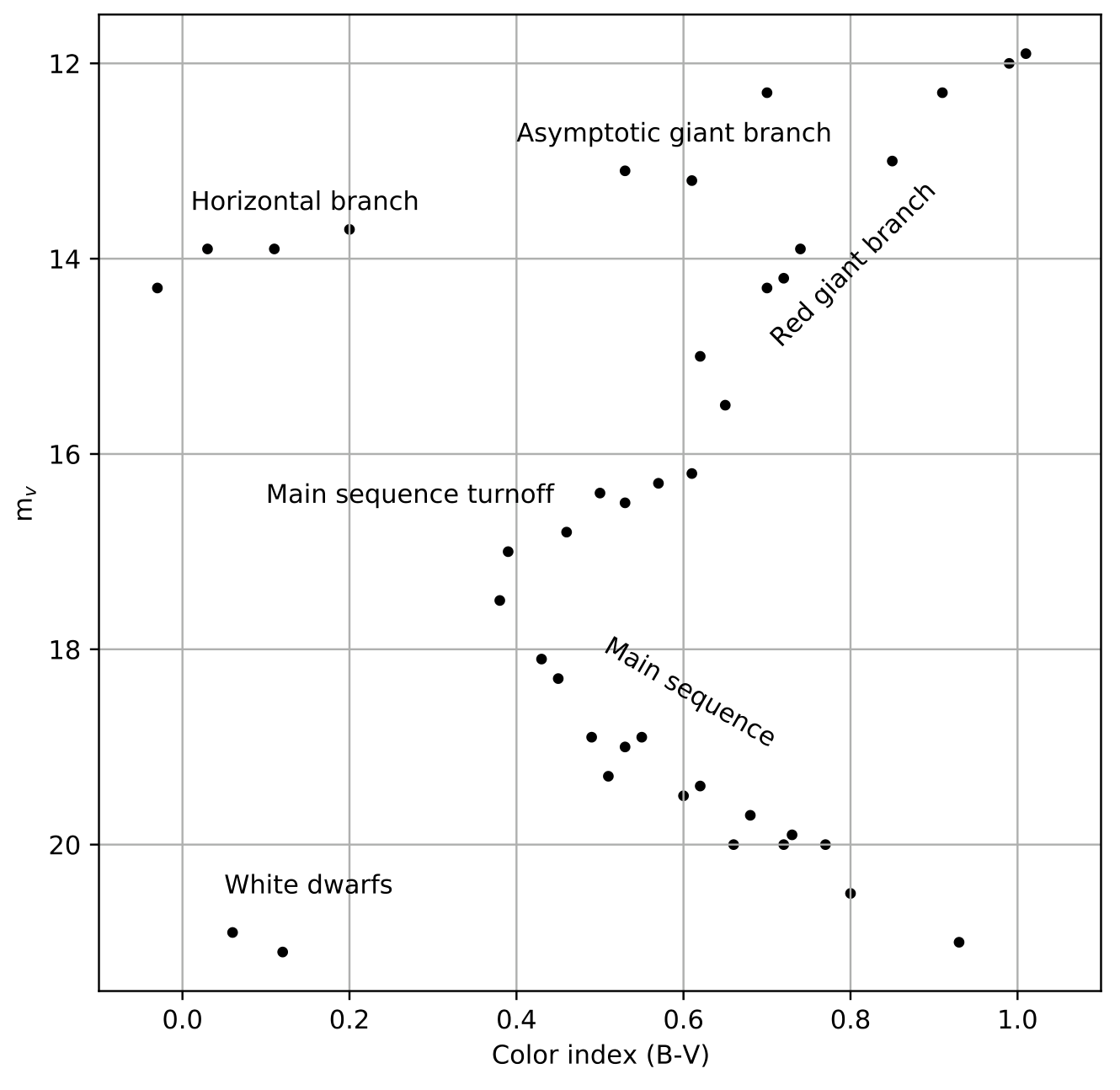
(9 points for a correctly drawn plot, 3 points for labeled axes, and 2 points per correctly labeled feature up to 3.)
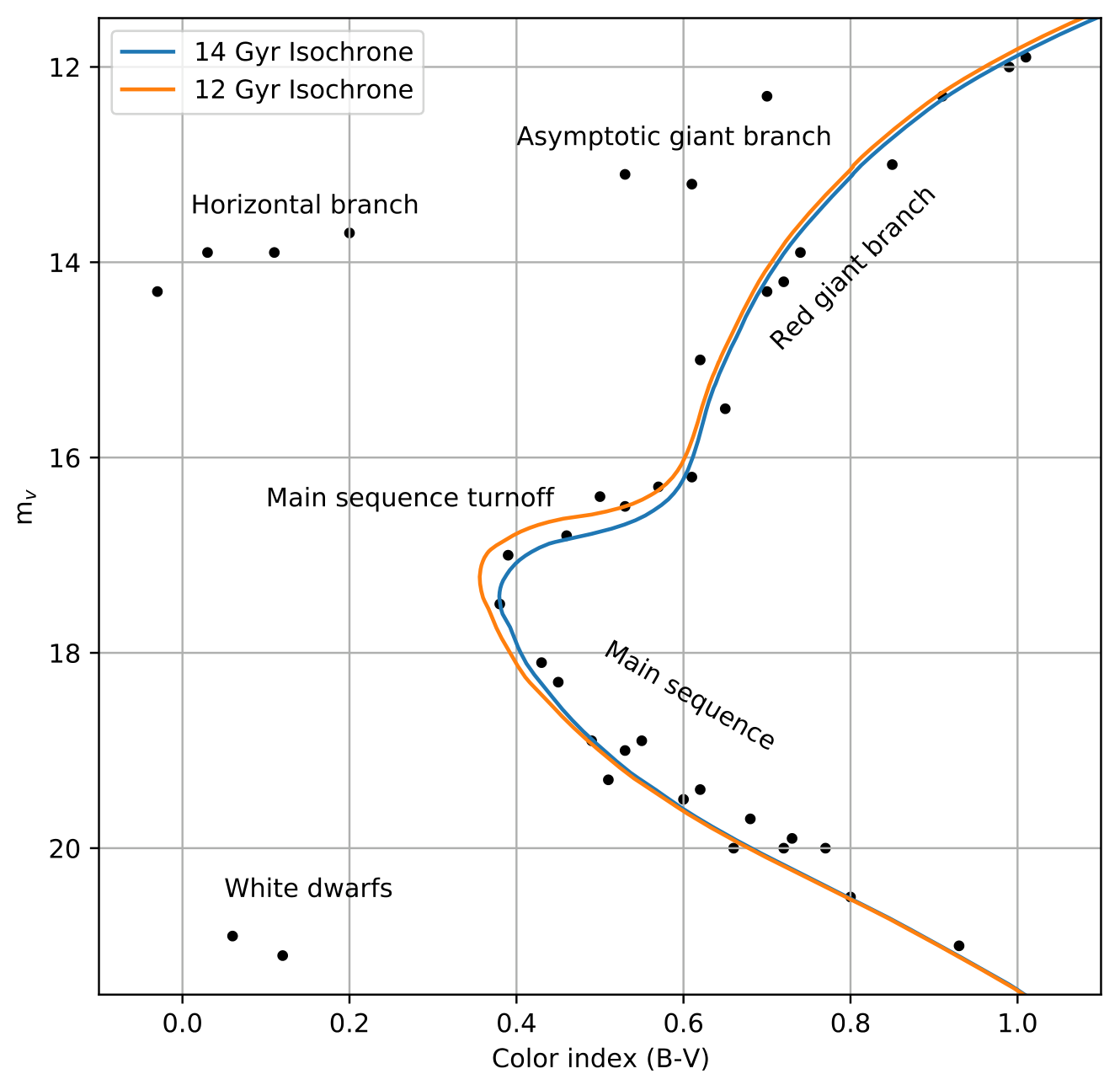
(b) The HR diagram plotted from the given data is a close visual match to isochrones with a metallicity [Fe/H] = -2 and an age of about 12-14 Gyr (formed in the early universe). One easy way to tell is to compare the shape and color index of the main sequence turnoff region.
(5 points for [Fe/H] = -2, 5 points for age from 12-14 Gyr.)
Note that the absolute magnitudes need to be shifted by an overall distance modulus to match the apparent magnitudes in the given data, so the magnitudes cannot be compared directly. Instead, it’s best to compare the color indices as well as the difference in magnitude between two points on the isochrone (so that the distance modulus cancels out.)
These two isochrones are plotted on top of the scatter plot for reference (with their magnitudes shifted using the distance modulus described below):
The difference between the apparent and absolute magnitudes is related to the distance to the cluster according to the distance modulus equation:
(2 points for applying this equation.)
Visually estimating, we have (2 points, acceptable range is 13 to 14). This gives (3 points, acceptable range is 3900 to 6400 pc).
(c) A metallicity of [Fe/H] = -2 is very low, containing only 1% the metal abundance of the Sun. Both this and an age of 12-14 Gyr are characteristic of globular clusters, rather than open clusters.
(5 points for correct answer with explained reasoning.)
Оригинал в Архива: usaaao2026.pdf · официални решения: usaaao2026_sol.pdf · допълнителни данни: physical-constants.pdf