USAPhO 1997, Полуфинал — Задача 1. A1
United States Physics Team — 1997 Exam 2
Указания
Entia non multiplicanda sunt praeter necessitatem
DO NOT OPEN THIS TEST UNTIL YOU ARE TOLD TO BEGIN
Please show all work, and do not hesitate to use explanatory words in addition to equations. Partial credit will be awarded.
Begin each problem on a fresh sheet of paper. In the upper right-hand corner of each page, write your name, problem number, and the page number/total number of pages for this problem (e.g., "A2, 3/4" for "Problem A2, page 3 of four").
You may use a non-programmable calculator, but may not use any tables, books, notes, or collections of formulas.
Work Part A first. You have ninety minutes to complete all four problems.
After you have completed Part A, you may take a break.
Then work Part B. You have 90 minutes to complete both problems.
Possibly useful information:
Gravitational field on Earth’s surface:
Gravitational constant:
Coulomb constant:
Speed of light in vacuum:
Permeability of empty space: , where
Ideal gas constant
Boltzmann’s constant:
Avagadro’s number:
1 electron volt =
Planck’s constant:
for for
for for
Условие
A laser may be constructed from two main components: a resonant cavity of length formed from two highly reflecting flat mirrors, and a gas-filled tube that emits light when excited by a high voltage. Placed inside the otherwise evacuated cavity, the tube creates light which bounces back and forth between the mirrors such that standing light waves are produced within the cavity. (The radiation can be let out through a tiny window in one of the mirrors, but in this problem we are interested in what goes inside the cavity.)
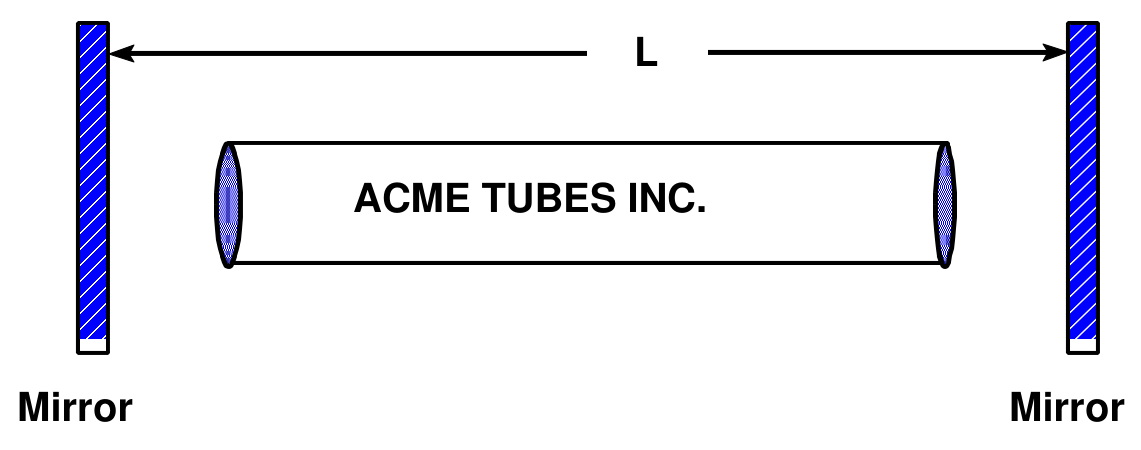
(a) What are the frequencies possible for the standing light waves in the cavity? Express your answer in terms of the cavity length and the speed of light in vacuum, . [5 т.]
(b) Suppose the plasma tube emits light of a pure frequency Hz. Which standing wave mode (specified by an integer ) is excited in the cavity if m? [5 т.]
(c) Suppose the plasma tube emits light not of a pure frequency, but emits light having all the frequencies in the range , where Hz, and Hz. How many standing wave modes are excited in the cavity if m? [5 т.]
(d) Using the and of part (c), what is the largest value of such that only one standing wave mode will be excited in the cavity, thereby giving the laser only one output frequency? [5 т.]
(Adapted from A.P. French, Vibrations and Waves, Norton, NY, 1971).
Отговори
- (a)
- (b)
- (c) 21
- (d) 15 cm
Решение
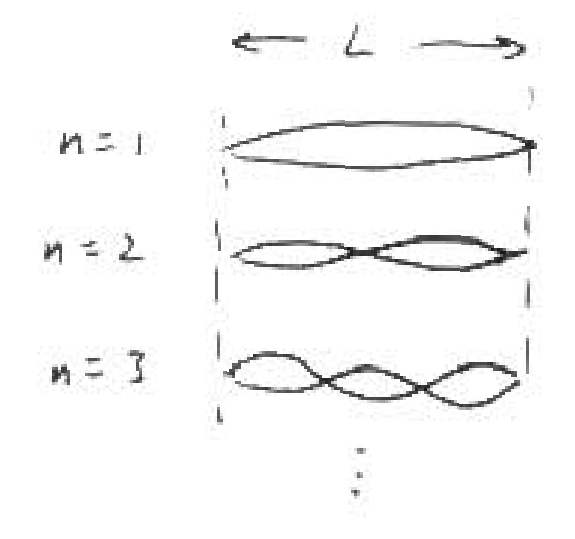
(a) The modes are
(b)
(c)
So the frequencies being excited into resonance are those corresponding to
(d) From (c), we note that as gets shorter, gets smaller ( is fixed by the plasma tube, not the cavity). Decreasing , the first modes to go away are , next is , etc. To lop off modes, the length must be as long as before (since ). Hence
Оригинал в Архива: Semifinal 1997.pdf · официални решения: Semifinal 1997 Solutions.pdf