USAPhO 1997, Полуфинал — Задача 4. A4
United States Physics Team — 1997 Exam 2
Указания
Entia non multiplicanda sunt praeter necessitatem
DO NOT OPEN THIS TEST UNTIL YOU ARE TOLD TO BEGIN
Please show all work, and do not hesitate to use explanatory words in addition to equations. Partial credit will be awarded.
Begin each problem on a fresh sheet of paper. In the upper right-hand corner of each page, write your name, problem number, and the page number/total number of pages for this problem (e.g., "A2, 3/4" for "Problem A2, page 3 of four").
You may use a non-programmable calculator, but may not use any tables, books, notes, or collections of formulas.
Work Part A first. You have ninety minutes to complete all four problems.
After you have completed Part A, you may take a break.
Then work Part B. You have 90 minutes to complete both problems.
Possibly useful information:
Gravitational field on Earth’s surface:
Gravitational constant:
Coulomb constant:
Speed of light in vacuum:
Permeability of empty space: , where
Ideal gas constant
Boltzmann’s constant:
Avagadro’s number:
1 electron volt =
Planck’s constant:
for for
for for
Условие
An atom in an excited state typically decays by emitting a photon. The atom is originally in some excited state , and after the decay it is in the ground state . We usually think of the photon as carrying away the energy difference between states and . In this problem we examine this process closely.
(a) Consider a stationary, isolated atom in some excited state . Before decay the mass of the atom is . The atom decays into the ground state . In the ground state the mass of the atom is . Thus the energy , which we denote here as , is the energy that is released by the atom, and is therefore an upper limit on the energy that the photon could possibly carry away ( is the speed of light). Let denote the energy of the outgoing photon. Without solving any equation, by merely giving an qualitative argument, explain why must be strictly less than in the case of an isolated excited atom undergoing radiative decay. [4 т.]
(b) Quantify your answer to part (a) by showing that, approximately,
, where . [6 т.]
(c) Consider an atom decaying from the excited state to the ground state , where eV and eV. A photon energy corresponds to a radiation frequency. Thus the energy difference corresponds to a frequency shift . Calculate the fractional frequency shift . [5 т.]
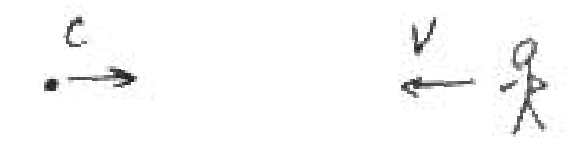
(d) Another way to produce a frequency shift is the Doppler effect, produced by relative motion between source and observer. The atom of part (c) emits the photon energy , which corresponds to light frequency . With what speed and in what direction would an observer have to move relative to this photon, to Doppler-shift its frequency back to the value corresponding to the energy ? The observer’s speed is . [5 т.]
Отговори
(a) To conserve momentum the atom must recoil, so it carries some kinetic energy K, leaving less than Eo for the photon.
(c) 0.000001
(d) 300 m/s
The observer must move towards the photon.
Решение
(a) To conserve momentum the atom must recoil. Thus after emitting the photon, the atom carries some kinetic energy , leaving less than for photon.
(b) Before decay: . After decay: atom , photon .
Conservation of Energy
Cons. of Momentum
[since the atom is heavy, and , or for atom]
or, relativistically,
[given since and are , and are too]
Conservation of Energy Equation becomes
[Alternate: Quadratic formula —
since take
Note: 2nd order needed in Binomial]
If then is negligible
(c) From part (b),
Using , and writing ,
(d) For , Doppler shift says
Since , the observer must move towards the photon
[Alternate: ; ; ; ; minus sign means that a decrease in corresponds to increase in frequency!]
(in magnitude)

Оригинал в Архива: Semifinal 1997.pdf · официални решения: Semifinal 1997 Solutions.pdf