Please show all work, and do not hesitate to use explanatory words in addition to equations. Partial credit will be awarded.
Begin each problem on a fresh sheet of paper. In the upper right-hand corner of each page, write your name, problem number, and the page number/total number of pages for this problem (e.g., "A2, 3/4" for "Problem A2, page 3 of four").
You may use a non-programmable calculator, but may not use any tables, books, notes, or collections of formulas.
Work Part A first. You have ninety minutes to complete all four problems.
After you have completed Part A, you may take a break.
Then work Part B. You have 90 minutes to complete both problems.
Possibly useful information:
Gravitational field on Earth’s surface: g=9.8N/kg
Gravitational constant: G=6.67×10⁻¹¹N-m2/kg2
Coulomb constant: k=1/4πϵo=8.99×109N-m2/C2
Speed of light in vacuum: c=3.00×10⁸m/s
Permeability of empty space: μo, where μoϵo=1/c2
Ideal gas constant R=8.31J/mol-K
Boltzmann’s constant: kB=1.38×10⁻²³J/K
Avagadro’s number: NA=6.02×10²³
1 electron volt = 1eV=1.60×10⁻¹⁹J
Planck’s constant: h=6.63×10⁻³⁴J-s=4.14×10⁻¹⁵eV-s
(1−x)−1=1+x+x2+x3+… for ∣x∣<1cosθ≈1−θ2/2 for θ≪1
(1+x)n=1+nx+(1/2!)n(n−1)x2+… for ∣x∣<1sinθ≈θ for θ≪1
Условие
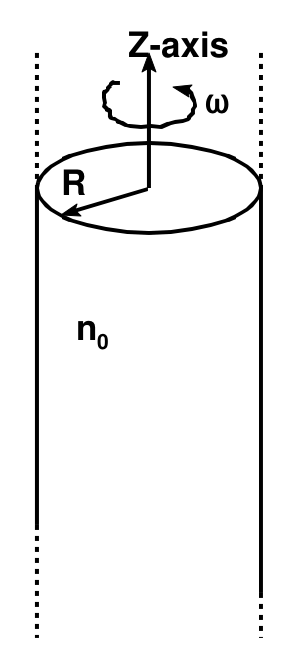
Consider an infinitely long, cylindrical cloud of electrons. The cloud has radius R, the number density of electrons has the uniform value no, the charge of each electron is −e (where e>0), and the mass of each electron is m. The cloud is surrounded by vacuum. There is a constant, uniform magnetic field along the cylinder's axis (the z-axis), so that B=Bok, with Bo>0. The cloud of electrons is rotating about the z-axis with angular velocity ω as shown in the figure. The speeds are non-relativistic. [A gas of charged particles is called a "plasma."]
(a) Find the electric field at the radius r<R within the cloud. [6 т.]
(b) Find the total force on an electron located at the radius r within the cloud, neglecting any magnetic field induced by the cloud's rotation. (This neglect will be justified in part (f) below.) [6 т.]
(c) Using Newton's second law, show that there are two values of ω possible for the electrons to steadily orbit the cylinder's axis. Write these values of ω in terms of two other frequencies relevant to such problems: the cyclotron frequency ωc=eBo/m, and the "plasma frequency" ωp=[noe2/ϵom]1/2, where ϵo is the permittivity of empty space. [8 т.]
(d) Find the largest electron number density (no)max that can be confined by the applied magnetic field Bok. Write your answer in terms of the magnetic field energy density B2/2μo and the electron's mass energy mc2. [6 т.]
[This theoretical limit is called the Brillouin limit, and plays a key role in the confinement of plasmas consisting of particles all of like charge.]
(e) At a point located at radius r within the cylindrical cloud, calculate the magnetic field induced by the cloud's rotation. Assume that the field induced on the axis of symmetry is zero. [8 т.]
(f) Determine the force on a charge in the cloud, due to the induced magnetic field of part (e). Show that the magnitude of this force divided by the magnitude of the electric force is v2/c2, where v is the speed of the charge and c is the speed of light. [This shows that the effect of the induced field is ignorable when the rotation speeds are non-relativistic.] [6 т.]
Отговори
(a)E=2ϵonoer(−r^)
(b)F=(2ϵonoe2r−rωBoe)r^
(c)ω=2ωc(1±1−2(ωcωp)2)
(d)(no)max=2mBo2ϵo=mc2Bo2/2μo
(e)B′=μonoeω2r2
(f)F′=2μonoe2ω2r3(−r^),∣Fel.∣∣F′∣=c2v2
Решение
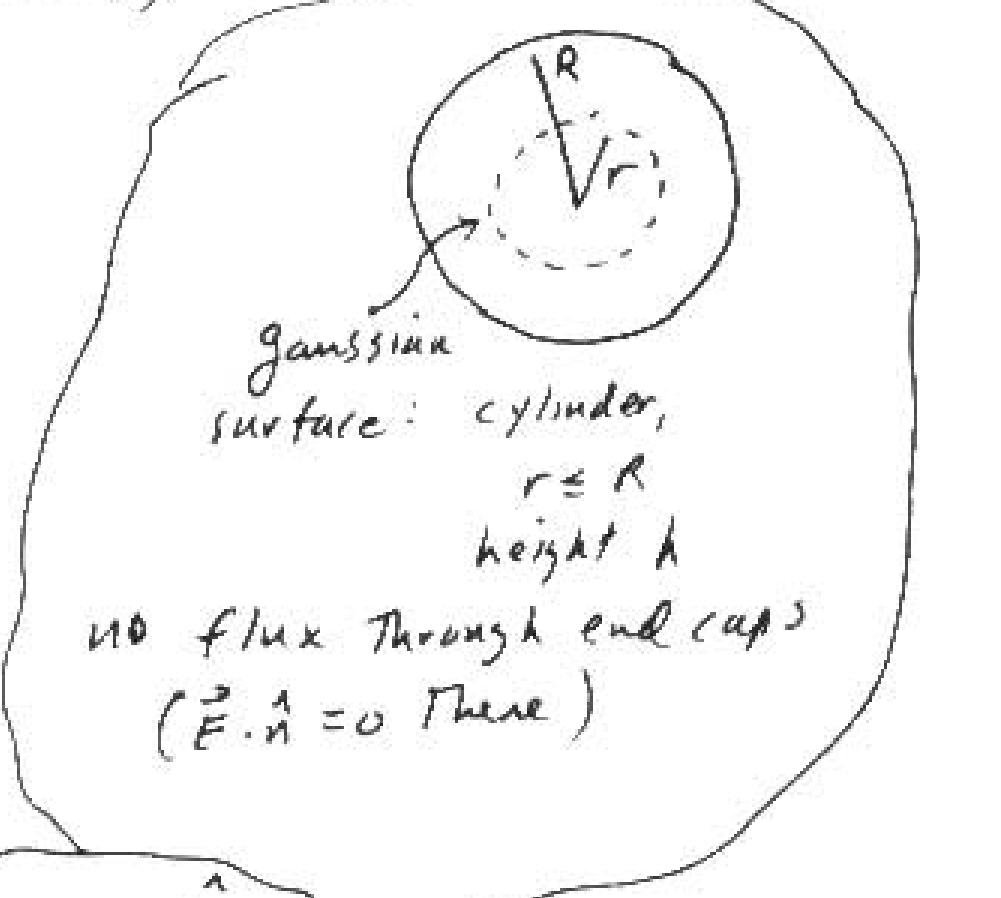
(a) Use Gauss' law:
flux of E=ϵo1(charge enclosed)
E2πrh=ϵo1(noe)(πr2h)
E=(2ϵonoe)r
E=2ϵonoer(−r^)radially in
[gaussian surface: cylinder, r≤R, height h; no flux through end caps (E⋅n^=0 there)]
(b)
F=q(E+v×B)=−e[−2ϵonoerr^+rωBor^]
[B=Bok^, v=rωθ^, θ^×k^=r^]
F=(2ϵonoe2r−rωBoe)r^
(c)
F=ma
(2ϵonoe2r−rωBoe)r^=mr(rω)2(−r^)
⇒2ϵonoe2−ωBoe+mω2=0
ω2−(mBe)ω+2ϵomnoe2=0
ω2−ωcω+21ωp2=0
[ωc≡mBoe, ωp2≡ϵomnoe2]
ω=2ωc±21ωc2−2ωp2
ω=2ωc1±1−2(ωcωp)2
(d) Since ω is real, this requires
1−2(ωcωp)2≥0
ωp2≤21ωc2
ϵomnoe2≤21m2e2Bo2
no≤2mBo2ϵoso(no)max=2mBo2ϵo
(e)
(no)max=2mBo2ϵouse μoϵo=c21
=2m(μoc2)Bo2
=mc2Bo2/2μo=electron mass energymagnetic field energy density
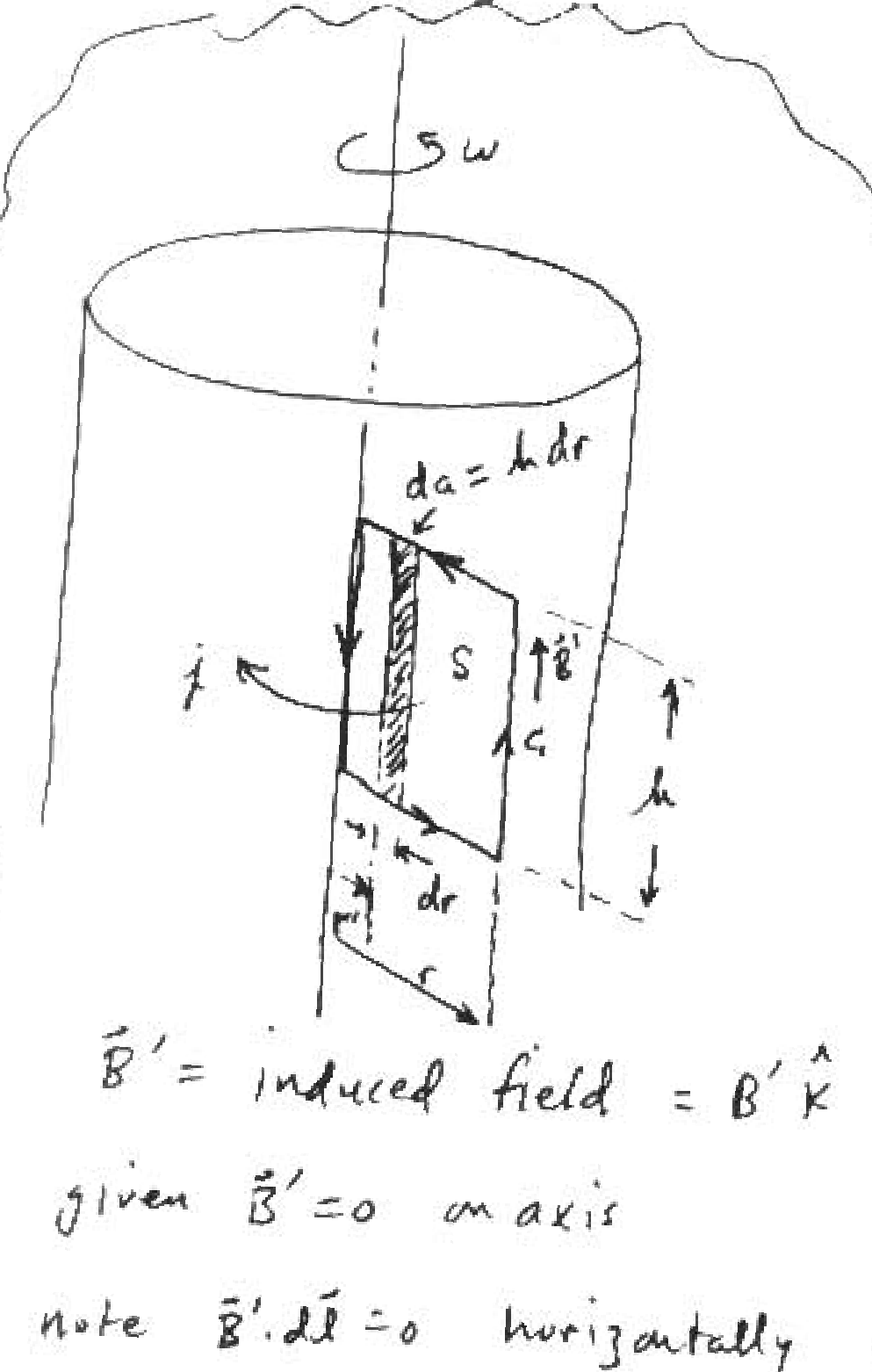
(e) Apply Ampere's law,
∮CB⋅dl=μoISwhere C=boundary of S
B′h=μo∫Sjda
where
j=current density=(noe)v=noer′ω
(or ΣrΔr)
B′h=μo(noeω)∫0rr′(dr′h)
B′h=μonoeωh∫0rr′dr′
B′=μonoeω2r2
[B′ = induced field =B′k^; given B′=0 on axis; note B′⋅dl=0 horizontally]
(f) Force due to induced magnetic field is F′ where