USAPhO 1997, Полуфинал — Задача 6. B2
United States Physics Team — 1997 Exam 2
Указания
Entia non multiplicanda sunt praeter necessitatem
DO NOT OPEN THIS TEST UNTIL YOU ARE TOLD TO BEGIN
Please show all work, and do not hesitate to use explanatory words in addition to equations. Partial credit will be awarded.
Begin each problem on a fresh sheet of paper. In the upper right-hand corner of each page, write your name, problem number, and the page number/total number of pages for this problem (e.g., "A2, 3/4" for "Problem A2, page 3 of four").
You may use a non-programmable calculator, but may not use any tables, books, notes, or collections of formulas.
Work Part A first. You have ninety minutes to complete all four problems.
After you have completed Part A, you may take a break.
Then work Part B. You have 90 minutes to complete both problems.
Possibly useful information:
Gravitational field on Earth’s surface:
Gravitational constant:
Coulomb constant:
Speed of light in vacuum:
Permeability of empty space: , where
Ideal gas constant
Boltzmann’s constant:
Avagadro’s number:
1 electron volt =
Planck’s constant:
for for
for for
Условие
An unmanned space probe approaches the surface of a planet whose atmosphere is pure CO (molecular weight gm/mol). Upon entering atmosphere, the probe descends straight down at a constant speed , recording information about the atmospheric pressure, which is shown on the attached graph. Unfortunately, a technician forgot to calibrate the pressure-measuring instrument, so that the -axis on the pressure vs. time graph has no units! (The technician has been reprimanded, but fortunately, as leader of the data analysis team, you have figured out how to use the data anyway.) Upon reaching the planet’s surface, the probe reports the surface temperature to be 400 K, and the gravitational field there to be 9.9 N/kg. The radius of the planet is m. Model the atmosphere locally as an ideal gas.
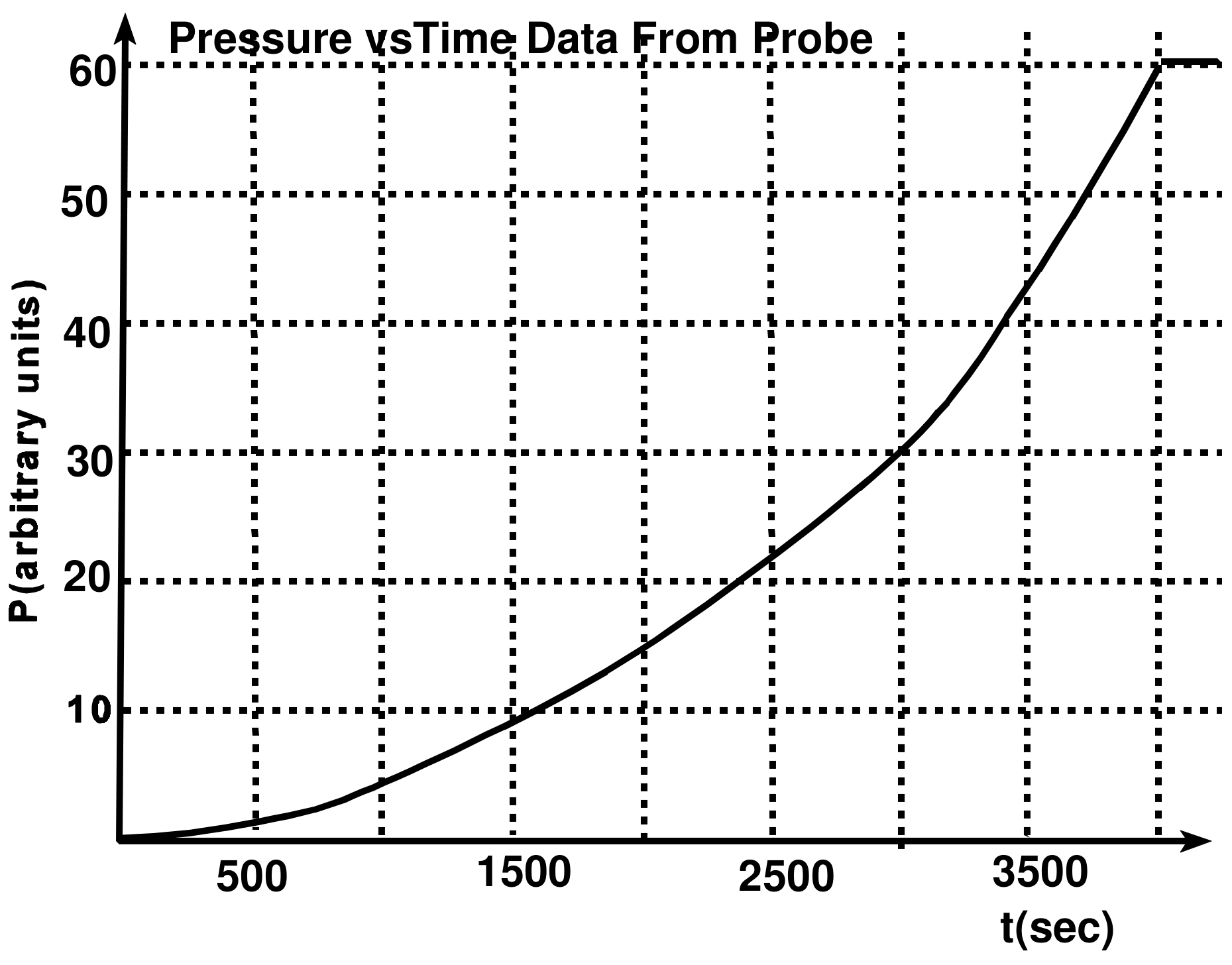
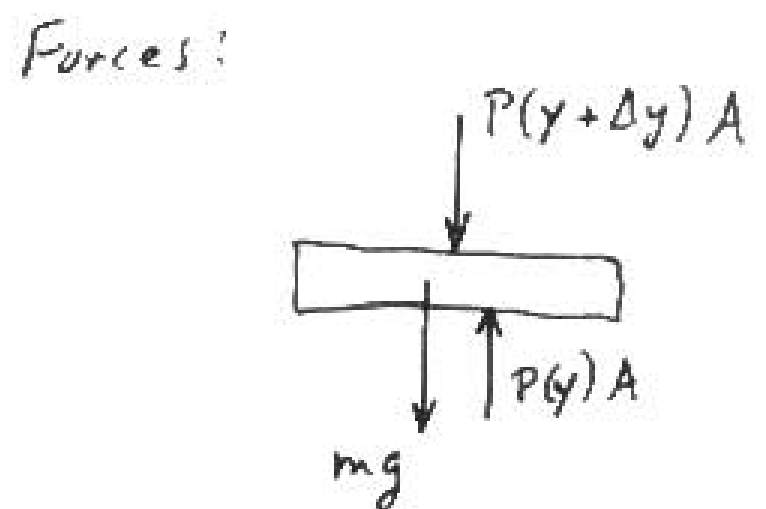
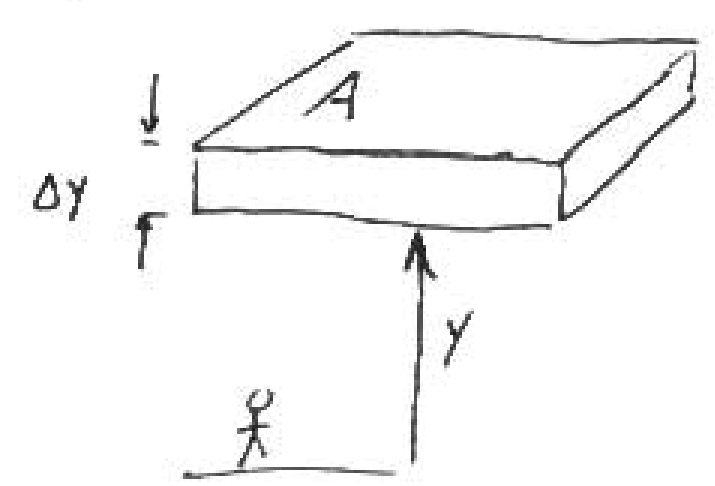
(a) Apply Newton’s Second Law to a small slab of the atmosphere of thickness that is in static equilibrium, to show that the change in pressure between the top and bottom sides of the slab is given by , where the atmosphere’s density and is the local gravitational field (the plus or minus sign is determined by the choice for the positive direction of the vertical -axis; work out the sign in terms of your choice). [5 т.]
(b) Estimate the velocity with which the probe descends to the surface. [15 т.]
(c) Estimate the temperature of the atmosphere 15 km above the surface. Neglect the variation of the planet’s gravitational field between the surface and this height. [15 т.]
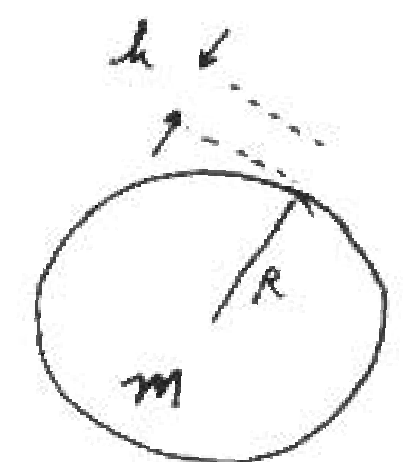
(d) Justify the neglect of the variation of the planet’s gravitational field between the surface and 15 km above the surface. Suggestion: Calculate the fractional difference between the gravitational field’s magnitude on the surface and its value 15 km above the surface, and assess whether that difference is significant compared to the accuracy of the estimate made in part (c). [5 т.]
Отговори
(a) With y positive upwards, ΔP = −ρgΔy.
(b) 6.4 m/s
(c) 367 K
(d) 0.006
Δg/go = 2h/R = 6×10⁻³, much smaller than the accuracy of the estimate in part (c).
Решение
(a) Apply to a slab of atmosphere of thickness , cross-sectional area , density . Take positive upwards.
Forces: (down), (up), (down).
[note , ]
(b) Since (probe going down, points up)
gives
Need : From ideal gas eq. of state ,
Using from (2) in (1),
From graph, probe lands on surface at s
[From graph: at surface
[line from (3900, 55) to (4000, 60) is straight]]
From Eq. (3),
(c) Probe was 15 km above surface
at s, units
slope at s is about the same as slope of line from (1500 s, 9 units) to (2000 s, 15 units)
to two sig. figures (like slope found above)
From Eq. (3),
(d)
where
In part (c), the estimate of and at 15 km above the surface was much cruder than 6 parts out of a thousand.
Оригинал в Архива: Semifinal 1997.pdf · официални решения: Semifinal 1997 Solutions.pdf