USAPhO 1998, Четвъртфинал — Задача 2
1998 Creative Response Portion of Exam 1 · 25 т.
Указания
DO NOT OPEN THIS TEST UNTIL YOU ARE TOLD TO BEGIN
Show all work, as partial credit may be earned.
Communicate! Only that which is written can be graded.
A hand-held calculator may be used. Its memory must be cleared of data and programs. Calculators may not be shared.
Possibly useful information:
Gravitational field at Earth’s surface:
Newton’s gravitational constant:
Coulomb’s constant:
Elementary charge:
Binomial expansion: whenever
Concerning double jeopardy
Some problems require answers to be used in subsequent parts. Incorrect answers should be penalized only once. Correct reasoning should be acknowledged.
Условие
(a, 5) A certain linear spring is stretched by the amount when a block of mass hangs vertically from it at rest. Find the spring constant . (Throughout this entire problem, neglect the mass of the spring.) [5 т.]
(b, 10) One end of this same spring is now fastened to a rigid vertical wall, and the block of mass is attached to the other end of the spring such that this block rests on the surface of a horizontal table (see diagram). By means of strings and a pulley of negligible mass, another 1 kg mass hangs as shown. The system is released from a state of rest, with the spring initially relaxed. The coefficient of sliding friction between the block and the table has the value of . Find the maximum stretch of the spring. Neglect air resistance.
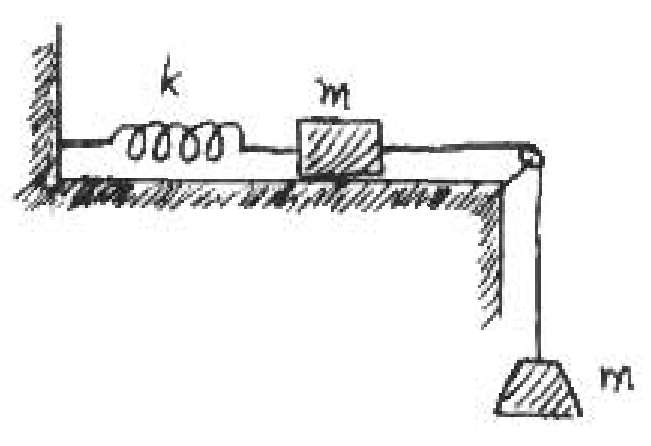
[10 т.]
(c, 10) If the friction between the block and the table were removed, what would be the period of the system’s oscillation? [10 т.]
Отговори
- (a, 5) 49 N/m
- (b, 10) 0.3 m
- (c, 10) 1.27 s
Решение
(a, 5) becomes (3)
so that . (2)
(b, 10) One may use the work-energy theorem,
(3)
where is the work done by non-conservative forces and is the total mechanical energy. With the zero of gravitational P.E. at the initial position of the hanging mass, becomes
(4)
The solution gives . (3)
(c, 10) The system is equivalent to a particle of mass being pulled in one direction by the force , in the opposite direction by the force . Thus, Newton’s second law gives
(3)
which says , which is the equation of motion of a simple harmonic oscillator (in a uniform gravitational field), with angular frequency . (4)
[Alternatively, if the student notes that the angular frequency squared equals divided by the mass that is oscillating, and notes that is the mass that oscillates, give full credit for part (c) up to here.]
Next, convert to period: gives . (3)
Теми и трудност
Трудност: неоценена.
Механика · Работа и енергия · Механични трептения · Триене
Предпоставки: Разширена олимпиадна подготовка
Оригинал в Архива: Quarterfinal 1998.pdf · официални решения: Quarterfinal 1998 Solutions.pdf