USAPhO 1998, Четвъртфинал — Задача 3
1998 Creative Response Portion of Exam 1 · 25 т.
Указания
DO NOT OPEN THIS TEST UNTIL YOU ARE TOLD TO BEGIN
Show all work, as partial credit may be earned.
Communicate! Only that which is written can be graded.
A hand-held calculator may be used. Its memory must be cleared of data and programs. Calculators may not be shared.
Possibly useful information:
Gravitational field at Earth’s surface:
Newton’s gravitational constant:
Coulomb’s constant:
Elementary charge:
Binomial expansion: whenever
Concerning double jeopardy
Some problems require answers to be used in subsequent parts. Incorrect answers should be penalized only once. Correct reasoning should be acknowledged.
Условие
Two small but heavy metal beads, each of mass , are soldered to a thin rigid rod of length . One bead is soldered halfway along the rod, and the second bead is soldered at one end of the rod. The other end of the rod is connected to the ceiling by a frictionless pivot, making a pendulum of the rod and two beads (see the sketch). The mass of the rod is negligible, as is air resistance. This pendulum is pulled to one side such that it is initially horizontal (). The pendulum is then released and swings down, with decreasing from through .
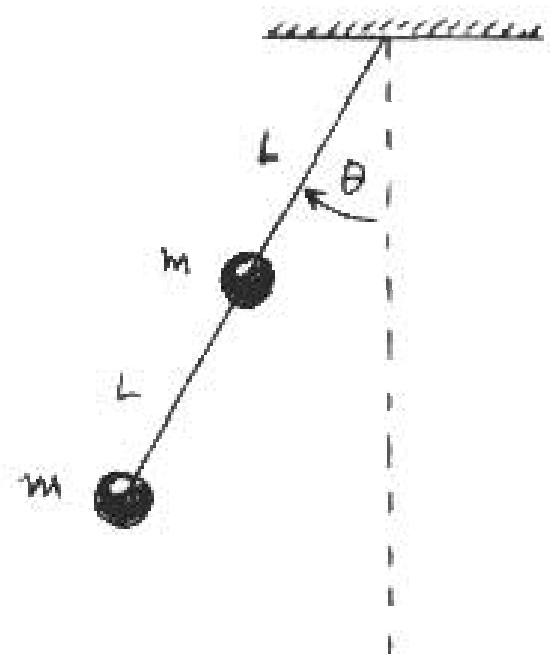
(a, 9) Find the speed of each bead when the rod is vertical (), assuming for now that neither section of the rod breaks. [9 т.]
(b, 16) Either section of the rod will break if subjected to a tension force of or greater. In the motion described above, does either section break? If so, find the angle at which it breaks. [16 т.]
Отговори
- (a, 9)
- (b, 16) The upper rod breaks at θ=41.4°; the lower rod does not break.
Решение
(a, 9) One may apply conservation of energy, , (2)
and obtain (choosing P.E. = 0 at ):
which simplifies to
(3)
We note that for all , and . (2)
Hence, and (1)
so that, at , and (1)
(b, 16)
Consider the bottom mass (mass #2) [6 points to be earned here]:
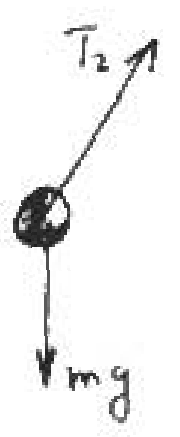
The radial component of becomes
(3)
Using the result from part (a), one finds
(2)
which is for all , so the lower rod does not break. (1)
[Note: if the student says “we need consider only the top rod because if either rod breaks it must be the top one,” award the (1) point for this conclusion; however, the the student will still need to find as a function of in order to determine the angle where the upper rod breaks.]
Consider next the upper mass (mass #1) [10 points to be earned here]:
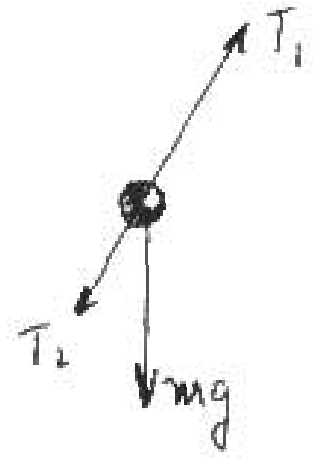
The radial component of becomes
(5)
Using and , one obtains
. (3)
Thus, will equal when . (2)
Теми и трудност
Трудност: неоценена.
Механика · Въртене на твърдо тяло · Работа и енергия · Движение по окръжност
Предпоставки: Разширена олимпиадна подготовка
Оригинал в Архива: Quarterfinal 1998.pdf · официални решения: Quarterfinal 1998 Solutions.pdf