USAPhO 1998, Полуфинал — A2
1998 Exam 2 · 25 т.
1998 Exam 2 — INSTRUCTIONS
United States Physics Team
Entia non multiplicanda sunt praeter necessitatem
- DO NOT OPEN THIS TEST UNTIL YOU ARE GIVEN THE SIGNAL TO BEGIN.
- Work Part A first. You have 90 minutes to complete all four problems.
- After you have completed Part A, you may take a break.
- Then work Part B. You have 90 minutes to complete both problems.
- Show all work, as partial credit may be earned.
- Begin each problem on a fresh sheet of paper. In the upper right-hand corner of each page, write your name (last name first), the problem number, and the page number / total number of pages for that particular problem, for example:
Einstein, Albert
A2 - 3/4 for “Problem A2, page 3 of 4”
- A hand-held calculator may be used. Its memory must be cleared of data and programs. You may not use any books, notes, tables, or collections of formulas.
- Best wishes for an outstanding exam!
Possibly useful information
| Quantity | Value |
|---|---|
| Gravitational field at Earth’s surface | N/kg |
| Newton’s gravitational constant | N·m/kg |
| Coulomb’s constant | N·m/C |
| Biot-Savart constant | N·s/C |
| Speed of light in vacuum | m/s |
| Boltzmann’s constant | J/K |
| Avogadro’s number | mol |
| Ideal gas constant | J/mol-K |
| Elementary charge | C |
| 1 electron volt | J |
| Planck’s constant | |
| Electron mass | |
| Binomial expansion | whenever |
| Small-angle approximations | , whenever |
Copyright © 1998, AAPT
Условие
Two uniformly charged balls each have mass and carry electric charge . Each ball is tied to a string of length and negligible mass. The other ends of the strings are tied to a hook in the ceiling. When the balls are in equilibrium the strings stand apart with the angle between them.
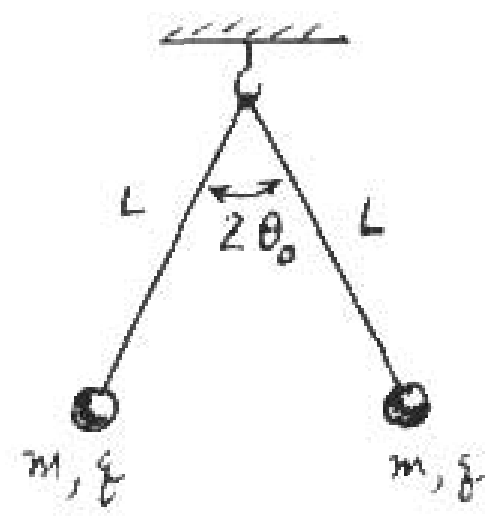
a. Find an expression for in terms of the given quantities and known constants. Neglect the gravitational force which the balls exert on each other. [7 т.]
b. Now let both balls be displaced an additional angle . Find the magnitude of the new electric force which one ball exerts on the other one. In particular, show that where is the electric force’s magnitude for the situation of part (a). Along with the binomial expansion, the following approximations may be useful:
[6 т.]
c. When the balls are released from the angle , each ball undergoes an oscillation about its equilibrium position (assume that the balls move only in the original plane of the two strings). Find an expression for the period of this oscillation in terms of given quantities and known constants. Neglect air resistance. [10 т.]
d. Evaluate for degrees, where is the period of a simple pendulum of length . [2 т.]
Решение
a. (7 т.)
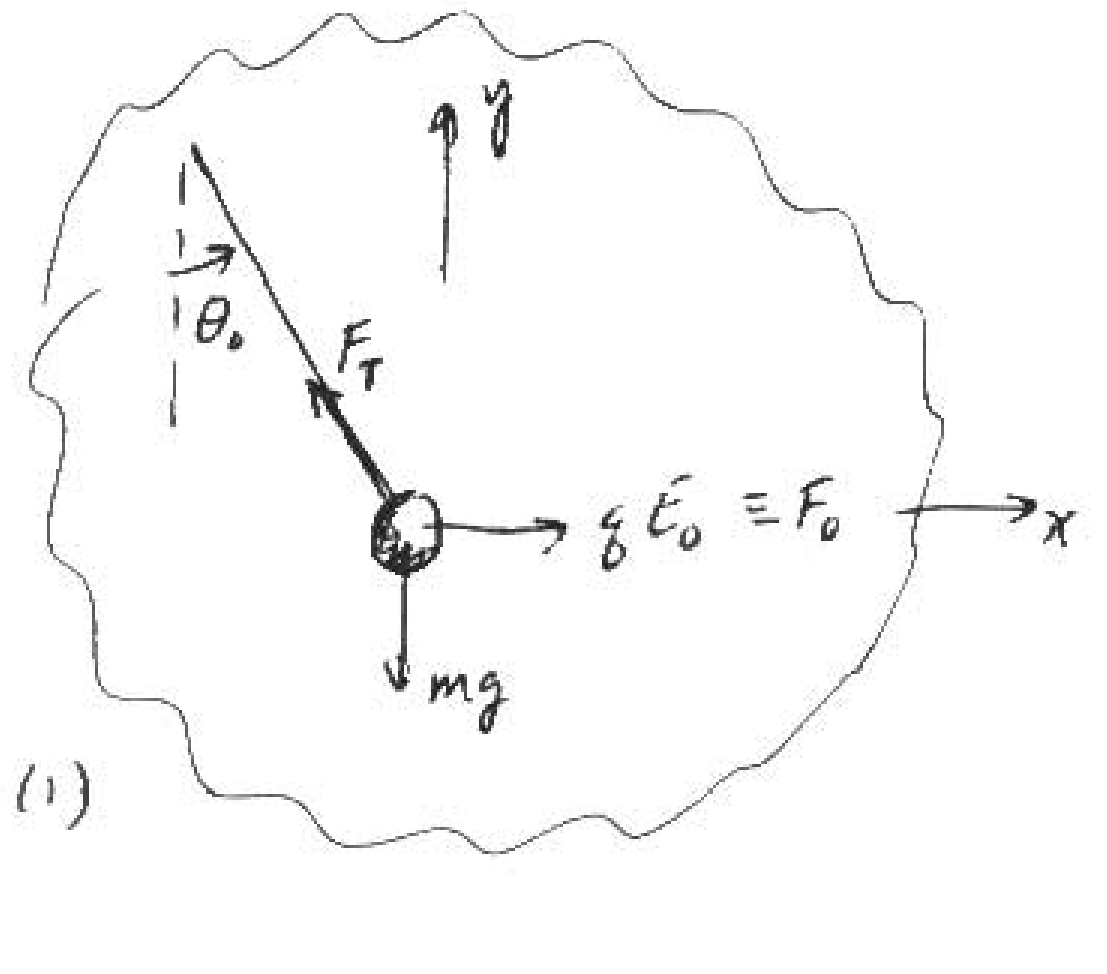
: .
: .
b. (6 т.)
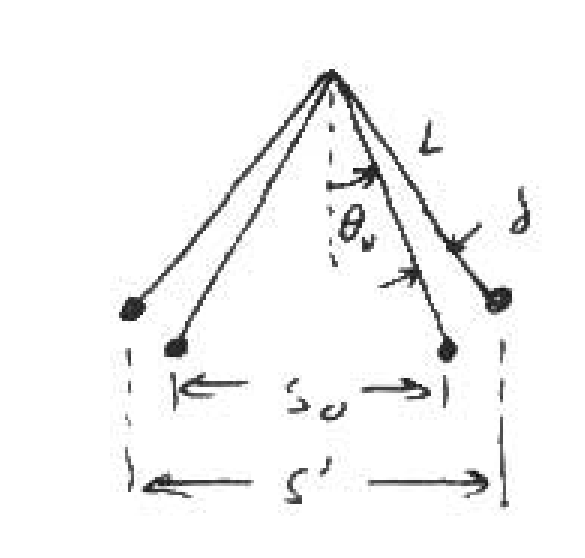
c. (10 т.)
Apply about hook.
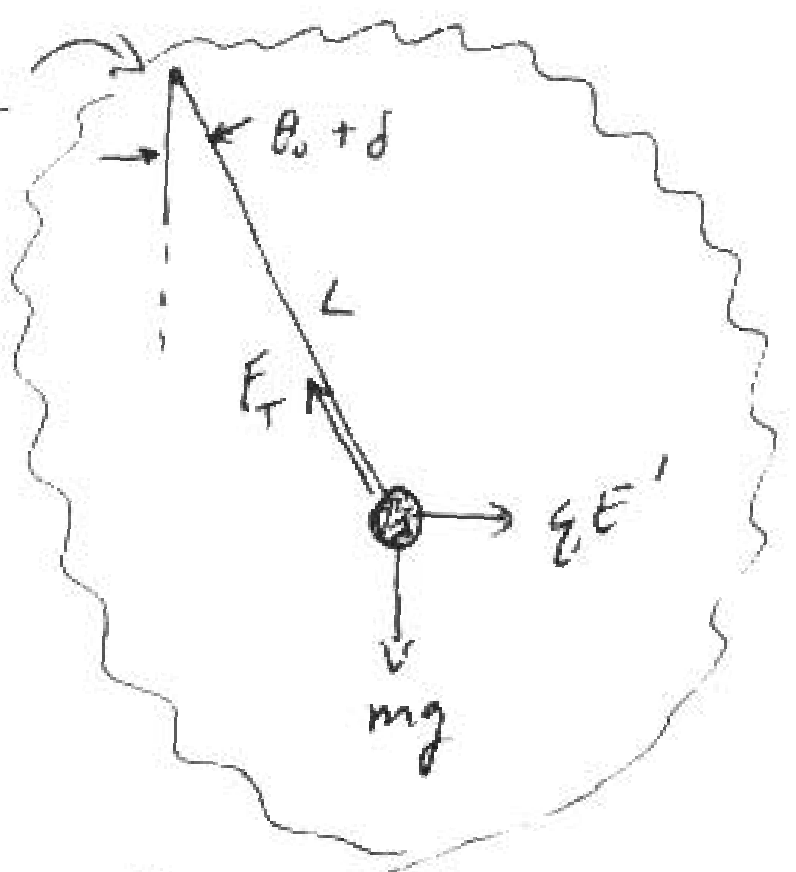
Use Eq. (1), . To , Eq. (2) becomes
d. (2 т.)
At , .
Оригинал в Архива: Semifinal 1998.pdf · официални решения: Semifinal 1998 Solutions.pdf