USAPhO 1998, Полуфинал — A3
1998 Exam 2 · 25 т.
1998 Exam 2 — INSTRUCTIONS
United States Physics Team
Entia non multiplicanda sunt praeter necessitatem
- DO NOT OPEN THIS TEST UNTIL YOU ARE GIVEN THE SIGNAL TO BEGIN.
- Work Part A first. You have 90 minutes to complete all four problems.
- After you have completed Part A, you may take a break.
- Then work Part B. You have 90 minutes to complete both problems.
- Show all work, as partial credit may be earned.
- Begin each problem on a fresh sheet of paper. In the upper right-hand corner of each page, write your name (last name first), the problem number, and the page number / total number of pages for that particular problem, for example:
Einstein, Albert
A2 - 3/4 for “Problem A2, page 3 of 4”
- A hand-held calculator may be used. Its memory must be cleared of data and programs. You may not use any books, notes, tables, or collections of formulas.
- Best wishes for an outstanding exam!
Possibly useful information
| Quantity | Value |
|---|---|
| Gravitational field at Earth’s surface | N/kg |
| Newton’s gravitational constant | N·m/kg |
| Coulomb’s constant | N·m/C |
| Biot-Savart constant | N·s/C |
| Speed of light in vacuum | m/s |
| Boltzmann’s constant | J/K |
| Avogadro’s number | mol |
| Ideal gas constant | J/mol-K |
| Elementary charge | C |
| 1 electron volt | J |
| Planck’s constant | |
| Electron mass | |
| Binomial expansion | whenever |
| Small-angle approximations | , whenever |
Copyright © 1998, AAPT
Условие
A certain metal has various energy levels for the electrons in its atoms. Assuming the energy of a free electron at rest is zero, the first five energy levels of the electrons in the metal’s atoms are as follows:
| State | Energy |
|---|---|
| State 1 | eV |
| State 2 | eV |
| State 3 | eV |
| State 4 | eV |
| State 5 | eV |
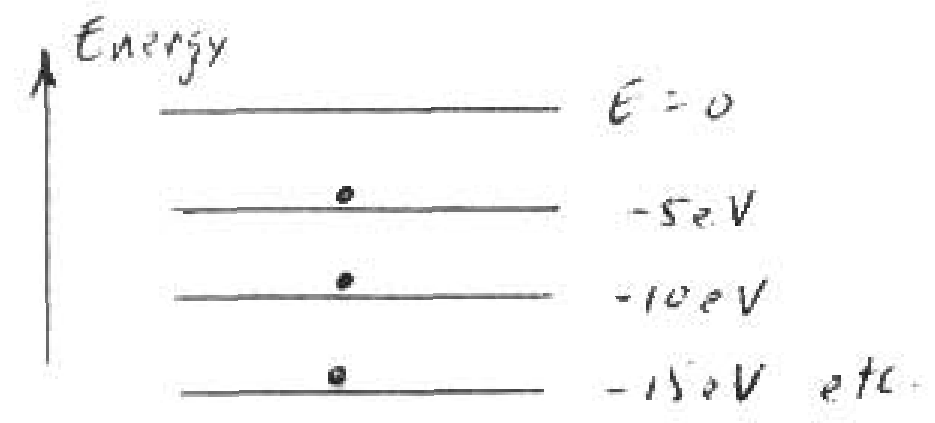
a. In this part of the problem we will see what the wave model of light predicts for the ability of light to free the electrons from the metal surface. Suppose the intensity of light irradiating the metal is 0.01 W/m and the density of surface electrons is electrons per square meter. Calculate the minimum time required to liberate an electron from the metal surface, assuming that this energy falling on the metal can be absorbed by the electrons, so that they will be ejected as soon as they acquire sufficient energy. [7 т.]
b. Unfortunately for the wave model’s result suggested by part (a), experiments show that, even when the intensity of the light is very low, some electrons are liberated in less than s, provided the frequency of the light is above a specific minimum value. Calculate this minimum frequency for the metal described above. [5 т.]
c. Suppose the metal surface is irradiated with photons corresponding to the frequency Hz. Calculate the kinetic energies of the electrons that originally occupied States 1 through 5. (If you like, you may leave your answers in units of electron volts.) [8 т.]
d. The electrons liberated from the metal by the photons of part (c) form an electric current. What minimum stopping voltage would be required to halt the motion of every liberated electron, and thus bring the current to zero? [5 т.]
Решение
a. (7 т.)
Min. energy required is 5 eV.
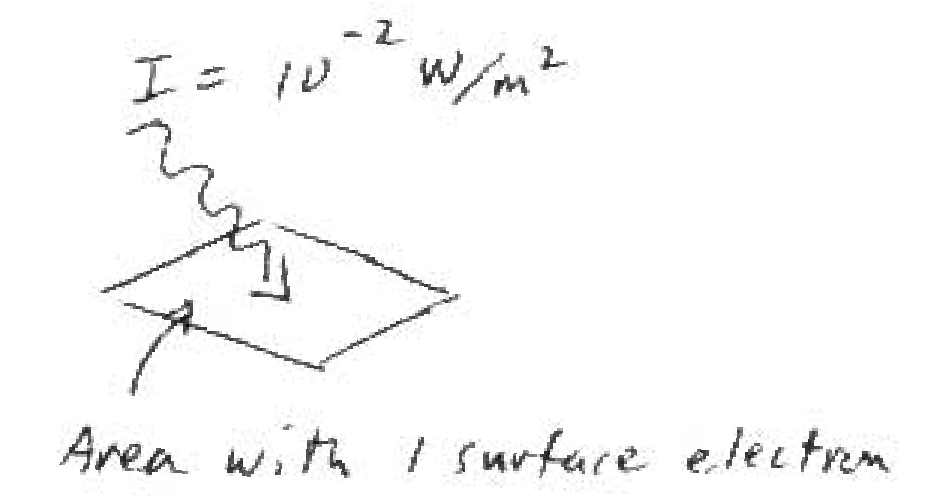
Area with 1 surface electron:
b. (5 т.)
c. (8 т.)
: incoming photon energy; : K.E. left over; : what it costs to liberate electron.
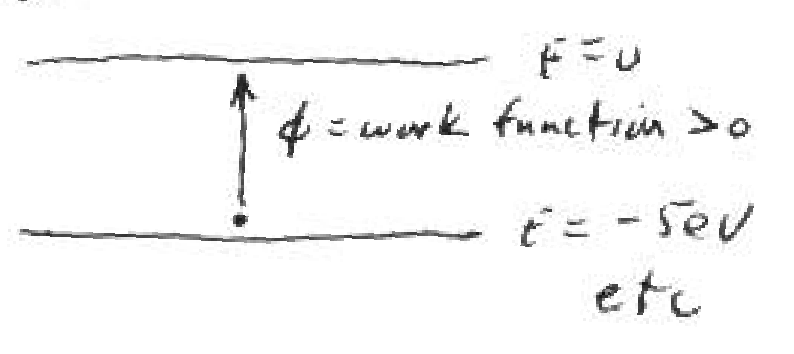
| State | Kinetic energy |
|---|---|
| 1 | |
| 2 | |
| 3 | |
| 4 | — |
| 5 | — |
K.E. cannot be .
d. (5 т.)
Оригинал в Архива: Semifinal 1998.pdf · официални решения: Semifinal 1998 Solutions.pdf