USAPhO 1998, Полуфинал — A4
1998 Exam 2 · 25 т.
1998 Exam 2 — INSTRUCTIONS
United States Physics Team
Entia non multiplicanda sunt praeter necessitatem
- DO NOT OPEN THIS TEST UNTIL YOU ARE GIVEN THE SIGNAL TO BEGIN.
- Work Part A first. You have 90 minutes to complete all four problems.
- After you have completed Part A, you may take a break.
- Then work Part B. You have 90 minutes to complete both problems.
- Show all work, as partial credit may be earned.
- Begin each problem on a fresh sheet of paper. In the upper right-hand corner of each page, write your name (last name first), the problem number, and the page number / total number of pages for that particular problem, for example:
Einstein, Albert
A2 - 3/4 for “Problem A2, page 3 of 4”
- A hand-held calculator may be used. Its memory must be cleared of data and programs. You may not use any books, notes, tables, or collections of formulas.
- Best wishes for an outstanding exam!
Possibly useful information
| Quantity | Value |
|---|---|
| Gravitational field at Earth’s surface | N/kg |
| Newton’s gravitational constant | N·m/kg |
| Coulomb’s constant | N·m/C |
| Biot-Savart constant | N·s/C |
| Speed of light in vacuum | m/s |
| Boltzmann’s constant | J/K |
| Avogadro’s number | mol |
| Ideal gas constant | J/mol-K |
| Elementary charge | C |
| 1 electron volt | J |
| Planck’s constant | |
| Electron mass | |
| Binomial expansion | whenever |
| Small-angle approximations | , whenever |
Copyright © 1998, AAPT
Условие
This problem describes a real situation once faced by Federal Aviation Administration engineers. In Florida, where there are frequent thunderstorms, the FAA experienced a large number of communications equipment failures. Suspecting lightning strikes, a power recording monitor was installed at one Florida site. After carefully studying the problem, the engineers concluded that the failures were the result of inductive coupling of energy into the communications system. They determined that a conducting loop (with dimensions of about 2 meters by 6 meters) was formed by the steel tower, the copper microwave waveguide, the steel equipment cabinet, and the ground (see sketch). Using typical figures for the rise time of electric current in a lightning bolt, one can estimate that significant voltages would be induced in this loop, even by a lightning strike several kilometers away.
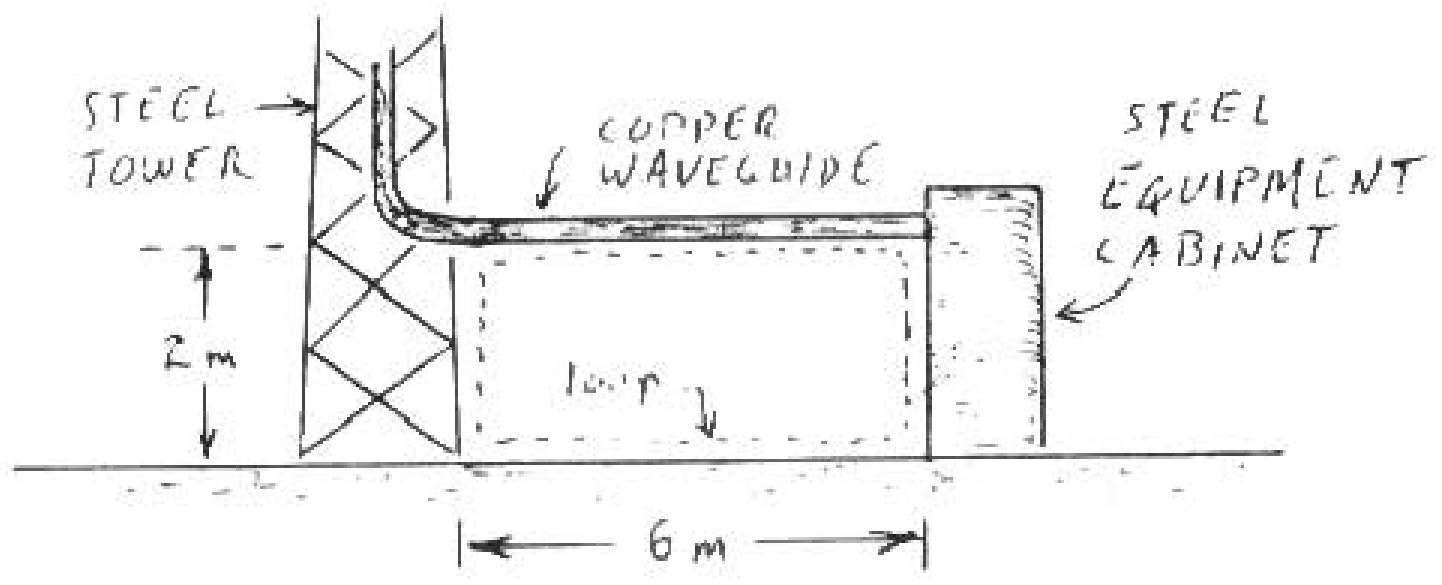
Let us model the process as follows:
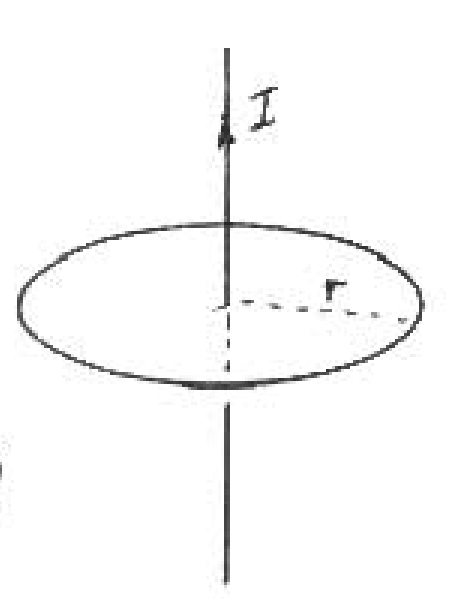
a. Begin with the magnetic field produced by a straight, infinite line of steady current . Use either the Biot-Savart law or Ampere’s law to obtain an expression for the magnetic field at the distance from the current. [8 т.]
b. Although the result of part (a) holds rigorously only for a steady current, let us use it to estimate the time-dependent magnetic field produced by a lightning bolt. Let us model the lightning bolt as a straight, vertical, infinite line of current that rises linearly from zero to A in s. Let the lightning bolt strike one kilometer from the tower. Find the emf induced in the conducting loop while the lightning current increases. Describe any other approximations you make besides the ones we have already mentioned. [10 т.]
c. Suppose the conducting loop described above has a resistance of 50 Ohms. Inside the cabinet there is a solid state device that can survive a maximum current of A. Could this device be damaged by the lightning strike described in part (b)? [7 т.]
(This problem adapted from the Structures and Interactions in Nature model curriculum of the Introductory University Physics Project. Special thanks to Paul Griffith of the FAA.)
Решение
a. (8 т.)
b. (10 т.)
Neglect variation of with over area of loop.
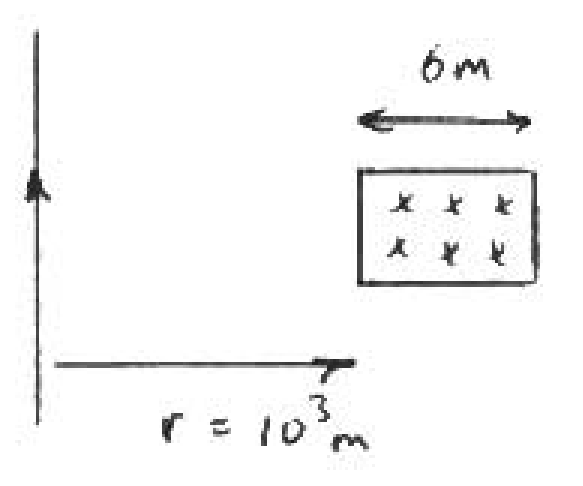
In magnitude,
c. (7 т.)
Yes the device may be damaged.
Оригинал в Архива: Semifinal 1998.pdf · официални решения: Semifinal 1998 Solutions.pdf