USAPhO 1998, Полуфинал — B1
1998 Exam 2 · 40 т.
1998 Exam 2 — INSTRUCTIONS
United States Physics Team
Entia non multiplicanda sunt praeter necessitatem
- DO NOT OPEN THIS TEST UNTIL YOU ARE GIVEN THE SIGNAL TO BEGIN.
- Work Part A first. You have 90 minutes to complete all four problems.
- After you have completed Part A, you may take a break.
- Then work Part B. You have 90 minutes to complete both problems.
- Show all work, as partial credit may be earned.
- Begin each problem on a fresh sheet of paper. In the upper right-hand corner of each page, write your name (last name first), the problem number, and the page number / total number of pages for that particular problem, for example:
Einstein, Albert
A2 - 3/4 for “Problem A2, page 3 of 4”
- A hand-held calculator may be used. Its memory must be cleared of data and programs. You may not use any books, notes, tables, or collections of formulas.
- Best wishes for an outstanding exam!
Possibly useful information
| Quantity | Value |
|---|---|
| Gravitational field at Earth’s surface | N/kg |
| Newton’s gravitational constant | N·m/kg |
| Coulomb’s constant | N·m/C |
| Biot-Savart constant | N·s/C |
| Speed of light in vacuum | m/s |
| Boltzmann’s constant | J/K |
| Avogadro’s number | mol |
| Ideal gas constant | J/mol-K |
| Elementary charge | C |
| 1 electron volt | J |
| Planck’s constant | |
| Electron mass | |
| Binomial expansion | whenever |
| Small-angle approximations | , whenever |
Copyright © 1998, AAPT
Условие
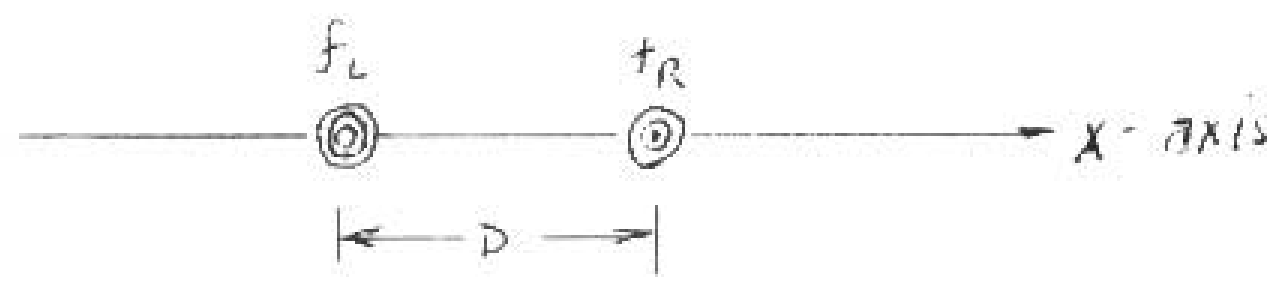
Two sirens located on the x-axis are separated by a certain distance . As heard by an observer at rest, denotes the frequency emitted by the left-hand siren, and denotes the frequency emitted by the right-hand siren. You are moving with constant velocity at speed along the x-axis, and record the following observations:
When you are on the right side of both sirens, you hear a beat frequency of 1.01 Hz.
When you are on the left of both sirens, you hear a beat frequency of 0.99 Hz.
When you are between the sirens, the beat frequency is zero.
a. Determine in which direction you are moving along the x-axis. [5 т.]
b. Evaluate your speed as a fraction of the speed of sound. [10 т.]
c. Determine which frequency is greater, or . [5 т.]
d. Determine the numerical values of and . [10 т.]
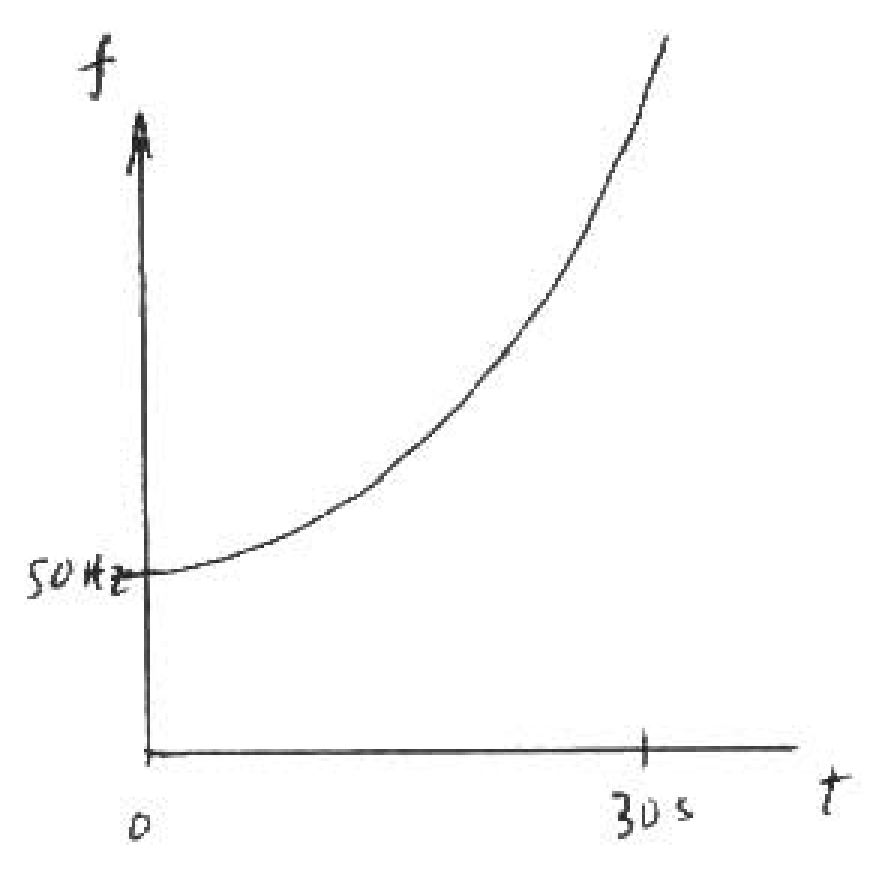
e. Suppose you stop moving, and the siren that emits sound of frequency is taken aboard a helicopter. The helicopter hovers with zero velocity above you. The siren (assumed to be battery-powered) is dropped from the helicopter. In the case of negligible air resistance, sketch a graph of frequency as a function of time, that describes the frequency you hear from this falling siren. [If you did not obtain a value for in part (d), use 50 Hz.] Take the speed of sound to be 343 m/s. The siren falls for 30 seconds before striking the ground beside you. [10 т.]
Решение
a. (5 т.)
The beat frequency is “blue shifted” on the [text missing in original scan], and “red shifted” on the L — hence moving [text missing in original scan].
b. (10 т.)
The beats are a “source” of frequency [remainder missing in original scan].
When on L: , moving away; speed of sound.
Using given data,
When on R: , moving towards.
(1) and (2)
c. (5 т.)
In between, is red-shifted:
In between, is blue-shifted:
In between, .
so .
d. (10 т.)
In between,
And , so .
I.e.,
Also, from either (1) or (2), and using (4) [], it follows that
Solving (5) and (6) gives , .
e. (10 т.)
Source moving: .
, , .
Оригинал в Архива: Semifinal 1998.pdf · официални решения: Semifinal 1998 Solutions.pdf