USAPhO 1998, Полуфинал — B2. Electron-Nucleus Interactions
1998 Exam 2 · 40 т.
1998 Exam 2 — INSTRUCTIONS
United States Physics Team
Entia non multiplicanda sunt praeter necessitatem
- DO NOT OPEN THIS TEST UNTIL YOU ARE GIVEN THE SIGNAL TO BEGIN.
- Work Part A first. You have 90 minutes to complete all four problems.
- After you have completed Part A, you may take a break.
- Then work Part B. You have 90 minutes to complete both problems.
- Show all work, as partial credit may be earned.
- Begin each problem on a fresh sheet of paper. In the upper right-hand corner of each page, write your name (last name first), the problem number, and the page number / total number of pages for that particular problem, for example:
Einstein, Albert
A2 - 3/4 for “Problem A2, page 3 of 4”
- A hand-held calculator may be used. Its memory must be cleared of data and programs. You may not use any books, notes, tables, or collections of formulas.
- Best wishes for an outstanding exam!
Possibly useful information
| Quantity | Value |
|---|---|
| Gravitational field at Earth’s surface | N/kg |
| Newton’s gravitational constant | N·m/kg |
| Coulomb’s constant | N·m/C |
| Biot-Savart constant | N·s/C |
| Speed of light in vacuum | m/s |
| Boltzmann’s constant | J/K |
| Avogadro’s number | mol |
| Ideal gas constant | J/mol-K |
| Elementary charge | C |
| 1 electron volt | J |
| Planck’s constant | |
| Electron mass | |
| Binomial expansion | whenever |
| Small-angle approximations | , whenever |
Copyright © 1998, AAPT
Условие
Consider an electron that starts from rest, essentially infinitely far from a completely ionized, extremely massive nucleus containing protons. The electron is captured by this nucleus. In the capture process, one photon is emitted. After being captured, the electron possesses angular momentum of magnitude as it orbits the nucleus. In parts (a) and (b) let us suppose the electron orbits classically in an elliptical orbit whose perigee (minimum distance from the nucleus) is and whose apogee (maximum distance from the nucleus) is . For numerical values use:
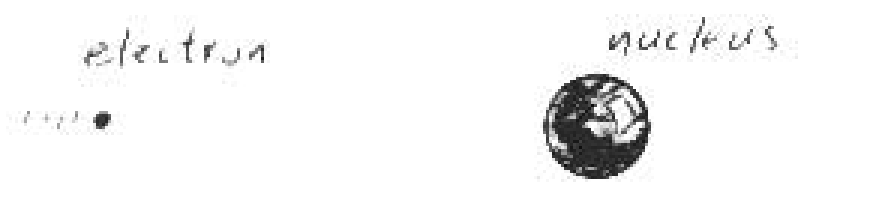
a. Find the value of . [15 т.]
b. What is the wavelength of the single photon that was emitted during the capture process? [10 т.]
c. Now let us consider another heavy but completely ionized nucleus of mass M, where . Let an electron be accelerated such that, as observed in the reference frame where the nucleus is originally at rest, the electron has 1 GeV of kinetic energy right before it impacts the nucleus. Upon entering the nucleus, the electron reacts with one of the protons in an inverse beta decay,
The neutrino immediately escapes the nucleus. Let us approximate the mass of the transformed nucleus as equal to , since . The mass of the neutrino is very small; experimentally it cannot be above about , so let us assume that the neutrino’s mass is exactly zero. Find the neutrino’s energy in the case where it is emitted in the direction exactly opposite the direction of the incoming electron (that is, the angle between the incoming electron’s momentum and the outgoing neutrino’s momentum is 180 degrees). Describe any other approximations you make in addition to those already stated.
Here again are the numerical values for this problem:
neutrino mass
electron mass
incoming electron’s kinetic energy: 1 GeV
Note: , and . [15 т.]
Решение
a. (15 т.)
At apogee (2) and perigee (1), .
Source note: In the handwritten key on page 8, the first equality has in the right-hand denominator, without a superscript 2. The following line uses . Both lines are reproduced as written.
b. (10 т.)
“initial” and “final” refer to electron’s energy.
c. (15 т.)
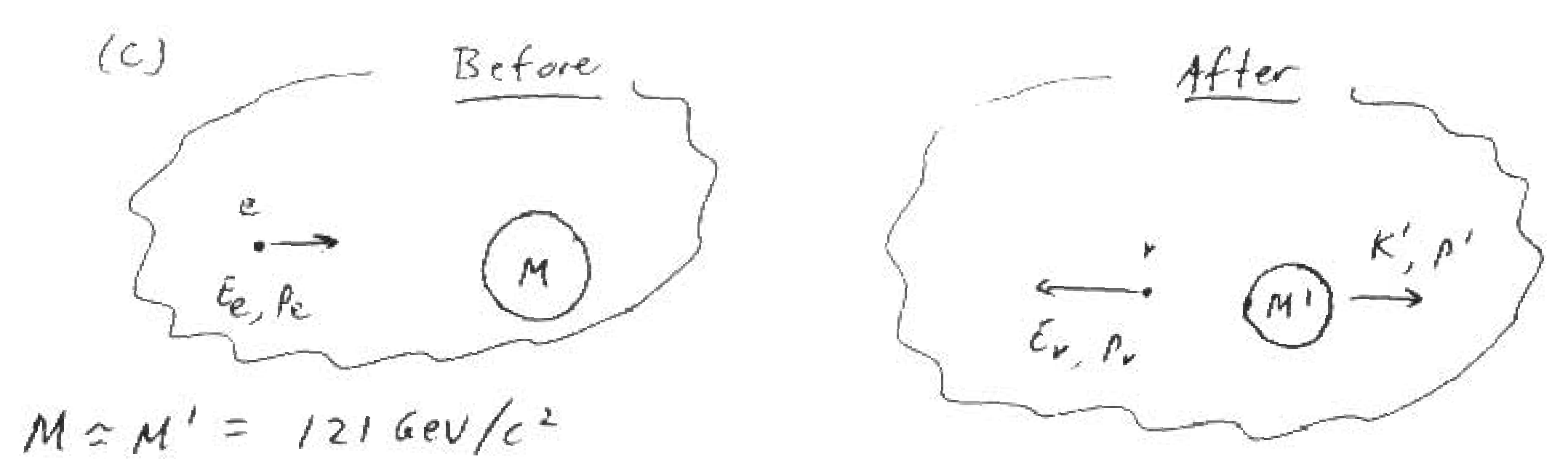
The electron is relativistic, the nucleus non-relativistic.
[Need we consider electron’s electrical potential energy?
Estimate P.E. at surface of nucleus (order of magnitude)
— may ignore P.E.]
Ok, here we go: (units: ignore c’s — in eV, in eV/, in eV/)
Cons. of Energy:
Cons. of momentum (one-dimensional):
(2) into (1)
For neutrino,
For electron,
(3) becomes
Numerically,
Neglect .
Neglect .
(+ root), a little less than 1 GeV. [The last handwritten digits of the intermediate 121.9… value are overwritten in the original scan.] Keeping and gives .98.
Оригинал в Архива: Semifinal 1998.pdf · официални решения: Semifinal 1998 Solutions.pdf