USAPhO 2000, Полуфинал — B1
2000 Semi-Final Exam · 40 т.
Указания
DO NOT OPEN THIS TEST UNTIL YOU ARE TOLD TO BEGIN
- Work Part A first. You have 90 minutes to complete all four problems.
- After you have completed Part A, you may take a break.
- Then work Part B. You have 90 minutes to complete both problems.
- Show all your work. Partial credit will be given.
- Start each question on a new sheet of paper. Be sure to put your name in the upper right-hand corner of each page, along with the question number and the page number/total pages for this problem. For example,
Doe, Jamie
A1 – 1/3
- A hand-held calculator may be used. Its memory must be cleared of data and programs. It may not be used in graphing mode. Calculators may not be shared. You may not use any tables, books, or collections of formulas. You may use a ruler or straight edge.
- Questions with the same point value are not necessarily of the same difficulty.
- Good luck!
Possibly Useful Information
| Quantity | Value |
|---|---|
| Gravitational field at the Earth's surface | N/kg |
| Newton's gravitational constant | N·m/kg |
| Coulomb's constant | N·m/C |
| Biot-Savart constant | T·m/A |
| Speed of light in a vacuum | m/s |
| Boltzmann's constant | J/K |
| Avogadro's number | (mol) |
| Ideal gas constant | J/mol·K |
| Elementary charge | C |
| 1 electron volt | J |
| Planck's constant | |
| Electron mass | |
| Binomial expansion |
Copyright © 2000, AAPT
Условие
A hollow spherical shell of radius and negligible thickness is constructed out of insulating material with total charge . A second similar shell has radius where and total charge . Each shell has its charge distributed uniformly over its surface. Assume the electrostatic potential is zero at infinity. As shown at the right, the symbols I, II, and III may be used to denote the regions inside the smaller shell, between the shells, and outside the larger shell, respectively. Express your answers to the following in terms of given quantities and known constants. You may use either spherical or Cartesian coordinates.
a–b
The spherical shells are concentric as shown in Figure a. at the right.
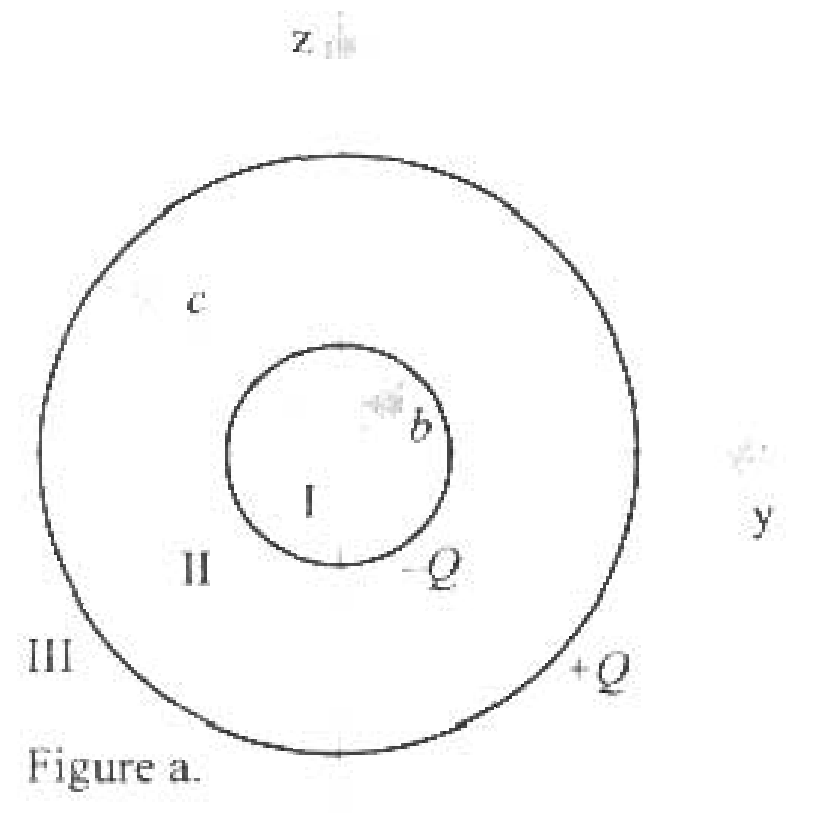
a. Find the electrostatic field in regions I, II, and III as a function of position. [10 т.]
b. Find the electrostatic potential in regions I, II, and III as a function of position. [10 т.]
c–d
The spherical shells are not concentric as shown in Figure b at the right. The inner shell is shifted in the positive direction a distance equal to its radius.
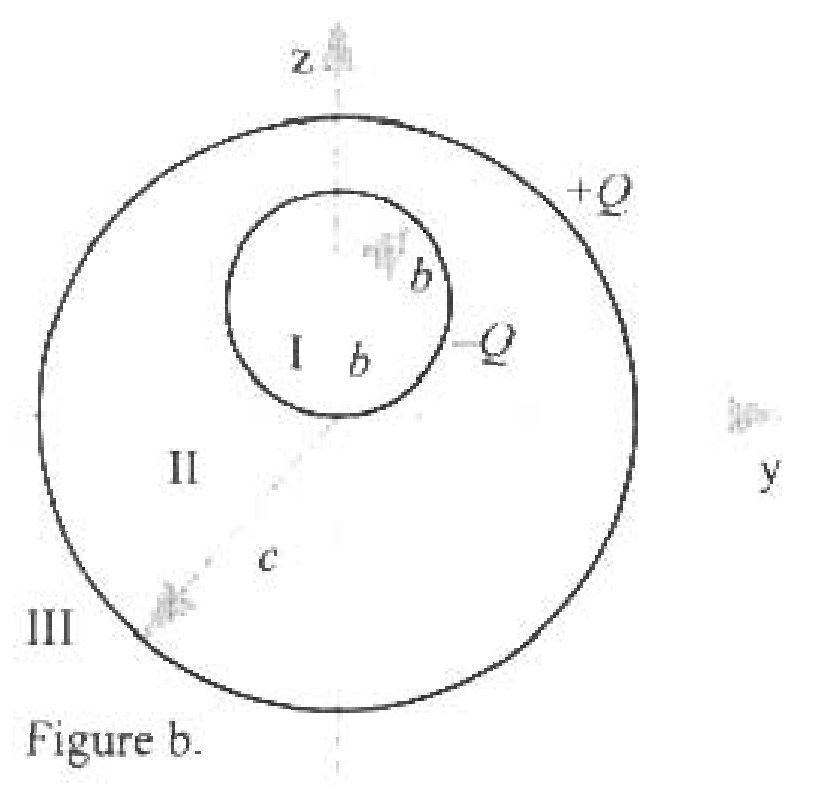
c. Find the electrostatic field in regions I, II, and III as a function of position. [10 т.]
d. Find the electrostatic potential in regions I, II, and III as a function of position. [10 т.]
Решение
a. (10 т.)
Because the charge distribution is uniform, there is spherical symmetry and we can use Gauss’s Law to calculate the electrostatic field. This yields
where , is the charge enclosed by a Gaussian surface of radius R, and is a unit vector in the direction.
Region I: A Gaussian surface of radius encloses no charge, so
Region II: A Gaussian surface of radius encloses
Thus
Region III: A Gaussian surface of radius encloses
Therefore
b. (10 т.)
Region III: Since the field is zero, the potential is a constant throughout the region. Its value at any point in III is the same as its value at infinity
Region II:
Using (B1.1), , and noting
Region I: Since the field is zero, the potential is constant and is everywhere equal to its value on the boundary at . Thus .
c. (10 т.)
In each region the total field can be obtained by superposition, adding vectorially the fields due to the individual spheres. .
Inside each uniformly charged sphere the field due to that sphere is zero.
Region I: This region is inside both spheres so both contributions are zero and .
Region II: The field due to the sphere is zero in this region. The field due to the is equivalent to that due to a point charge at , , . Letting represent the vector from this point charge to the arbitrary field point, we have
Region III: In this region both spheres contribute to the field. Adding to the previous result the contribution equivalent to a point charge at the origin, yields
d. (10 т.)
Region III: Since the field here is the equivalent to that due to two point charges, so is the potential.
Region II: In this region, the contribution due to the inner sphere is equivalent to that due to a point charge. The contribution due to the outer sphere is constant. To find this value, equate across the boundary with Region III.
Region I: Since the field is zero, the potential is constant. To find this value, equate across the boundary with Region II.
Оригинал в Архива: Semifinal 2000.pdf · официални решения: Semifinal 2000 Solutions.pdf