USAPhO 2000, Полуфинал — B2
2000 Semi-Final Exam · 40 т.
Указания
DO NOT OPEN THIS TEST UNTIL YOU ARE TOLD TO BEGIN
- Work Part A first. You have 90 minutes to complete all four problems.
- After you have completed Part A, you may take a break.
- Then work Part B. You have 90 minutes to complete both problems.
- Show all your work. Partial credit will be given.
- Start each question on a new sheet of paper. Be sure to put your name in the upper right-hand corner of each page, along with the question number and the page number/total pages for this problem. For example,
Doe, Jamie
A1 – 1/3
- A hand-held calculator may be used. Its memory must be cleared of data and programs. It may not be used in graphing mode. Calculators may not be shared. You may not use any tables, books, or collections of formulas. You may use a ruler or straight edge.
- Questions with the same point value are not necessarily of the same difficulty.
- Good luck!
Possibly Useful Information
| Quantity | Value |
|---|---|
| Gravitational field at the Earth's surface | N/kg |
| Newton's gravitational constant | N·m/kg |
| Coulomb's constant | N·m/C |
| Biot-Savart constant | T·m/A |
| Speed of light in a vacuum | m/s |
| Boltzmann's constant | J/K |
| Avogadro's number | (mol) |
| Ideal gas constant | J/mol·K |
| Elementary charge | C |
| 1 electron volt | J |
| Planck's constant | |
| Electron mass | |
| Binomial expansion |
Copyright © 2000, AAPT
Условие
We shall model a car as a uniform rectangular block of length and height with mass that has struts of length that rest on the frictionless axles of two wheels of radius , one front wheel and one rear wheel. Each wheel has a mass and a uniform mass density. The driver can exert a friction force at the top of the front wheel to slow down the car. See the diagram below.
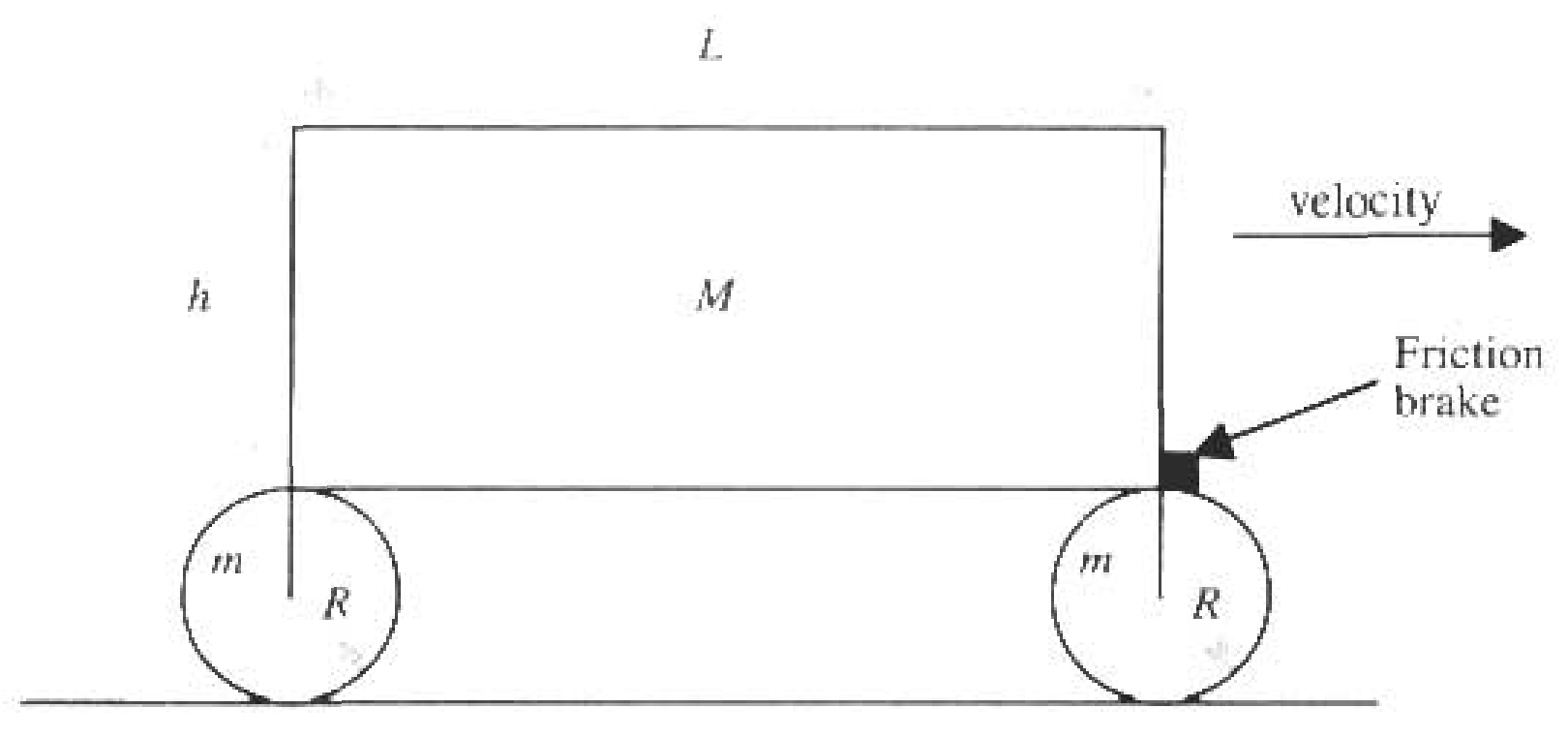
Assume that the two identical wheels have a coefficient of static friction with the ground. The driver applies a braking force that causes the vehicle to decelerate with a deceleration of magnitude .
a–g
Express your answers to the following in terms of given quantities and known constants.
a. Find the frictional force of the ground on the rear wheel. [4 т.]
b. Find the horizontal component of the force exerted by the car on the axle of the rear wheel. [4 т.]
c. Find the frictional force of the ground on the front wheel. [4 т.]
d. Find the force of the brake that is applied to the front wheel. [4 т.]
e. Find the horizontal component of the force exerted by the car on the axle of the front wheel. [4 т.]
f. Find and the normal forces exerted by the ground on the front and rear wheels. [8 т.]
g. For each wheel, find the maximum possible deceleration of the car before that wheel starts to slip. [4 т.]
h–i
If m, m, m, kg, kg, ,
h. Numerically evaluate the magnitude of the maximum possible deceleration of the car in terms of the acceleration of gravity, . [4 т.]
i. Numerically evaluate the ratio of the normal force of the ground on the front wheel to that on the rear wheel at this maximum deceleration. [4 т.]
Решение
a. (4 т.)
For the wheel and since it is rolling without slipping. The wheel is turning clockwise. It’s decelerating so the force producing the torque must be towards the front of the car. For the rotational motion of the rear wheel about its axis
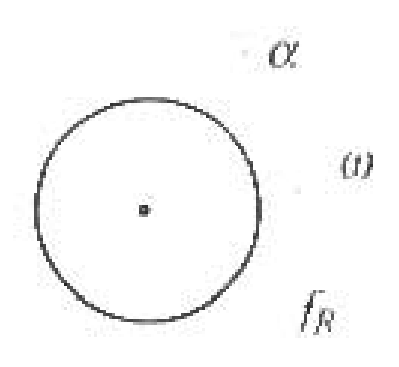
Therefore
b. (4 т.)
Now consider the translational deceleration of the rear wheel
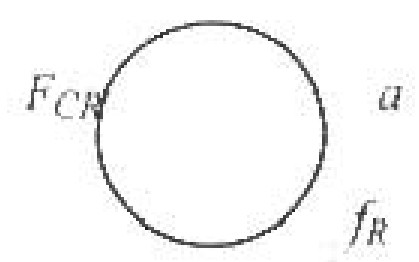
where we have chosen the acceleration direction to be positive. Therefore
c. (4 т.)
Consider the total external force acting on the car-wheel combination which has total mass
d. (4 т.)
Considering the rotational motion of the front wheel about its axis
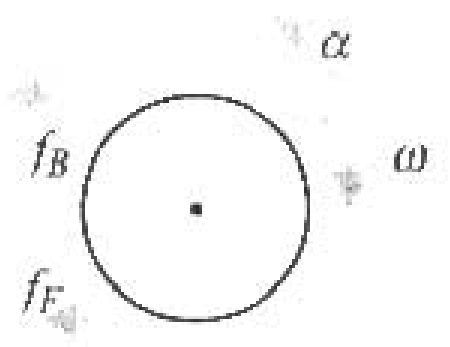
Solving for
towards the rear.
e. (4 т.)
Consider the total external force acting on the front wheel
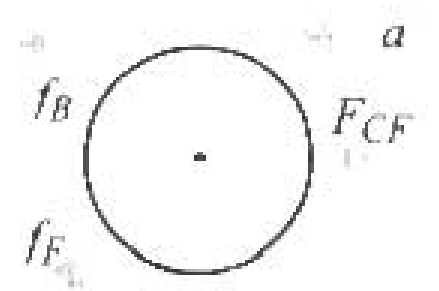
towards the front.
f. (8 т.)
We will first calculate the normal forces exerted by the axles on the carriage part of the car. Call these normal forces and . Using Newton’s third law to find the horizontal forces exerted on the carriage by the axles and the brake, we have the force diagram at the right.
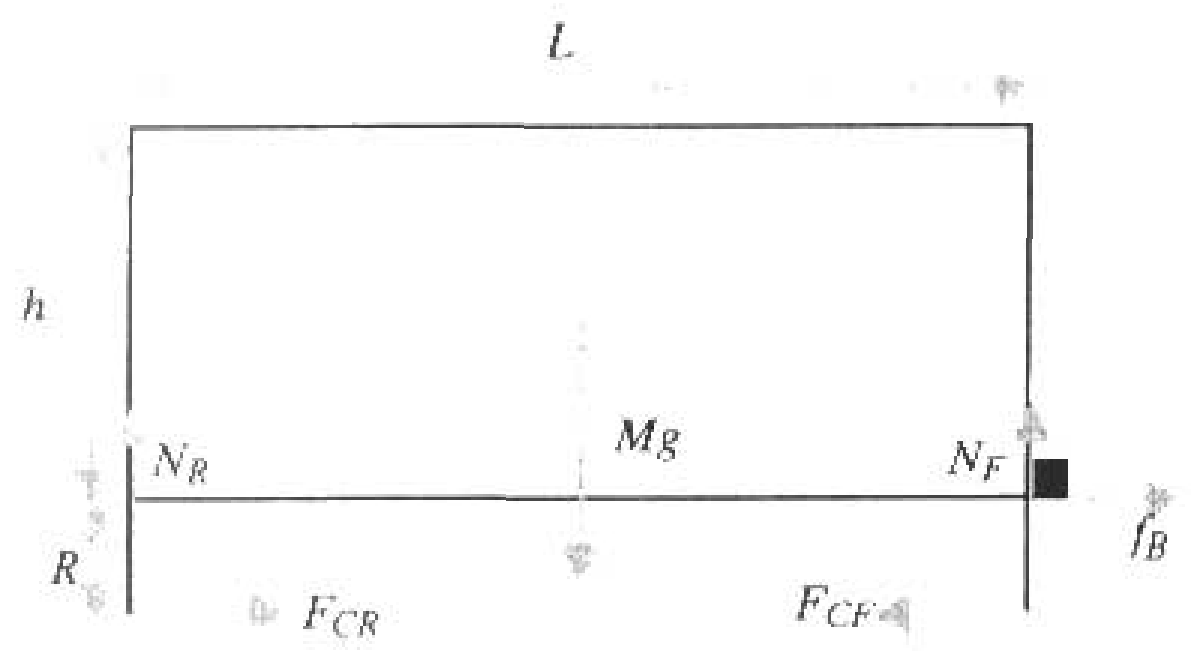
Consider the vertical forces acting on the block part of the car. There is no acceleration in the vertical direction, so these must sum to zero. Or
Consider the torques acting on the block part of the car. It is not rotating, so the total torque about the center of mass must equal zero.
Rearranging terms
Substituting the known , , and
Adding (B2.1) and (B2.2)
And for the rear axle
These are the upward forces exerted by the axles on the carriage. Consider now the vertical forces acting on the wheel, shown in the diagram at the right. Since there is no vertical acceleration these must sum to zero.
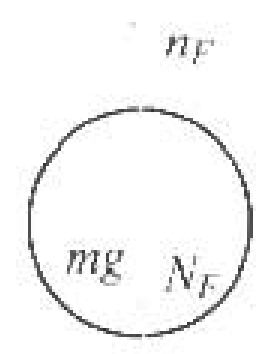
Finally
Similarly for the rear wheel
g. (4 т.)
For each wheel the maximum frictional force corresponding to the maximum deceleration is . For the rear wheel .
Using the results of Part a and Part f.
Solving for a
For the front wheel
h. (4 т.)
Putting the given values into (B2.5) and (B2.6), we have
therefore the maximum deceleration the car can have is
i. (4 т.)
Forming the ratio and substituting in the given values
Оригинал в Архива: Semifinal 2000.pdf · официални решения: Semifinal 2000 Solutions.pdf