USAPhO 2001, Полуфинал — A1
2001 Semi-Final Exam · 25 т.
Указания
DO NOT OPEN THIS TEST UNTIL YOU ARE TOLD TO BEGIN
- Work Part A first. You have 90 minutes to complete all four problems.
- After you have completed Part A, you may take a break.
- Then work Part B. You have 90 minutes to complete both problems.
- Show all your work. Partial credit will be given.
- Start each question on a new sheet of paper. Be sure to put your name in the upper right-hand corner of each page, along with the question number and the page number/total pages for this problem. For example,
Doe, Jamie
A1 – 1/3
- A hand-held calculator may be used. Its memory must be cleared of data and programs. It may not be used in graphing mode. Calculators may not be shared. You may not use any tables, books, or collections of formulas. You may use a ruler or straight edge.
- Questions with the same point value are not necessarily of the same difficulty.
- Good luck!
Possibly Useful Information
| Quantity | Value |
|---|---|
| Gravitational field at the Earth's surface | N/kg |
| Newton's gravitational constant | N·m/kg |
| Coulomb's constant | N·m/C |
| Biot-Savart constant | T·m/A |
| Speed of light in a vacuum | m/s |
| Boltzmann's constant | J/K |
| Avogadro's number | (mol) |
| Ideal gas constant | J/(mol·K) |
| Stefan-Boltzmann constant | J/(s·m·K) |
| Elementary charge | C |
| 1 electron volt | J |
| Planck's constant | |
| Electron mass | |
| Binomial expansion |
Copyright © 2001, American Association of Physics Teachers
Условие
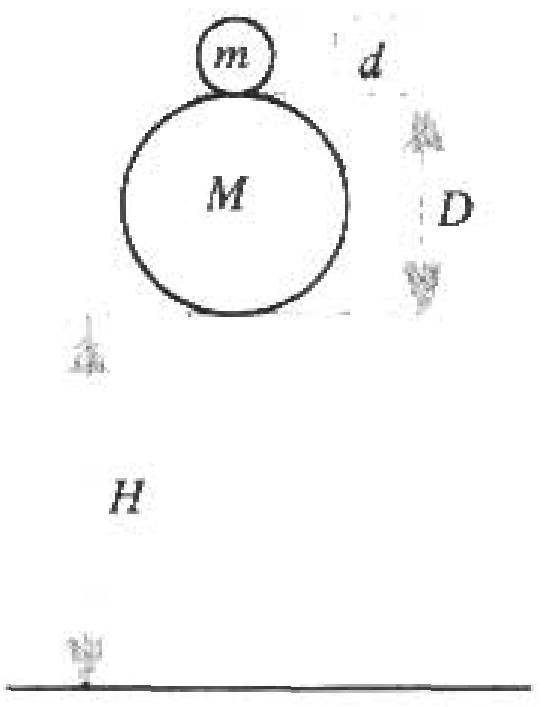
A small ball of diameter and mass rests on top of a large ball of diameter and mass () which is initially held so that its bottom is a height above the floor. Please see the diagram to the right. The balls are released from rest. Assume all collisions are perfectly elastic and occur along a vertical line. How high does the small ball rise above its initial position after its first bounce? Express your answer in terms of the quantities given in the diagram.
Решение
Each ball starts at rest and falls through a height to its lowest point, which we will take as the zero of gravitational potential energy. Applying energy conservation, each ball reaches its lowest point with velocity
The large ball collides elastically with the floor and the direction of its velocity reverses. Moving upward, collides elastically with moving downward. Letting be the speed of and be the speed of after the collision and taking down to be negative and up positive, momentum conservation yields
Solving for
Energy conservation yields:
Inserting from the momentum equation,
Multiplying by
Regrouping terms
Solving the quadratic equation for yields
Since we want m moving upward (positive velocity), we select the plus sign.
Let equal the maximum height of the small ball above its lowest position. At 's highest point its kinetic energy is zero and
The ball's height above its initial position is .
Оригинал в Архива: Semifinal 2001.pdf · официални решения: Semifinal 2001 Solutions.pdf