USAPhO 2004, Полуфинал — Задача 4. A4
AAPT UNITED STATES PHYSICS TEAM AIP 2004 — 2004 Semi-Final Exam · 25 т.
Указания
DO NOT OPEN THIS TEST UNTIL YOU ARE TOLD TO BEGIN
Work Part A first. You have 90 minutes to complete all four problems.
After you have completed Part A, you may take a break.
Then work Part B. You have 90 minutes to complete both problems.
Show all your work. Partial credit will be given.
Start each question on a new sheet of paper. Be sure to put your name in the upper right-hand corner of each page, along with the question number and the page number/total pages for this problem. For example,
Doe, Jamie
A1 – 1/3
A hand-held calculator may be used. Its memory must be cleared of data and programs. You may use only the basic functions found on a simple scientific calculator. Calculators may not be shared. Cell phones, PDA’s, or cameras may not be used during the exam or while the exam papers are present. You may not use any tables, books, or collections of formulas.
Questions with the same point value are not necessarily of the same difficulty.
Do not discuss the contents of this exam with anyone until after the submission deadline.
Good luck!
Possibly Useful Information
| Gravitational field at the Earth’s surface | |
| Newton’s gravitational constant | |
| Coulomb’s constant | |
| Biot-Savart constant | |
| Speed of light in a vacuum | |
| Boltzmann’s constant | |
| Avogadro’s number | |
| Ideal gas constant | |
| Stefan-Boltzmann constant | |
| Elementary charge | |
| 1 electron volt | |
| Planck’s constant | |
| Electron mass | |
| Binomial expansion | for |
| Small angle approximations | , |
Copyright © 2004, American Association of Physics Teachers
Условие
A ball is thrown so that it hits a stationary ramp and then bounces up the ramp. Immediately before the first collision between the ball and the ramp, the ball has a velocity that is horizontal as shown in the accompanying diagram. Assume that all collisions are perfectly elastic, that there is no friction between the ramp and the ball, and that air resistance is negligible. At the instant that the ball makes its +1 collision with the ramp, the ball is moving perpendicular to the ramp. Express your answers in terms of , , and .
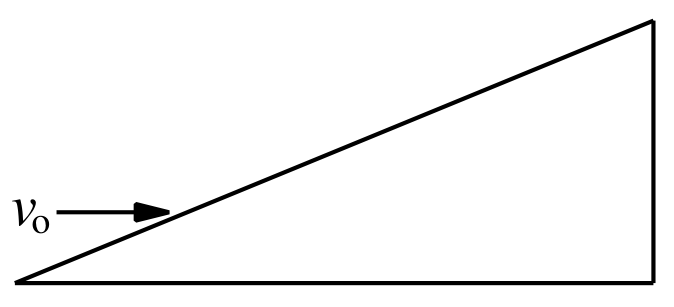
a. Find the angle that the ramp makes with the horizontal. [20 т.]
b. What is the distance, measured along the ramp, between the point at which the first collision occurs and the point at which the +1 collision occurs? [5 т.]
Отговори
- a.
- b.
Решение
A4. Selecting the -axis perpendicular to the ramp and the -axis parallel to the ramp in the upward direction, the components of the gravitational acceleration are
and ,
where is the angle the ramp makes with the horizontal. The components of the initial velocity are and .
a. At each collision with the plane, the -component of velocity does not change while the -component reverses sign. At the start of the first bounce .
The -displacement is given by
Let at , the start of the first bounce. Let , the time when the ball returns to the ramp , at the end of the first bounce. Substituting these values into (A4 – 1)
Solving for and eliminating the initial time ,
The velocity at the end of the first bounce, as the ball is about to impact the ramp again, is
Upon hitting the ramp the velocity reverses to become .
Each bounce has the same and , so each bounce takes the same amount of time .
Therefore the time for bounces is
There is no impulse in the -direction, so the -equations hold continuously. At the end of the Nth bounce, the ball’s velocity is perpendicular to the ramp, . Substituting this into the equation for the -component of velocity,
Dividing by ,
Solving for
b. The x-displacement is given by .
The maximum displacement occurs at the end of the Nth bounce, time . Combining (A4 – 2) and (A4 – 3)
Substituting this into the x-equation,
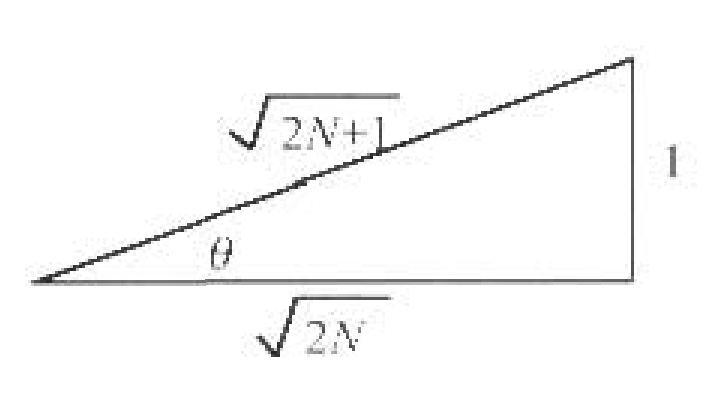
Using the triangle to the right to determine and
Оригинал в Архива: Semifinal 2004.pdf · официални решения: Semifinal 2004 Solutions.pdf