USAPhO 2004, Полуфинал — Задача 5. B1
AAPT UNITED STATES PHYSICS TEAM AIP 2004 — 2004 Semi-Final Exam · 50 т.
Указания
DO NOT OPEN THIS TEST UNTIL YOU ARE TOLD TO BEGIN
Work Part A first. You have 90 minutes to complete all four problems.
After you have completed Part A, you may take a break.
Then work Part B. You have 90 minutes to complete both problems.
Show all your work. Partial credit will be given.
Start each question on a new sheet of paper. Be sure to put your name in the upper right-hand corner of each page, along with the question number and the page number/total pages for this problem. For example,
Doe, Jamie
A1 – 1/3
A hand-held calculator may be used. Its memory must be cleared of data and programs. You may use only the basic functions found on a simple scientific calculator. Calculators may not be shared. Cell phones, PDA’s, or cameras may not be used during the exam or while the exam papers are present. You may not use any tables, books, or collections of formulas.
Questions with the same point value are not necessarily of the same difficulty.
Do not discuss the contents of this exam with anyone until after the submission deadline.
Good luck!
Possibly Useful Information
| Gravitational field at the Earth’s surface | |
| Newton’s gravitational constant | |
| Coulomb’s constant | |
| Biot-Savart constant | |
| Speed of light in a vacuum | |
| Boltzmann’s constant | |
| Avogadro’s number | |
| Ideal gas constant | |
| Stefan-Boltzmann constant | |
| Elementary charge | |
| 1 electron volt | |
| Planck’s constant | |
| Electron mass | |
| Binomial expansion | for |
| Small angle approximations | , |
Copyright © 2004, American Association of Physics Teachers
Условие
a. In 1913, Niels Bohr first derived a formula for the energy levels of the hydrogen atom. He postulated that the single electron orbited a very massive proton under the influence of the electrostatic force and that the circular electron orbits had quantized angular momentum
where and is Planck’s constant. These postulates gave rise to discrete values of the electron’s total energy . Derive these Bohr Model energy levels. Express your answer in terms of Coulomb’s constant , the electron mass , the electron charge , , and . If done correctly, your answer should evaluate to
[20 т.]
b. In a hypothetical modern day experiment, electrons are accelerated from rest through a potential into a cloud of cold atomic hydrogen (Figure 1-1). A series of plates with aligned holes select a beam of scattered electrons moving perpendicular to the plates. Immediately beyond the final plate, the electrons enter a uniform magnetic field perpendicular to the beam; they curve and strike a piece of film mounted on the final plate.
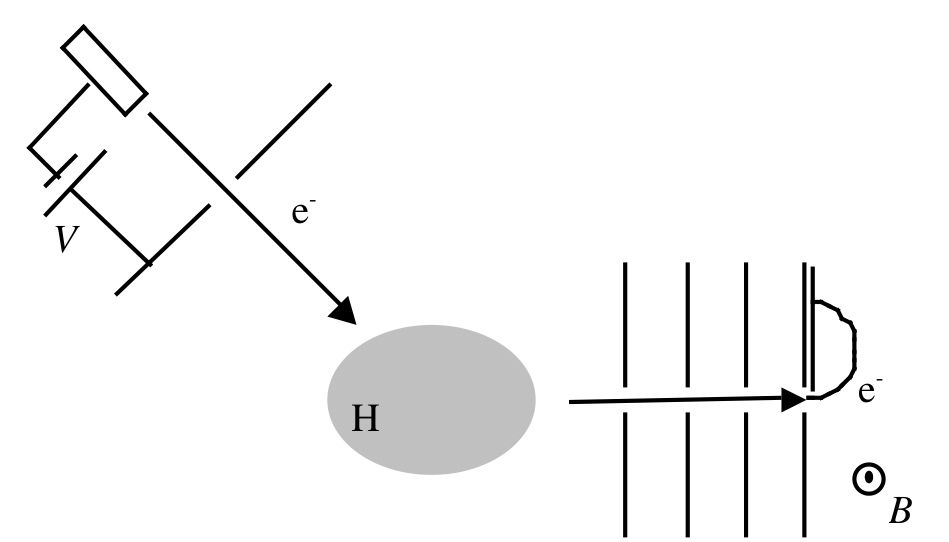
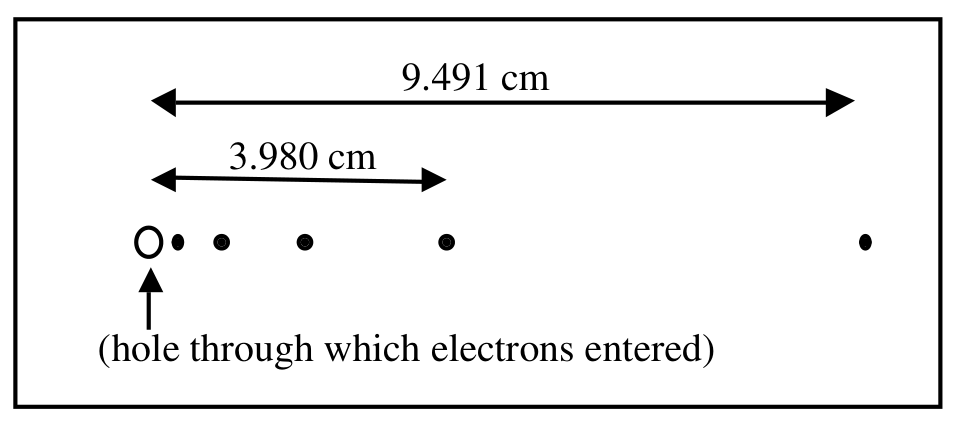
When the film is developed, a series of spots is observed (Figure 1-2). The distances between the hole and the two most distant spots are measured. You may assume that the film is large enough to have intercepted all of the electrons, i.e. that there are no spots farther from the hole than those shown. The number of spots shown is not necessarily accurate.
Make the approximation that the mass of the hydrogen atom is much larger than the mass of the electron. Assume that each electron scatters off only one atom, which is initially in the ground state (lowest energy state) and has negligible thermal velocity.
Determine:
i. The magnitude of the magnetic field . [10 т.]
ii. The magnitude of the accelerating potential . [10 т.]
iii. The total number of spots on the film. [10 т.]
Отговори
- a.
- i. 0.00025 T
- ii. 12.4 V
- iii. 3
Решение
B1. a. The electrostatic force causes the centripetal acceleration that keeps the electron in its circular orbit around the proton. Since the proton is assumed to be very massive, reduced mass effects can be neglected.
where is the electron mass, is the electron charge, is its orbital velocity, is its orbital radius and is Coulomb’s constant. Multiplying by yields
The angular momentum of an object moving in a circle is .
Combining this with Bohr’s postulate
Solving this for
Solving this for
The total energy is the sum of the electron’s kinetic and potential energy.
Which is
b. i. As the electrons are accelerated through the potential difference , they gained kinetic energy . The hydrogen is initially in its ground state . After the collision the electron has kinetic energy and the atom is in state with energy . Applying energy conservation, we have
The electron enters the magnetic field with velocity perpendicular to . The force on the electron causes it to move in a circular path with radius .
Solving for
Combining with (B1-1),
The two furthest out spots correspond to and 2. The diameters of the paths are m and m. The radii are m and m
Writing (B1-2) for these two cases
or
and
or
Solving for
ii. Substituting into (B1-3)
iii. The electron’s kinetic energy after the collision has got to be greater than zero. Using to represent the maximum in (B1-1)
Expressing the energies in electron volts, this is
or
or
The maximum number of spots is 3.
Оригинал в Архива: Semifinal 2004.pdf · официални решения: Semifinal 2004 Solutions.pdf