USAPhO 2004, Полуфинал — Задача 6. B2
AAPT UNITED STATES PHYSICS TEAM AIP 2004 — 2004 Semi-Final Exam · 50 т.
Указания
DO NOT OPEN THIS TEST UNTIL YOU ARE TOLD TO BEGIN
Work Part A first. You have 90 minutes to complete all four problems.
After you have completed Part A, you may take a break.
Then work Part B. You have 90 minutes to complete both problems.
Show all your work. Partial credit will be given.
Start each question on a new sheet of paper. Be sure to put your name in the upper right-hand corner of each page, along with the question number and the page number/total pages for this problem. For example,
Doe, Jamie
A1 – 1/3
A hand-held calculator may be used. Its memory must be cleared of data and programs. You may use only the basic functions found on a simple scientific calculator. Calculators may not be shared. Cell phones, PDA’s, or cameras may not be used during the exam or while the exam papers are present. You may not use any tables, books, or collections of formulas.
Questions with the same point value are not necessarily of the same difficulty.
Do not discuss the contents of this exam with anyone until after the submission deadline.
Good luck!
Possibly Useful Information
| Gravitational field at the Earth’s surface | |
| Newton’s gravitational constant | |
| Coulomb’s constant | |
| Biot-Savart constant | |
| Speed of light in a vacuum | |
| Boltzmann’s constant | |
| Avogadro’s number | |
| Ideal gas constant | |
| Stefan-Boltzmann constant | |
| Elementary charge | |
| 1 electron volt | |
| Planck’s constant | |
| Electron mass | |
| Binomial expansion | for |
| Small angle approximations | , |
Copyright © 2004, American Association of Physics Teachers
Условие
A very long solenoid has radius , turns per unit length, and carries current as shown in the accompanying cross-sectional view. The solenoid is firmly fixed in place and cannot rotate.
a. What is the magnetic field inside the solenoid, far from its ends? [5 т.]
b. What is the magnetic energy density stored in the solenoid? [5 т.]
There are two long cylindrical shells of length and mass coaxial to the solenoid – one, inside the solenoid at a radius , carries a charge , uniformly distributed over its surface; the other, outside the solenoid at radius , carries charge . . Use to represent the distance from the cylinders’ axis. The cylinders are free to rotate about their axes.
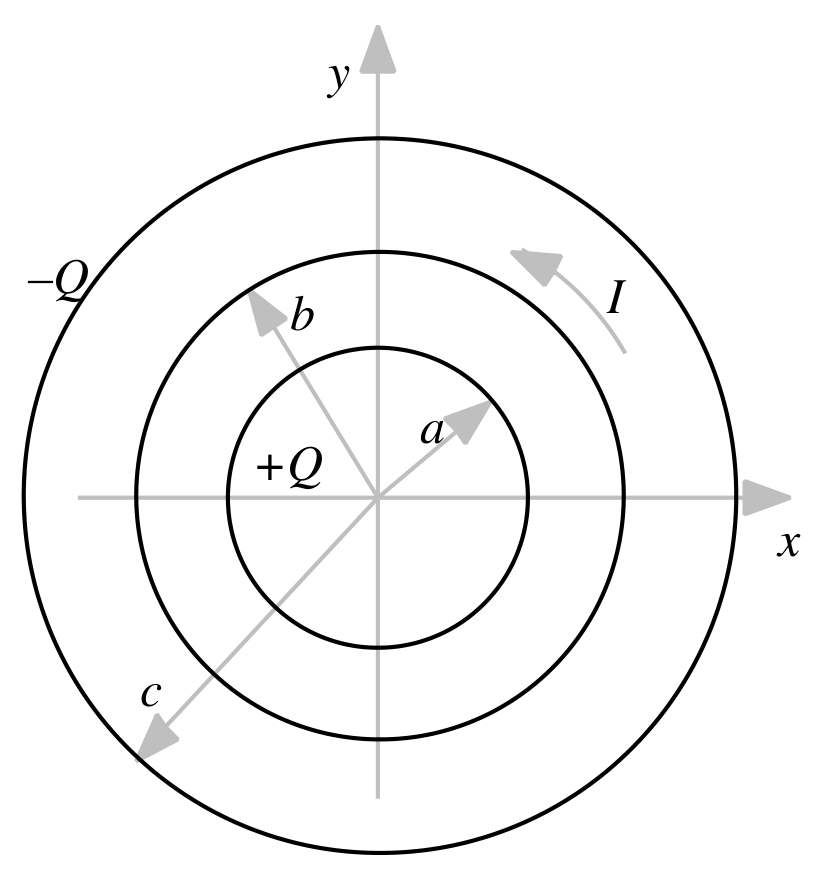
c. What is the electric field between the cylindrical shells, far from their ends? [5 т.]
d. What is the electric energy density stored between the shells? [5 т.]
The current in the solenoid is gradually reduced from to zero at a constant rate, . The cylindrical shells begin to rotate. Assume the magnetic field generated by the rotating cylindrical shells is negligible.
e. Calculate the gain in angular momentum of each cylinder about its axis when the current in the solenoid is reduced from to zero. [15 т.]
f. In addition to storing energy, fields can also store linear momentum and angular momentum. The density of linear momentum stored in electromagnetic fields is
Calculate the change in angular momentum of the electromagnetic fields about the cylinders’ axis as the current in the solenoid is reduced from to zero. [15 т.]
Suggested by a problem in Introduction to Electrodynamics, 3rd Ed., by David J. Griffiths (Prentice Hall, Upper Saddle River, New Jersey, 1999), page 359.
Отговори
a.
b.
c.
d.
e.
f.
The official solution prints the stored angular momentum −½Qμ₀nI(b² − a²)ẑ, which goes to zero; it labels this the change.
Решение
B2. a. Using to represent a unit vector in the -direction, for . (It is not necessary to derive this result from Ampere’s Law.)
b.
It is also possible to derive this result from .
If edge effects are ignored
where is the length and is the cross-sectional area of the solenoid. Combining this with
yields
or
c. The charge per unit length on the inner cylindrical shell is .
Letting represent a unit vector in the -direction, Gauss’s Law for cylindrical symmetry yields
d.
e. Use Faradays Law to find the induced electric field at the location of each charged cylinder.
is constant around a circular path, the cross-section of the cylinder, .
The magnetic flux is
where is the enclosed area that has a magnetic field. Thus
Since is decreasing at a constant rate
For the inner cylinder, and , and
Therefore
In order to oppose the decrease in , is in the same direction as
For the outer cylinder, and , since the field for
and
Therefore
with
Each cylinder experiences a torque caused by the electric force.
For the inner cylinder
Since decreases at a constant rate, also changes at a constant rate.
For the outer cylinder
and
f. for and for . Using to represent the linear momentum density
and
Using to represent the angular momentum density
In the region ,
The angular momentum density is constant in the region and zero outside. Therefore the total angular momentum originally stored in the fields is
When the current is reduced to zero, this angular momentum goes to zero. Therefore the change in angular momentum is
Оригинал в Архива: Semifinal 2004.pdf · официални решения: Semifinal 2004 Solutions.pdf