USAPhO 2005, Полуфинал — B1
2005 Semi-Final Exam · 50 т.
2005 Semi-Final Exam — Instructions
AAPT / AIP — United States Physics Team 2005.
DO NOT OPEN THIS TEST UNTIL YOU ARE TOLD TO BEGIN
- Work Part A first. You have 90 minutes to complete all four problems.
- After you have completed Part A, you may take a break.
- Then work Part B. You have 90 minutes to complete both problems.
- Show all your work. Partial credit will be given.
- Start each question on a new sheet of paper. Be sure to put your name in the upper right-hand corner of each page, along with the question number and the page number/total pages for this problem. For example: Doe, Jamie; A1 – 1/3.
- A hand-held calculator may be used. Its memory must be cleared of data and programs. You may use only the basic functions found on a simple scientific calculator. Calculators may not be shared. Cell phones, PDA’s, or cameras may not be used during the exam or while the exam papers are present. You may not use any tables, books, or collections of formulas.
- Questions with the same point value are not necessarily of the same difficulty.
- Do not discuss the contents of this exam with anyone until after the submission deadline.
- Good luck!
Possibly Useful Information
| Quantity | Value |
|---|---|
| Gravitational field at the Earth’s surface | N/kg |
| Newton’s gravitational constant | N·m/kg |
| Coulomb’s constant | N·m/C |
| Biot-Savart constant | T·m/A |
| Speed of light in a vacuum | m/s |
| Boltzmann’s constant | J/K |
| Avogadro’s number | (mol) |
| Ideal gas constant | J/(mol·K) |
| Stefan-Boltzmann constant | J/(s·m·K) |
| Elementary charge | C |
| 1 electron volt | J |
| Planck’s constant | |
| Electron mass | |
| Binomial expansion | for |
| Small angle approximations | , |
Copyright © 2005, American Association of Physics Teachers
Условие
A length of wire is formed into a ring of radius and total charge that is distributed uniformly around the ring. The ring is in the - plane and centered on the origin as shown in the accompanying diagram. , , and are unit vectors in the , , and directions respectively. Assume the potential vanishes at infinity.
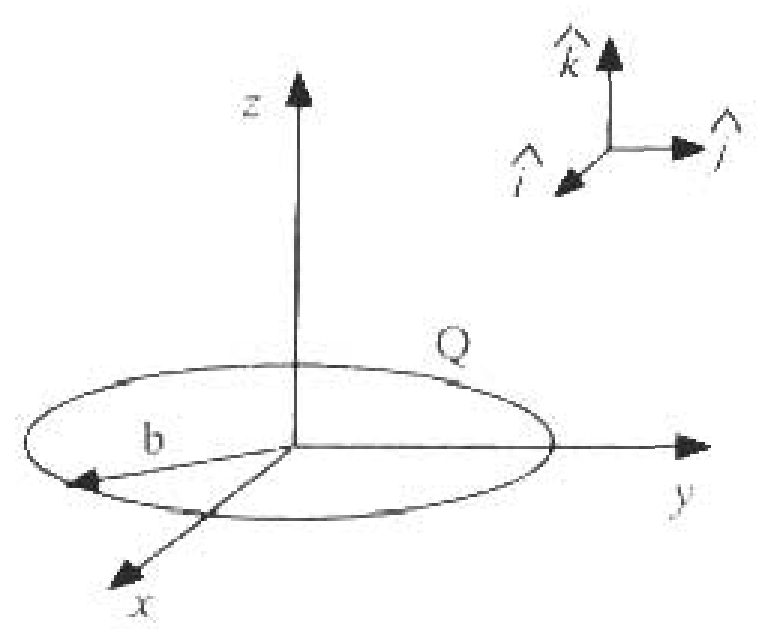
a.–b.
a. Find the field at any point on the axis. [7 т.]
b. Find the potential at any point on the axis. [5 т.]
c.–e.
A point charge with mass and charge is placed at where and released from rest at . Ignore any effects due to radiation.
c. Find the potential energy of the system as a function of , the position of the charge. Expand this potential energy function about the origin for . Keep only terms to lowest non-zero order in . [10 т.]
d. Find the speed of the charge as it passes through the origin. [5 т.]
e. Find the velocity of the charge as a function of time. [8 т.]
f.–g.
The point charge is removed and the ring is set into rotation about the -axis with angular velocity . Ignore any effects due to radiation.
f. Find the magnetic field due to the rotating ring at any point along the -axis. [10 т.]
g. A second point charge with mass and charge is placed at where and released from rest. What is the magnetic force on the charge as it passes through the origin? [5 т.]
Решение
a. (7 т.)
By symmetry, the and components of the electric field from different parts of the ring will cancel:
Therefore, we need to add up the -components of the electric field from the various parts of the ring:
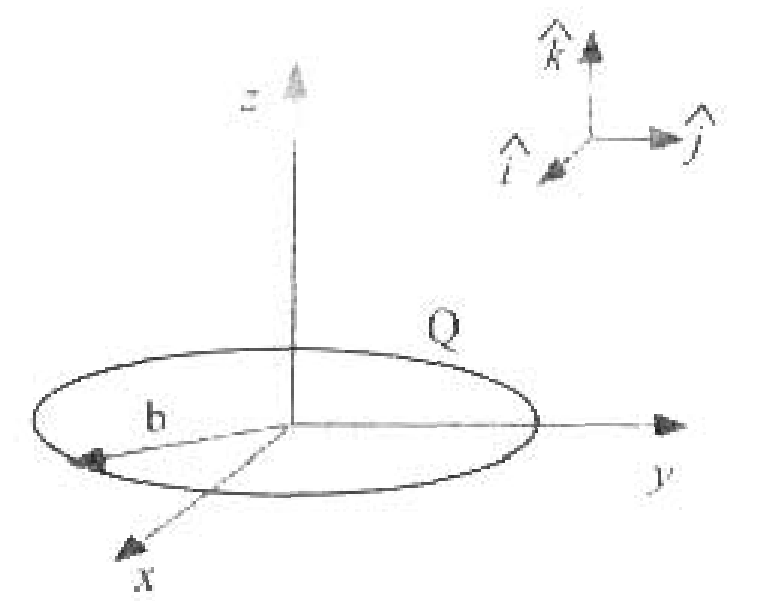
The electric field due to an infinitesimal charge on the ring at a distance from the origin is
where . (B1-2)
( is the distance from a point on the ring to the point .) is a unit vector at the point pointing away from the charge on the ring.
The -component is then given by:
where is the angle between and the axis.
Substituting eq. (B1-1) into (B1-2) yields:
Integrating (B1-4) around the ring and observing that is the same for all points on the ring yields
Using the fact that and substituting (B1-2) into (B1-5) gives us the answer.
b. (5 т.)
The potential a distance away from an infinitesimal charge is given by
Integrating around the ring, using the fact that is the same from every point on the ring to the point , and substituting (B1-2) for yields
Note that it is easier to solve part (b) first and then to solve part (a) using
c. (10 т.)
The potential energy of the system is given by
Using (B1-8),
Factoring out ,
Using the fact that and using the approximation when , (B1-12) becomes
d. (5 т.)
Mechanical energy is conserved, so
Since the charge is at rest at and using (B1-13),
Solving for ,
e. (8 т.)
We shall use Newton’s Second Law:
The force on the charge is where is given by (B1-6). Substituting into (B1-17),
But, , so and, after dividing both sides by , (B1-18) becomes
We recognize that the differential equation
is simple harmonic motion. The solution to (B1-20) is
Since , we find that .
By comparison with (B1-19), we find that
We can derive an expression for the velocity as a function of time by differentiating (B1-21):
(where is given by (B1-22).)
Note that an alternative method of solving part (d) is to note that the speed at the origin will be the maximum value of the magnitude of the velocity
Note that an alternative (easier) method of solving part (e) is to note that the potential energy found in (B1-13) is of the form .
Therefore, since it starts from rest, we know that and that
Thus, and was found in (B1-16).
f. (10 т.)
According to the Biot-Savart law, the magnetic field due to a moving infinitesimal charge is given by
Since depends on the cross product , must be perpendicular to both and .
By symmetry, when we add the magnetic field vectors due to all points on the rotating ring, the and components will cancel. Therefore, we need to find the components and add them. Let be the angle between and .
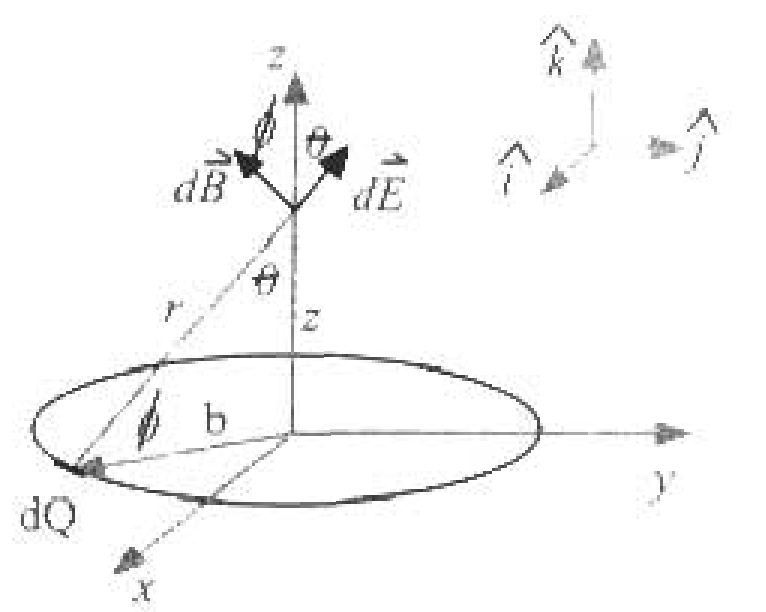
Substituting and (B1-24) into (B1-25):
Integrating (B1-26) around the ring and observing that is the same for all points on the ring yields
Using the fact that and substituting (B1-2) into (B1-27) gives us the answer.
g. (5 т.)
A point charge moving with velocity in a magnetic field experiences a magnetic force
However, since the charge is moving in the direction and the magnetic field is in the direction, , so .
Оригинал в Архива: Semifinal 2005.pdf · официални решения: Semifinal 2005 Solutions.pdf