USAPhO 2005, Полуфинал — B2
2005 Semi-Final Exam · 50 т.
2005 Semi-Final Exam — Instructions
AAPT / AIP — United States Physics Team 2005.
DO NOT OPEN THIS TEST UNTIL YOU ARE TOLD TO BEGIN
- Work Part A first. You have 90 minutes to complete all four problems.
- After you have completed Part A, you may take a break.
- Then work Part B. You have 90 minutes to complete both problems.
- Show all your work. Partial credit will be given.
- Start each question on a new sheet of paper. Be sure to put your name in the upper right-hand corner of each page, along with the question number and the page number/total pages for this problem. For example: Doe, Jamie; A1 – 1/3.
- A hand-held calculator may be used. Its memory must be cleared of data and programs. You may use only the basic functions found on a simple scientific calculator. Calculators may not be shared. Cell phones, PDA’s, or cameras may not be used during the exam or while the exam papers are present. You may not use any tables, books, or collections of formulas.
- Questions with the same point value are not necessarily of the same difficulty.
- Do not discuss the contents of this exam with anyone until after the submission deadline.
- Good luck!
Possibly Useful Information
| Quantity | Value |
|---|---|
| Gravitational field at the Earth’s surface | N/kg |
| Newton’s gravitational constant | N·m/kg |
| Coulomb’s constant | N·m/C |
| Biot-Savart constant | T·m/A |
| Speed of light in a vacuum | m/s |
| Boltzmann’s constant | J/K |
| Avogadro’s number | (mol) |
| Ideal gas constant | J/(mol·K) |
| Stefan-Boltzmann constant | J/(s·m·K) |
| Elementary charge | C |
| 1 electron volt | J |
| Planck’s constant | |
| Electron mass | |
| Binomial expansion | for |
| Small angle approximations | , |
Copyright © 2005, American Association of Physics Teachers
Условие
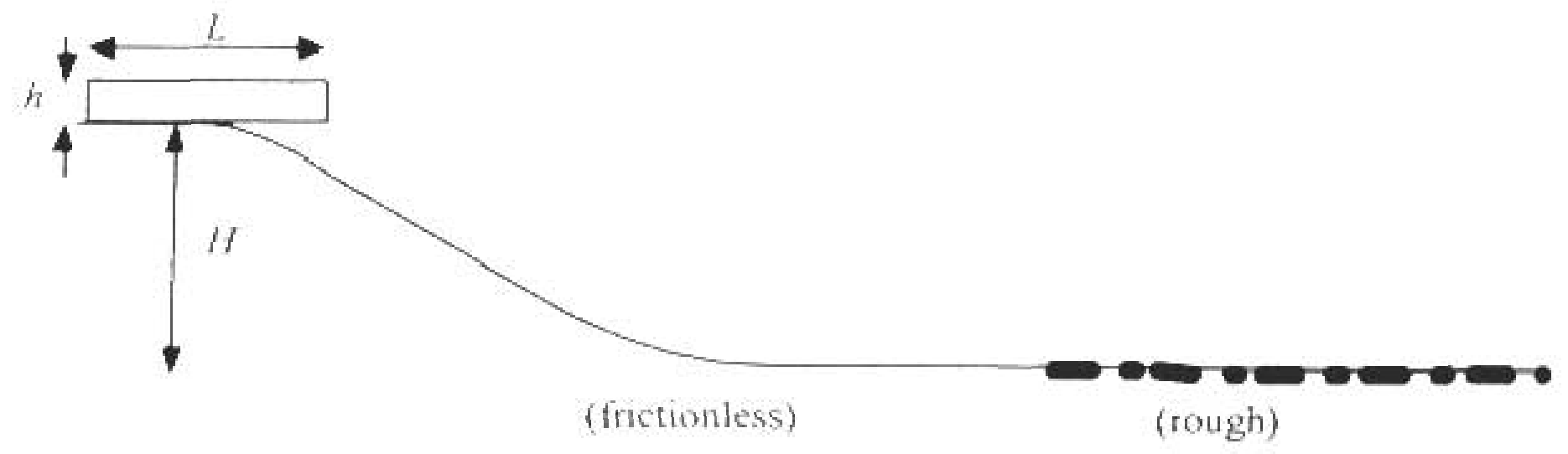
A block with uniform density, length , and height , , starts from rest at the top of a hill of height as shown in the accompanying diagram. The hill is frictionless and there is a flat frictionless surface at the bottom of the hill that is longer than . Then, there is a flat horizontal surface that has friction. The coefficient of friction between the block and the flat surface with friction is . The leading edge of the block comes into contact with the surface with friction when the rest of the block is on a flat frictionless surface.
Express your answers to part (a) in terms of , , and .
a.
If the hill has a certain critical height, , the block comes to a stop at the instant that the entire block is on the surface with friction. (This is the instant at which the leading edge has traveled a distance across the surface with friction).
i. Find the critical height . [6 т.]
ii. If the hill has the critical height found in part (i), what is the time from the instant that the leading edge of the block encounters friction until the block comes to a stop? [8 т.]
b.
Express your answers to parts (b) and (c) in terms of , , , and .
If the hill has a height :
i. Find the distance that the leading edge of the block travels across the surface with friction before it comes to a stop. [6 т.]
ii. Find the time from the instant that the leading edge of the block encounters friction until the block comes to a stop. [6 т.]
c.
If the hill has a height :
i. Find the distance that the leading edge of the block travels across the surface with friction before it comes to a stop. [8 т.]
ii. Find the time from the instant that the leading edge of the block encounters friction until the block comes to a stop. [16 т.]
Решение
Source note: equations (B2-19), (B2-20), and (B2-25) print time inside square roots; the source’s final stopping-time expression is retained alongside those intermediates. The printed reference to (B2-10) immediately before (B2-23) is also retained.
a.
i. The frictional force acting on the block depends on the normal force on the portion of the block that is on the rough surface. Therefore,
As the leading edge travels a distance on the rough surface, friction does work:
Since the block stops after traveling a distance , the work done by friction must equal the initial potential energy of the block.
Using (B2-2), we obtain
Therefore,
[6 т.]
ii. Substituting (B2-1) into Newton’s Second Law yields:
Dividing both sides by :
We recognize that the differential equation
is simple harmonic motion.
By comparison with (B2-7), we find that
The period of SHM is . The motion of the block coming to rest is of a cycle, so
[8 т.]
b.
i. In this case, the leading edge travels a distance on the rough surface, so friction does work:
Since the block stops after traveling a distance , the work done by friction must equal the initial potential energy of the block.
Solving for ,
[6 т.]
ii. As the block slides on the rough surface, (B2-6) will hold as before. Thus, the motion will be of a cycle of simple harmonic motion as before. Although the amplitude will be (given by B2-13) instead of , the period of SHM is independent of the amplitude. Therefore, the time for the block to stop will be the same as (B2-10). [6 т.]
c.
i. Until the block is entirely on the rough surface, the force of friction acting on the block is given by (B2-1). Once the block is entirely on the surface, the force of friction is constant:
Let the distance that the block travels on the surface with friction after the entire block is on the surface.
We set the initial gravitational potential energy of the block equal to the total work done by friction as the block comes to a stop:
Solving for ,
The total distance traveled by the leading edge across the surface with friction is
[8 т.]
ii. While the block is only partially on the surface with friction, we have SHM as in equation (B2-7). However, since the block does not come to a stop until after the entire block is on the surface, we do not complete one-quarter of the cycle of SHM this time. The solution for SHM is given by
where we have used (B2-9).
Take the derivative of (B2-19) to find velocity:
We can find the velocity of the block just before the leading edge hits the surface with friction using conservation of mechanical energy:
We can evaluate the amplitude by substituting (B2-22) for when into (B2-10):
Let be the time that it takes the leading edge of the block to travel a distance across the surface with friction. To find , we substitute (B2-24) into (B2-19) and solve for .
Now, that the entire block is on the surface with friction, we need to find the additional time that it will take to stop it. Now that the entire block is on the surface, the force, and therefore the acceleration, are constant. We need to find out how fast the block is going at the instant that the leading edge has traveled a distance . We shall use the generalized work-energy theorem where the work done by friction is given by (B2-2).
Solving for ,
From (B2-14), we see that the acceleration of the block is given by
Let the time that it takes the block to come to rest after the entire block is on the surface with friction. Using the definition of acceleration and (B2-29) and (B2-28) we have
The total time that it takes to stop is then given by adding (B2-26) and (B2-30).
[16 т.]
Оригинал в Архива: Semifinal 2005.pdf · официални решения: Semifinal 2005 Solutions.pdf