USAPhO 2006, Полуфинал — A3
2006 Semi-Final Exam · 25 т.
2006 Semi-Final Exam — Instructions
AAPT / AIP — United States Physics Team 2006.
DO NOT OPEN THIS TEST UNTIL YOU ARE TOLD TO BEGIN
- Work Part A first. You have 90 minutes to complete all four problems.
- After you have completed Part A, you may take a break.
- Then work Part B. You have 90 minutes to complete both problems.
- Show all your work. Partial credit will be given.
- Start each question on a new sheet of paper. Be sure to put your name in the upper right-hand corner of each page, along with the question number and the page number/total pages for this problem. For example: Doe, Jamie; A1 – 1/3.
- A hand-held calculator may be used. Its memory must be cleared of data and programs. You may use only the basic functions found on a simple scientific calculator. Calculators may not be shared. Cell phones, PDA’s, or cameras may not be used during the exam or while the exam papers are present. You may not use any tables, books, or collections of formulas.
- Questions with the same point value are not necessarily of the same difficulty.
- Do not discuss the contents of this exam with anyone until after March 20th.
- Good luck!
Possibly Useful Information – (Use for both part A and for part B)
| Quantity | Value |
|---|---|
| Gravitational field at the Earth’s surface | N/kg |
| Newton’s gravitational constant | N·m/kg |
| Coulomb’s constant | N·m/C |
| Biot-Savart constant | T·m/A |
| Speed of light in a vacuum | m/s |
| Boltzmann’s constant | J/K |
| Avogadro’s number | (mol) |
| Ideal gas constant | J/(mol·K) |
| Stefan-Boltzmann constant | J/(s·m·K) |
| Elementary charge | C |
| 1 electron volt | J |
| Planck’s constant | |
| Electron mass | |
| Binomial expansion | for |
| Small angle approximations | , |
Copyright © 2006, American Association of Physics Teachers
Условие
A hollow vertical cylinder contains a solid cylindrical piston with length . The cylindrical piston is originally held in place by a retaining pin so that a fixed amount of gas at temperature and pressure is trapped beneath the piston. and are also the temperature and pressure of the gas outside the cylinder. The bottom of the piston is originally a height above the bottom of the cylinder.
When the retaining pin is removed, the piston falls under the influence of gravity, compressing the gas so that the piston drops to before bouncing back up. This process occurs so quickly that no heat enters or leaves the gas.
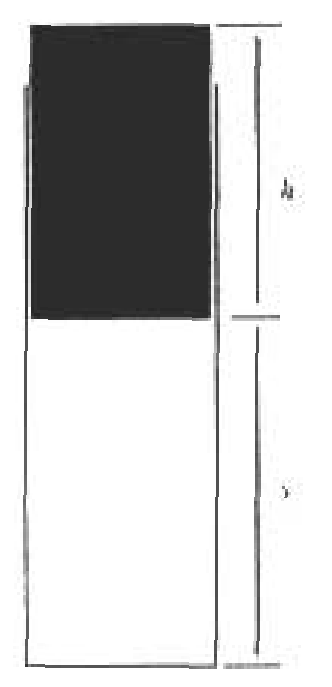
The piston bounces up and down, but eventually comes to rest at a height when the gas in the cylinder is once again in thermal equilibrium with the surroundings. The specific heat capacity at constant volume of the gas in the cylinder is .
a. Find the density of the piston in terms of , , and . [12 т.]
b. Find the numerical value of the ratio . [13 т.]
Решение
a. (12 т.)
First find :
Fast processes are adiabatic processes, especially when we are told that no heat exchange occurs! This means that is a constant, and then
But
so
is a constant. Finally, we can write
Work is done on the gas by the falling cylinder and the external atmosphere. Hence,
where is the mass of the piston. But the cross sections, , are uniform, so we can write and then the work done is
This work must equal the change in internal energy of the gas,
But
and
so
or
But , so
Solve for , and
We actually want the density, so
b. (13 т.)
Eventually the gas temperature returns to and then
The pressure will rise to the point that it can support the cylinder,
so
Rewriting in terms of the ratio ,
and then
Оригинал в Архива: Semifinal 2006.pdf · официални решения: Semifinal 2006 Solutions.pdf