USAPhO 2006, Полуфинал — A4
2006 Semi-Final Exam · 25 т.
2006 Semi-Final Exam — Instructions
AAPT / AIP — United States Physics Team 2006.
DO NOT OPEN THIS TEST UNTIL YOU ARE TOLD TO BEGIN
- Work Part A first. You have 90 minutes to complete all four problems.
- After you have completed Part A, you may take a break.
- Then work Part B. You have 90 minutes to complete both problems.
- Show all your work. Partial credit will be given.
- Start each question on a new sheet of paper. Be sure to put your name in the upper right-hand corner of each page, along with the question number and the page number/total pages for this problem. For example: Doe, Jamie; A1 – 1/3.
- A hand-held calculator may be used. Its memory must be cleared of data and programs. You may use only the basic functions found on a simple scientific calculator. Calculators may not be shared. Cell phones, PDA’s, or cameras may not be used during the exam or while the exam papers are present. You may not use any tables, books, or collections of formulas.
- Questions with the same point value are not necessarily of the same difficulty.
- Do not discuss the contents of this exam with anyone until after March 20th.
- Good luck!
Possibly Useful Information – (Use for both part A and for part B)
| Quantity | Value |
|---|---|
| Gravitational field at the Earth’s surface | N/kg |
| Newton’s gravitational constant | N·m/kg |
| Coulomb’s constant | N·m/C |
| Biot-Savart constant | T·m/A |
| Speed of light in a vacuum | m/s |
| Boltzmann’s constant | J/K |
| Avogadro’s number | (mol) |
| Ideal gas constant | J/(mol·K) |
| Stefan-Boltzmann constant | J/(s·m·K) |
| Elementary charge | C |
| 1 electron volt | J |
| Planck’s constant | |
| Electron mass | |
| Binomial expansion | for |
| Small angle approximations | , |
Copyright © 2006, American Association of Physics Teachers
Условие
A cyclotron is a particle accelerator consisting of dipole magnets that create two semi-circular regions of magnetic field , pointing uniformly down (toward the bottom of the page). These regions are called “Dees” due to their D shape. The two Dees are placed back-to-back, but with a small separation. Consider a small cyclotron of radius . An AC potential , that is switched on at , is applied across the Dee electrodes. The particles are accelerated whenever they cross the gap between the electrodes. The gap is small enough that any variation in during the time it takes a particle to cross the gap may be neglected.
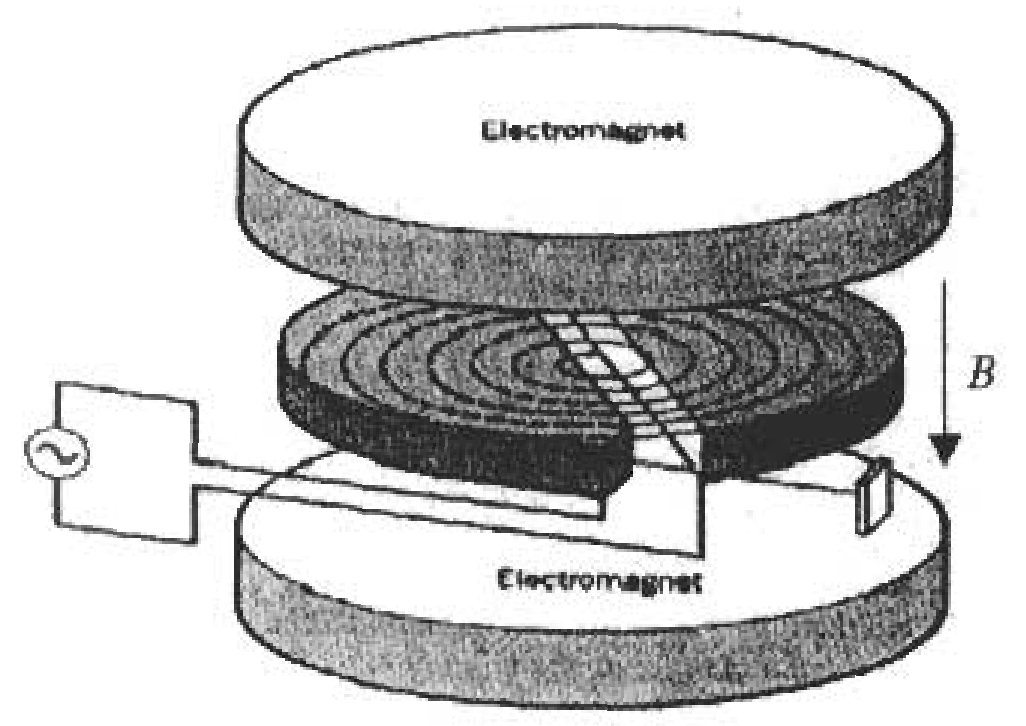
(Source: Wikne, Jon. Oslo Cyclotron Laboratory. 1994. 14 Feb. 2006. http://lynx.uio.no/cycdescr.html.)
The cyclotron is filled with a variety of ions of different masses, but each has the same charge . All ions start at the center of the cyclotron and are emitted when they reach the edge of the cyclotron. An ion will make many laps around the cyclotron before being emitted. Ignore relativistic effects in parts (a)–(c).
In terms of , , , , and ,
a. What is the maximum possible momentum of an emitted ion? [5 т.]
b. Of all of the possible ions that satisfy part (a), what is the kinetic energy of the ion emitted first? [7 т.]
c. At what time after turning on the AC potential are the ions from part (b) emitted? [6 т.]
d. Such a device won’t work well with electrons, as relativistic effects can’t be ignored for energies above one hundred thousand electron-volts. One possible correction is to create a magnetic field that is not constant, but varies with distance from the center of the cyclotron. This enhanced device is called an isochronous cyclotron. Find an expression for the necessary magnetic field in terms of , , (the mass of the electron), and (the charge on the electron). Relativistic effects must be considered. [7 т.]
Решение
a. (5 т.)
The ions move, for the most part, in uniform circular motion under the influence of a magnetic force, so
or
When we have the maximum possible momentum, so
b. (7 т.)
Since
we have
But
so
c. (6 т.)
The ions pick up this kinetic energy from the changing potential, collecting after every revolution. The number of revolutions required is then
and since each revolution requires a time , the total time is given by
d. (7 т.)
The cyclotron works only because the revolution of the charged particle is constant in time. is relativistically correct, but now the velocity is given by the condition that . The angular frequency of revolution needs to be in order to get a boost each half-cycle, so
Then
Putting this into the momentum expression yields
Оригинал в Архива: Semifinal 2006.pdf · официални решения: Semifinal 2006 Solutions.pdf