USAPhO 2006, Полуфинал — B1
2006 Semi-Final Exam · 50 т.
2006 Semi-Final Exam — Instructions
AAPT / AIP — United States Physics Team 2006.
DO NOT OPEN THIS TEST UNTIL YOU ARE TOLD TO BEGIN
- Work Part A first. You have 90 minutes to complete all four problems.
- After you have completed Part A, you may take a break.
- Then work Part B. You have 90 minutes to complete both problems.
- Show all your work. Partial credit will be given.
- Start each question on a new sheet of paper. Be sure to put your name in the upper right-hand corner of each page, along with the question number and the page number/total pages for this problem. For example: Doe, Jamie; A1 – 1/3.
- A hand-held calculator may be used. Its memory must be cleared of data and programs. You may use only the basic functions found on a simple scientific calculator. Calculators may not be shared. Cell phones, PDA’s, or cameras may not be used during the exam or while the exam papers are present. You may not use any tables, books, or collections of formulas.
- Questions with the same point value are not necessarily of the same difficulty.
- Do not discuss the contents of this exam with anyone until after March 20th.
- Good luck!
Possibly Useful Information – (Use for both part A and for part B)
| Quantity | Value |
|---|---|
| Gravitational field at the Earth’s surface | N/kg |
| Newton’s gravitational constant | N·m/kg |
| Coulomb’s constant | N·m/C |
| Biot-Savart constant | T·m/A |
| Speed of light in a vacuum | m/s |
| Boltzmann’s constant | J/K |
| Avogadro’s number | (mol) |
| Ideal gas constant | J/(mol·K) |
| Stefan-Boltzmann constant | J/(s·m·K) |
| Elementary charge | C |
| 1 electron volt | J |
| Planck’s constant | |
| Electron mass | |
| Binomial expansion | for |
| Small angle approximations | , |
Copyright © 2006, American Association of Physics Teachers
Условие
Consider a wire loop of width and height . The loop is held at rest vertically. There is a uniform magnetic field passing through the loop. However, the magnetic field abruptly decreases to zero everywhere below the location of the bottom edge of the loop at . The magnetic field is perpendicular to the plane of the loop. The mass of the loop is . At time , the loop is released from rest so that it begins to fall out of the magnetic field. Let be the distance that the bottom edge has traveled out of the magnetic field at seconds after the loop has been released. .
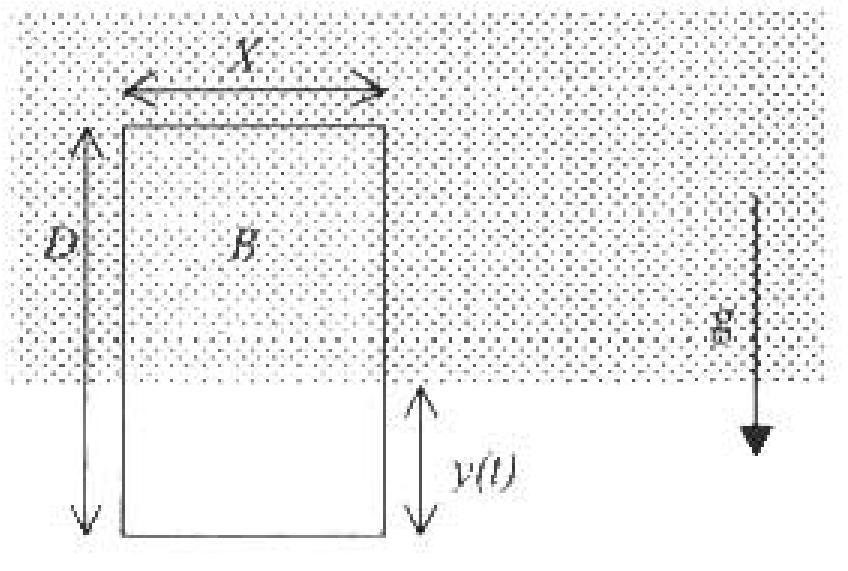
a.
Suppose that the loop has resistance but negligible inductance. Assume that is large enough that the loop very nearly reaches terminal velocity before the loop entirely falls out of the magnetic field. Express your answers to part (a) in terms of , , , , , , and .
i. Find the terminal velocity, , of the loop. [5 т.]
ii. Answers to part (a) ii–iv may include the symbol in addition to any of the symbols listed above.
Derive an expression for velocity as a function of time that is valid until the loop is entirely out of the magnetic field. [7 т.]
iii. Derive an expression for the rate at which thermal energy is dissipated due to the resistance of the loop. [3 т.]
iv. Determine the total amount of thermal energy dissipated from until the time that the top edge of the loop just starts to leave the magnetic field. [5 т.]
b.
Suppose instead that the loop is made of a superconducting material so that it has negligible resistance. In this case, we cannot neglect the self-inductance of the loop . Assume that is large enough that the loop never falls entirely out of the magnetic field. Express your answers to part (b) in terms of , , , , , , and .
i. Prove mathematically that the loop oscillates up and down in simple harmonic motion and determine the period of the oscillation. [12 т.]
ii. Derive an expression for . [6 т.]
iii. Determine the maximum kinetic energy of the loop. [4 т.]
iv. Determine the maximum energy stored in the magnetic field of the loop. [5 т.]
v. At what times is the energy stored in the magnetic field at its maximum value? [3 т.]
(Based on a problem by W. M. Saslow, Am. J. Phys. 55, 986 (1987).)
Решение
Source-legibility note: The signs before in (B1-27) and before the fraction in (B1-31) are indistinct in the retained scan. The displayed equations retain the separately authored archive transcription; neither sign is certified from these pixels. Compare the original key page 7 and page 8. No sign has been inferred from the expected physics.
a.
For simplicity we write instead of . Wherever possible we will solve the problem in the simplest possible manner.
i. The magnitude of the force of gravity on the wire is
the magnitude of the magnetic force on a current in the wire is
the induced emf, , in the wire when traveling with speed is
and finally, the relationship between the emf and current is
Terminal velocity occurs when there is no acceleration, so that the net force is zero. Then
It is traditional to give the terminal speed, and consequently we don’t usually write the negative sign indicating downward motion. Henceforth,
[5 т.]
ii. Let the above symbols, except for , now be variables in time. Define a dot notation for time derivatives, so that velocity is given by
and
The acceleration of the wire is given by Newton’s second law,
We must now integrate this expression,
Solving for :
[7 т.]
iii. Thermal energy dissipates at a rate given by
so
[3 т.]
iv. It is tempting to integrate the above expression. Don’t do it! Instead, focus on the fact that the energy dissipated is equal to the change in energy of the wire. Note that it is moving at terminal speed when it completely leaves the field region, so
[5 т.]
b.
Be warned that we never actually need to find in this problem, so don’t spend time trying to calculate it!
i. Equations B1-1, B1-2, and B1-3 are still true. But now the emf is related to the inductance and the change in current by
The dot above the means time derivative. Combining,
This is the differential equation for a simple harmonic oscillator, with angular frequency given by
The period of oscillation is then
[12 т.]
ii. Oscillatory motion is necessarily of the form
where , , and are constants. Since is a maximum when , we can conclude that . The acceleration will be given by , and the maximum acceleration is then . This maximum acceleration occurs when the object is released, and there is not yet any current through the wire, so, from Eq. B1-28,
Finally, when , so
[6 т.]
iii. Using ,
[4 т.]
iv. At the bottom point of the path all of the “lost” potential energy of the wire must be stored in the magnetic field, so
[5 т.]
v. At the low point of the oscillation the magnetic energy will be maximal, or
[3 т.]
Оригинал в Архива: Semifinal 2006.pdf · официални решения: Semifinal 2006 Solutions.pdf