USAPhO 2007, Полуфинал — Задача 5. B1
AAPT AIP United States Physics Team 2007 — 2007 Semi-Final Exam · 50 т.
Указания
DO NOT OPEN THIS TEST UNTIL YOU ARE TOLD TO BEGIN
Work Part A first. You have 90 minutes to complete all four problems.
After you have completed Part A, you may take a break.
Then work Part B. You have 90 minutes to complete both problems.
Show all your work. Partial credit will be given.
Start each question on a new sheet of paper. Be sure to put your name in the upper right-hand corner of each page, along with the question number and the page number/total pages for this problem. For example,
Doe, Jamie
A1 – 1/3
A hand-held calculator may be used. Its memory must be cleared of data and programs. You may use only the basic functions found on a simple scientific calculator. Calculators may not be shared. Cell phones, PDA’s, or cameras may not be used during the exam or while the exam papers are present. You may not use any tables, books, or collections of formulas.
Questions with the same point value are not necessarily of the same difficulty.
Do not discuss the contents of this exam with anyone until after March 27th.
Good luck!
Possibly Useful Information - (Use for both part A and for part B)
| Gravitational field at the Earth’s surface | |
| Newton’s gravitational constant | |
| Coulomb’s constant | |
| Biot-Savart constant | |
| Speed of light in a vacuum | |
| Boltzmann’s constant | |
| Avogadro’s number | |
| Ideal gas constant | |
| Stefan-Boltzmann constant | |
| Elementary charge | |
| 1 electron volt | |
| Planck’s constant | |
| Electron mass | |
| Binomial expansion | for |
| Small angle approximations | ; |
Условие
A certain mechanical oscillator can be modeled as an ideal massless spring connected to a moveable plate on an incline. The spring has spring constant , the plate has mass , and the incline makes an angle with the horizontal. When the system is operating correctly, the plate oscillates between points and in the figure, located a distance apart. When the plate reaches point it has zero kinetic energy, but then trips a small lever that instantaneously loads a block of mass onto the plate. The block and plate then move down the incline to point , where the force from the spring stops the plate. At this point, the block falls through a hole in the incline, allowing the plate to move back up under the force of the spring. Upon returning to point it collects another block, and the cycle repeats. Both the plate and the block have a coefficient of friction with the incline for both kinetic and static friction. It is reasonable that the motion in either direction is simple harmonic in nature.
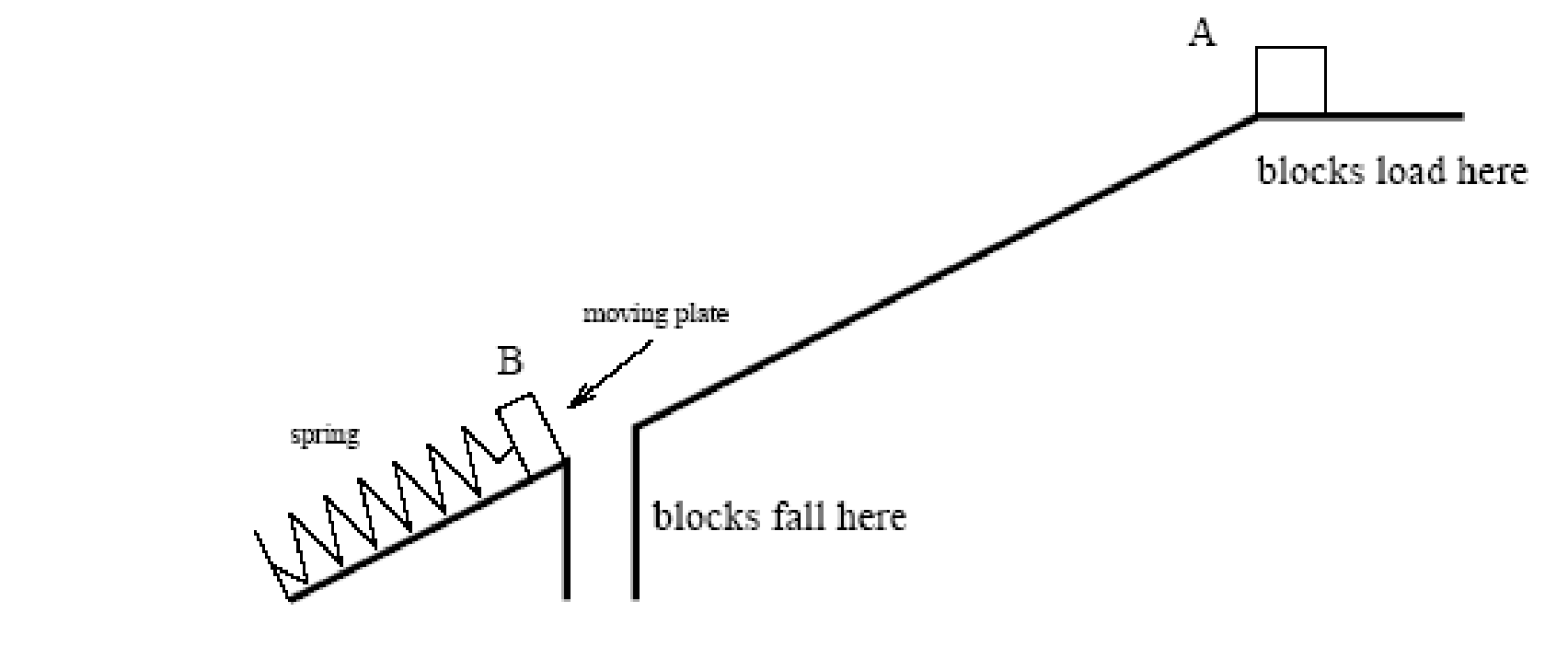
a. Let be the critical value of the coefficient of friction where the block will just start to slide under the force of gravity on an incline (without the spring acting on it). Then let . Find in terms of , the acceleration of free fall, and any or all of the following variables: and . [10 т.]
b. In order for this system to work correctly, it is necessary to have the correct ratio between the mass of the block and the mass of the plate. These masses are chosen so that the downward moving block and plate just stop at point while the upward moving plate just stops at point . Find the ratio . [14 т.]
c. The system delivers blocks to point with period , until the blocks run out. After that, the plate alone oscillates with a period . Find the ratio . [13 т.]
d. The plate only oscillates a few times after delivering the last block. At what distance up the incline, measured from point , does the plate come to a permanent stop? [13 т.]
Отговори
- a.
- b. 2
- c.
- d. Stopping points at n(2mg sin θ)/k and L − n(2mg sin θ)/k; the plate stops at the first of these for which n(2mg sin θ)/k > L/2 or (n + 1/2)(2mg sin θ)/k > L/2.
Решение
a. To not slip, from a free-body diagram, we must have
so
Therefore and hence
b. In one cycle the energy input into the system is
the energy of the block dropping.
The energy loss on the way up is
and the energy loss on the way down is
Thus
and since ,
c. The period of a mass oscillating on a spring of spring constant is
In this case, the friction force is constant on both the up and down trips, and so each trip is simple harmonic (with different equilibrium points). Hence
d. As mentioned in part (c), both the up and down trips are simple harmonic, this time with a mass of both ways. The equilibrium points for the two trips are different, however. On the up trip, the equilibrium point is clearly at a distance from , since the plate stops at both and and hence those are the endpoints of the oscillation and the equilibrium is halfway between. For the trip down, the equilibrium point will shift by a distance such that
because is the difference between the friction forces on the trip up and the trip down.
The place where the plate finally comes to a stop is the first place that is at the end of an oscillation (either up or down) and where the total force being exerted by gravity and the spring is less than the maximal force of friction. For that to happen, the plate needs to not have gone past the other equilibrium point during that oscillation.
So we start by determining where the endpoints of the oscillations are. For the first trip up these are and . For the following trip down, the plate stops at a distance of from (because the equilibrium shifts up by . For the following trip up, the plate stops a distance from , since the equilibrium point is again in the middle of the incline. And so forth.
Thus the stopping points are located at
for integer . The plate will stop permanently once either
or
whichever happens first. (The first condition corresponds to going down and ending up above the midpoint at the end of the down trip, the second condition corresponds to going up and stopping below the upper equilibrium.) The second condition can be rewritten as
Оригинал в Архива: olympiad_2007_semi-final.pdf · официални решения: olympiad_2007_semi-final_soln.pdf