USAPhO 2008, Четвъртфинал — Задача 2
2008 Quarter-Final Exam · 25 т.
Указания
4 QUESTIONS - 60 MINUTES
DO NOT OPEN THIS TEST UNTIL YOU ARE TOLD TO BEGIN
Show all your work. Partial credit will be given.
Start each question on a new sheet of paper. Put your name in the upper right-hand corner of each page, along with the question number and the page number/total pages for this problem. For example,
Doe, Jamie
Prob. 1 - P. 1/3
A hand-held calculator may be used. Its memory must be cleared of data and programs. You may use only the basic functions found on a simple scientific calculator. Calculators may not be shared.
Cell phones may not be used during the exam or while the exam papers are present. You may not use any tables, books, or collections of formulas.
Each of the four questions is worth 25 points. The questions are not necessarily of the same difficulty. Good luck!
In order to maintain exam security, do not communicate any information about the questions (or their answers or solutions) on this contest until after March 10, 2008.
Условие
A uniform pool ball of radius and mass begins at rest on a pool table. The ball is given a horizontal impulse of fixed magnitude at a distance above its center, where . The coefficient of kinetic friction between the ball and the pool table is . You may assume the ball and the table are perfectly rigid. Ignore effects due to deformation. (The moment of inertia about the center of mass of a solid sphere of mass and radius is .)
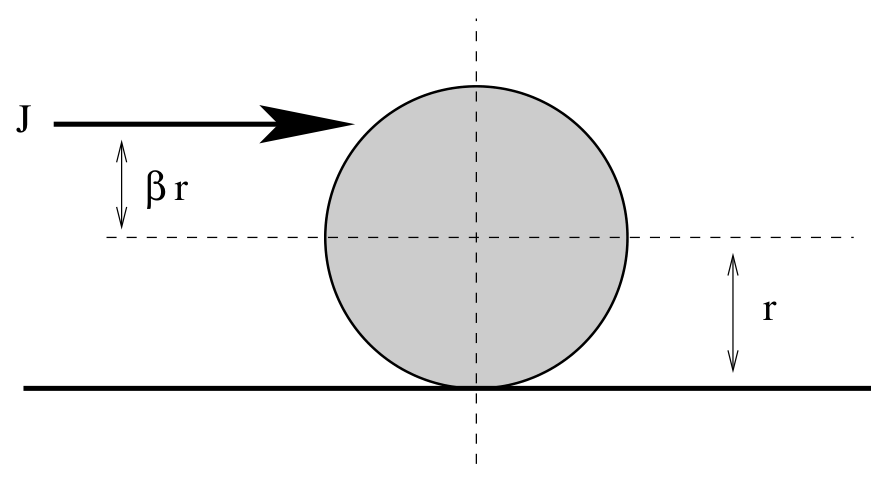
(a) Find an expression for the final speed of the ball as a function of , , and .
(b) For what value of does the ball immediately begin to roll without slipping, regardless of the value of ?
Отговори
- (a)
- (b)
Решение
Solution 1:
(a) Consider an axis perpendicular to the initial impulse and coplanar with the table. (Throughout this solution we consider only torques and angular momenta with respect to this axis.) After the initial impulse, the torque about this axis is always zero, so angular momentum is conserved. The initial impulse occurs a perpendicular distance from the axis, so the angular momentum is
After the ball has skidded along the table for a certain distance, it will begin to roll without slipping. At that point, .
Meanwhile, its moment of inertia about this axis is (by the parallel-axis theorem) , so that its final angular velocity is given by
Therefore,
(b) The ball acquires linear momentum as a result of the horizontal impulse, so its initial velocity is given by
We want the initial angular velocity and initial velocity to satisfy the no-slip condition ; thus
Solution 2:.
Consider torques and angular momenta about the center of mass. If the horizontal impulse is large compared with the horizontal impulse from friction during the time that the cue stick is in contact with the ball, then angular impulse = change in angular momentum becomes:
Linear impulse = change in linear momentum yields:
(b) We want the initial angular velocity and initial velocity to satisfy the no-slip condition ; thus
(a) In the case that the ball does not immediately begin to roll without slipping, friction will exert an angular impulse, , about the center of mass of the ball as the ball skids along the surface:
Friction will also exert a linear impulse that will cause a change in linear momentum:
Combining the last two equations:
After the ball has skidded along the table for a certain distance, it will begin to roll without slipping. At that point, .
Now, using the relationships between the impulse and the initial angular and linear momentum,
Оригинал в Архива: olympiad_2008_quarter-final.pdf · официални решения: olympiad_2008_quarter-final_soln.pdf