USAPhO 2008, Четвъртфинал — Задача 3
2008 Quarter-Final Exam · 25 т.
Указания
4 QUESTIONS - 60 MINUTES
DO NOT OPEN THIS TEST UNTIL YOU ARE TOLD TO BEGIN
Show all your work. Partial credit will be given.
Start each question on a new sheet of paper. Put your name in the upper right-hand corner of each page, along with the question number and the page number/total pages for this problem. For example,
Doe, Jamie
Prob. 1 - P. 1/3
A hand-held calculator may be used. Its memory must be cleared of data and programs. You may use only the basic functions found on a simple scientific calculator. Calculators may not be shared.
Cell phones may not be used during the exam or while the exam papers are present. You may not use any tables, books, or collections of formulas.
Each of the four questions is worth 25 points. The questions are not necessarily of the same difficulty. Good luck!
In order to maintain exam security, do not communicate any information about the questions (or their answers or solutions) on this contest until after March 10, 2008.
Условие
A block of mass slides on a circular track of radius whose wall and floor both have coefficient of kinetic friction with the block. The size of the block is small compared to the radius of the track. The floor lies in a horizontal plane and the wall is vertical. The block is in constant contact with both the wall and the floor. The block has initial speed .
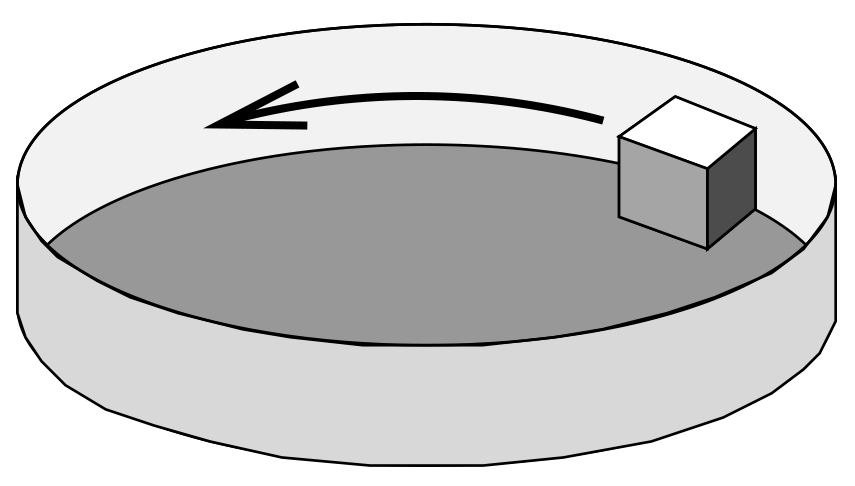
(a) Let the block have kinetic energy after traveling through an angle . Derive an expression for in terms of , , , and .
(b) Suppose the block circles the track exactly once before coming to a halt. Determine in terms of , , and .
Отговори
- (a)
- (b)
Решение
Solution Let be the speed of the block after it has traveled through an angle . When we apply Newton's Second Law to the block as it is traveling around the circular path of radius at a speed , we find that the force of the wall on the block, , is
and the force of the floor on the block, , is
Therefore, the total force of friction on the block is
Let denote the loss of kinetic energy as a result of the work that friction does on the block when it has traveled through an angle . The block will travel a distance as it travels through an angle .
Then,
Now, substituting in the expressions for , we find
where we have simply used the fact that the kinetic energy is .
(b) Now, we separate variables and solve the differential equation.
Exponentiating both sides, yields
Let denote the initial kinetic energy. Then, using initial conditions, we find that .
Now, using the fact that when , we obtain
Solving for ,
Then, using , and we find that
Оригинал в Архива: olympiad_2008_quarter-final.pdf · официални решения: olympiad_2008_quarter-final_soln.pdf