USAPhO 2008, Полуфинал — Задача 6. Question B2
AAPT AIP UNITED STATES PHYSICS TEAM 2008 — Semifinal Exam · 50 т.
Important Instructions for the Exam Supervisor
DO NOT DISTRIBUTE THIS PAGE
- This examination consists of three parts.
- Part A has four questions and is allowed 90 minutes.
- Part B has two questions and is allowed 90 minutes.
- Part C has one question and is allowed 20 minutes. The answer for Part C will not be used for team selection, but will be used for special recognition from the Optical Society of America.
- The first page that follows is a cover sheet. Examinees may keep the cover sheet for all three parts of the exam.
- The three parts are then identified by the center header on each page. Examinees are only allowed to do one part at a time, and may not work on other parts, even if they have time remaining.
- Allow 90 minutes to complete Part A. Do not let students look at Part B or Part C. Collect the answers to Part A before allowing the examinee to begin Part B. Examinees are allowed a 10 to 15 minutes break between parts A and B.
- Allow 90 minutes to complete Part B. Do not let students look at Part C or go back to Part A. Collect the answers to part B before allowing the examinee to begin Part C. Examinees are allowed a 10 to 15 minutes break between Parts B and C.
- Allow 20 minutes to complete Part C. This part is optional; scores on Part C will not be used to select the US Team. Examinees may not go back to Part A or B.
- Ideally the test supervisor will divide the question paper into 4 parts: the cover sheet (page 2), Part A (pages 3-7), Part B (pages 8-10), and Part C (page 11). Examinees should be provided the parts individually, although they may keep the cover sheet.
- The supervisor must collect all examination questions, including the cover sheet, at the end of the exam, as well as any scratch paper used by the examinees. Examinees may not take the exam questions. The examination questions may be returned to the students after March 31, 2008.
- Examinees are allowed calculators, but they may not use symbolic math, programming, or graphic features of these calculators. Calculators may not be shared and their memory must be cleared of data and programs. Cell phones, PDA's or cameras may not be used during the exam or while the exam papers are present. Examinees may not use any tables, books, or collections of formulas.
- Please provide the examinees with graph paper for Part A.
Указания
DO NOT OPEN THIS TEST UNTIL YOU ARE TOLD TO BEGIN
Work Part A first. You have 90 minutes to complete all four problems. Each question is worth 25 points. Do not look at Parts B or C during this time.
After you have completed Part A you may take a break.
Then work Part B. You have 90 minutes to complete both problems. Each question is worth 50 points. Do not look at Parts A or C during this time.
Show all your work. Partial credit will be given. Do not write on the back of any page. Do not write anything that you wish graded on the question sheets.
Start each question on a new sheet of paper. Put your school ID number, your name, the question number and the page number/total pages for this problem, in the upper right hand corner of each page. For example,
School ID #
Doe, Jamie
A1 - 1/3A hand-held calculator may be used. Its memory must be cleared of data and programs. You may use only the basic functions found on a simple scientific calculator. Calculators may not be shared. Cell phones, PDA's or cameras may not be used during the exam or while the exam papers are present. You may not use any tables, books, or collections of formulas.
Questions with the same point value are not necessarily of the same difficulty.
Part C is an optional part of the test. You will be given 20 additional minutes to complete Part C. Your score on Part C will not affect the selection for the US Team, but can be used for special prizes and recognition to be awarded by the Optical Society of America.
In order to maintain exam security, do not communicate any information about the questions (or their answers/solutions) on this contest until after March 31, 2008.
Possibly Useful Information
Possibly Useful Information. You may use this sheet for all three parts of the exam.
for
for for
Условие
Consider a parallel plate capacitor with the plates vertical. The plates of the capacitor are rigidly supported in place. The distance between the plates is . The plates have height and area . Assume throughout this problem that the force of air resistance may be neglected; however, the force of gravity cannot be neglected. Neglect any edge effects as well as any magnetic effects.
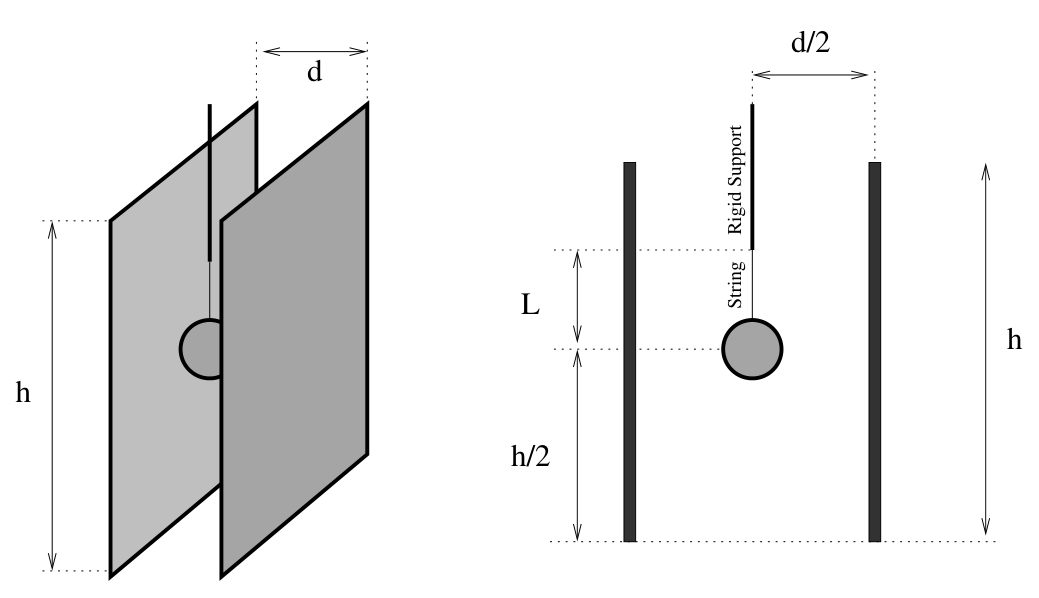
a. A small metal ball with a mass and a charge is suspended from a string of length that is tied to a rigid support. When the capacitor is not charged, the metal ball is located at the center of the capacitor— at a distance from both plates and at a height above the bottom edge of the plates. If instead a constant potential difference is applied across the plates, the string will make an angle to the vertical when the metal ball is in equilibrium.
a. i. Determine in terms of the given quantities and fundamental constants.
a. ii. The metal ball is then lifted until it makes an angle to the vertical where is only slightly greater than . The metal ball is then released from rest. Show that the resulting motion is simple harmonic motion and find the period of the oscillations in terms of the given quantities and fundamental constants.
a. iii. When the ball is at rest in the equilibrium position , the string is cut. What is the maximum value for so that the ball will not hit one of the plates before exiting? Express your answer in terms of the given quantities and fundamental constants.
b. Suppose instead that the ball of mass and charge is released from rest at a point halfway between the plates at a time . Now, an AC potential difference is also placed across the capacitor. The ball may hit one of the plates before it falls (under the influence of gravity) out of the region between the plates. If is sufficiently large, this will only occur for some range of angular frequencies . You may assume that and . Making these assumptions, find expressions for and in terms of the given quantities and/or fundamental constants.
c. Assume that the region between the plates is not quite a vacuum, but instead humid air with a uniform resistivity . Ignore any effects because of the motion of the ball, and assume that the humid air doesn't change the capacitance of the original system.
c. i. Determine the resistance between the plates.
c. ii. If the plates are originally charged to a constant potential source , and then the potential is removed, how much time is required for the potential difference between the plates to decrease to a value of , where ?
c. iii. If the plates are instead connected to an AC potential source so that the potential difference across the plates is , determine the amplitude of the alternating current through the potential source.
Отговори
a. i.
a. ii.
a. iii.
b.
c. i.
c. ii.
c. iii.
The official solution continues with the printed forms and ; the square on and on is missing in the source.
Решение
a. i. The electric field between the plates is . In equilibrium, the horizontal and vertical components of the tension balance the electrostatic and gravitational forces. Consequently,
ii. The simplest way to see this is to note that the electric field, for the purpose of this metal ball alone, acts like an effective extra horizontal contribution to the gravitational field. The system is thus a simple pendulum experiencing tilted gravity, which we know performs simple harmonic motion for small amplitudes. Then
iii. Upon cutting the string the ball will move in a straight line, tangent to the angle the string originally made. So it will leave the region between the plates a distance
away from the center line. Setting this equal to and solving for gives
b. The ball will experience an oscillating force in the direction of
Hence, the component of the acceleration will be
The ball is released from rest, so this can be directly integrated to give the component of the velocity,
This can be integrated again to find the position relative to the center, which we will define as ,
The ball hits one of the plates if this value exceeds while it is still in the region between the plates. It exits this region when .
For , we may perform a small angle approximation,
yielding
As for , we may neglect the term entirely, for
At higher frequencies the ball will miss, falling out of the plates before it hits either side.
c. i. The resistance between the plates is given by
ii. This is an circuit, with characteristic time
iii. The AC circuit is effectively a capacitor in parallel with a resistor. The current through each is ninety degrees out of phase, so if the magnitudes of the current through the capacitor and the resistor are known, then
Since the devices are in parallel, the potential drop across either are equal. We have
Then
Оригинал в Архива: olympiad_2008_semi-final.pdf · официални решения: USAPhO-2008-Solutions.pdf