USAPhO 2010, Полуфинал — Задача 5. Question B1
AAPT AIP United States Physics Team 2010 — Semifinal Exam · 50 т.
Important Instructions for the Exam Supervisor
DO NOT DISTRIBUTE THIS PAGE
- This examination consists of two parts.
- Part A has four questions and is allowed 90 minutes.
- Part B has two questions and is allowed 90 minutes.
- The first page that follows is a cover sheet. Examinees may keep the cover sheet for both parts of the exam.
- The parts are then identified by the center header on each page. Examinees are only allowed to do one part at a time, and may not work on other parts, even if they have time remaining.
- Allow 90 minutes to complete Part A. Do not let students look at Part B. Collect the answers to Part A before allowing the examinee to begin Part B. Examinees are allowed a 10 to 15 minutes break between parts A and B.
- Allow 90 minutes to complete Part B. Do not let students go back to Part A.
- Ideally the test supervisor will divide the question paper into 3 parts: the cover sheet (page 2), Part A (pages 3-4), and Part B (pages 6-7). Examinees should be provided parts A and B individually, although they may keep the cover sheet.
- The supervisor must collect all examination questions, including the cover sheet, at the end of the exam, as well as any scratch paper used by the examinees. Examinees may not take the exam questions. The examination questions may be returned to the students after March 31, 2010.
- Examinees are allowed calculators, but they may not use symbolic math, programming, or graphic features of these calculators. Calculators may not be shared and their memory must be cleared of data and programs. Cell phones, PDA’s or cameras may not be used during the exam or while the exam papers are present. Examinees may not use any tables, books, or collections of formulas.
Указания
DO NOT OPEN THIS TEST UNTIL YOU ARE TOLD TO BEGIN
Work Part A first. You have 90 minutes to complete all four problems. Each question is worth 25 points. Do not look at Part B during this time.
After you have completed Part A you may take a break.
Then work Part B. You have 90 minutes to complete both problems. Each question is worth 50 points. Do not look at Part A during this time.
Show all your work. Partial credit will be given. Do not write on the back of any page. Do not write anything that you wish graded on the question sheets.
Start each question on a new sheet of paper. Put your school ID number, your name, the question number and the page number/total pages for this problem, in the upper right hand corner of each page. For example,
School ID #
Doe, Jamie
A1 - 1/3
A hand-held calculator may be used. Its memory must be cleared of data and programs. You may use only the basic functions found on a simple scientific calculator. Calculators may not be shared. Cell phones, PDA’s or cameras may not be used during the exam or while the exam papers are present. You may not use any tables, books, or collections of formulas.
Questions with the same point value are not necessarily of the same difficulty.
In order to maintain exam security, do not communicate any information about the questions (or their answers/solutions) on this contest until after March 31, 2010.
Possibly Useful Information. You may use this sheet for both parts of the exam.
| for | |
| for | for |
Условие
A thin plank of mass and length rotates about a pivot at its center. A block of mass slides on the top of the plank. The system moves without friction. Initially, the plank makes an angle with the horizontal, the block is at the upper end of the plank, and the system is at rest. Throughout the problem you may assume that , and that the physical dimensions of the block are much, much smaller than the length of the plank.
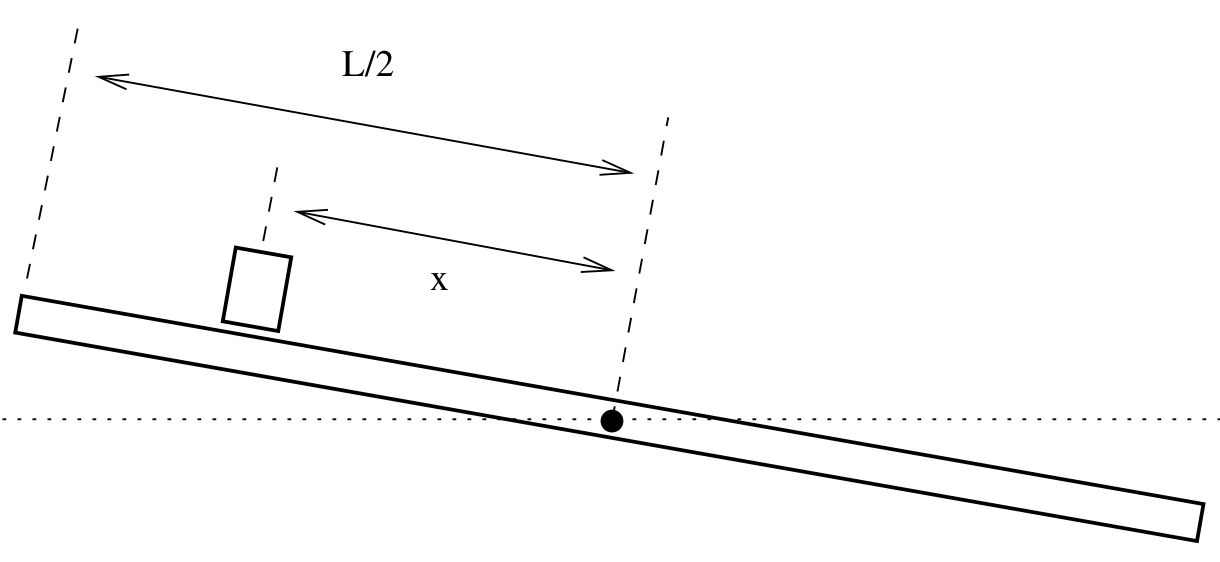
Let be the displacement of the block along the plank, as measured from the pivot, and let be the angle between the plank and the horizontal. You may assume that centripetal acceleration of the block is negligible compared with the linear acceleration of the block up and down the plank.
a. For a certain value of , throughout the motion, where is a constant. What is this value of ? Express your answer in terms of , , and any fundamental constants that you require.
b. Given that takes this special value, what is the period of oscillation of the system? Express your answer in terms of , , and any fundamental constants that you require.
c. Determine the maximum value of the ratio between the centripetal acceleration of the block and the linear acceleration of the block along the plank, writing your answer in terms of and , therefore justifying our approximation.
Отговори
- a.
- b.
- c.
Решение
a. The moment of inertia of the plank about its pivot is
and it is acceptable to simply write this down. The magnitude of the torque on the plank is
so the angular acceleration is
We may neglect the rotational inertia of the block, since . Next, the linear acceleration of the block is
It looks like we’ve derived two copies of the simple harmonic oscillator equation. However, the position of the block determines the linear restoring force for the plank, while the angular position of the plank determines the linear restoring force for the board. Hence the general solution will not look anything like simple harmonic motion; instead the block will most likely fall off the plank. The block and plank will only oscillate together for one special value of .
To find this special value, suppose throughout. Then
Differentiating, we have . Using these to eliminate and above, we have
This is only self-consistent if the coefficients are equal, so
b. Referring to one of our previous equations,
and the period of the motion is
One can trivially simplify to get an explicit expression for , though this isn’t necessary.
c. The centripetal acceleration is
Now , so the ratio is
which is indeed always small. If we did account for the centripetal acceleration, then there still would be a value for where the block and plank oscillate together, but the motion would not be precisely simple harmonic, and the equations would be too complicated to solve.
STOP: Do Not Continue to Part B
If there is still time remaining for Part A, you should review your work for Part A, but do not continue to Part B until instructed by your exam supervisor.
Оригинал в Архива: 2010_SemiFinal.pdf · официални решения: USAPhO-2010-Solutions.pdf