USAPhO 2010, Полуфинал — Задача 6. Question B2
AAPT AIP United States Physics Team 2010 — Semifinal Exam · 50 т.
Important Instructions for the Exam Supervisor
DO NOT DISTRIBUTE THIS PAGE
- This examination consists of two parts.
- Part A has four questions and is allowed 90 minutes.
- Part B has two questions and is allowed 90 minutes.
- The first page that follows is a cover sheet. Examinees may keep the cover sheet for both parts of the exam.
- The parts are then identified by the center header on each page. Examinees are only allowed to do one part at a time, and may not work on other parts, even if they have time remaining.
- Allow 90 minutes to complete Part A. Do not let students look at Part B. Collect the answers to Part A before allowing the examinee to begin Part B. Examinees are allowed a 10 to 15 minutes break between parts A and B.
- Allow 90 minutes to complete Part B. Do not let students go back to Part A.
- Ideally the test supervisor will divide the question paper into 3 parts: the cover sheet (page 2), Part A (pages 3-4), and Part B (pages 6-7). Examinees should be provided parts A and B individually, although they may keep the cover sheet.
- The supervisor must collect all examination questions, including the cover sheet, at the end of the exam, as well as any scratch paper used by the examinees. Examinees may not take the exam questions. The examination questions may be returned to the students after March 31, 2010.
- Examinees are allowed calculators, but they may not use symbolic math, programming, or graphic features of these calculators. Calculators may not be shared and their memory must be cleared of data and programs. Cell phones, PDA’s or cameras may not be used during the exam or while the exam papers are present. Examinees may not use any tables, books, or collections of formulas.
Указания
DO NOT OPEN THIS TEST UNTIL YOU ARE TOLD TO BEGIN
Work Part A first. You have 90 minutes to complete all four problems. Each question is worth 25 points. Do not look at Part B during this time.
After you have completed Part A you may take a break.
Then work Part B. You have 90 minutes to complete both problems. Each question is worth 50 points. Do not look at Part A during this time.
Show all your work. Partial credit will be given. Do not write on the back of any page. Do not write anything that you wish graded on the question sheets.
Start each question on a new sheet of paper. Put your school ID number, your name, the question number and the page number/total pages for this problem, in the upper right hand corner of each page. For example,
School ID #
Doe, Jamie
A1 - 1/3
A hand-held calculator may be used. Its memory must be cleared of data and programs. You may use only the basic functions found on a simple scientific calculator. Calculators may not be shared. Cell phones, PDA’s or cameras may not be used during the exam or while the exam papers are present. You may not use any tables, books, or collections of formulas.
Questions with the same point value are not necessarily of the same difficulty.
In order to maintain exam security, do not communicate any information about the questions (or their answers/solutions) on this contest until after March 31, 2010.
Possibly Useful Information. You may use this sheet for both parts of the exam.
| for | |
| for | for |
Условие
These three parts can be answered independently.
a.
One pair of ends of two long, parallel wires are connected by a resistor, , and a fuse that will break instantaneously if 5 amperes of current pass through it. The other pair of ends are unconnected. A conducting rod of mass is free to slide along the wires under the influence of gravity. The wires are separated by 30 cm, and the rod starts out 10 cm from the resistor and fuse. The whole system is placed in a uniform, constant magnetic field of as shown in the figure. The resistance of the rod and the wires is negligible. When the rod is released is falls under the influence of gravity, but never loses contact with the long parallel wires.
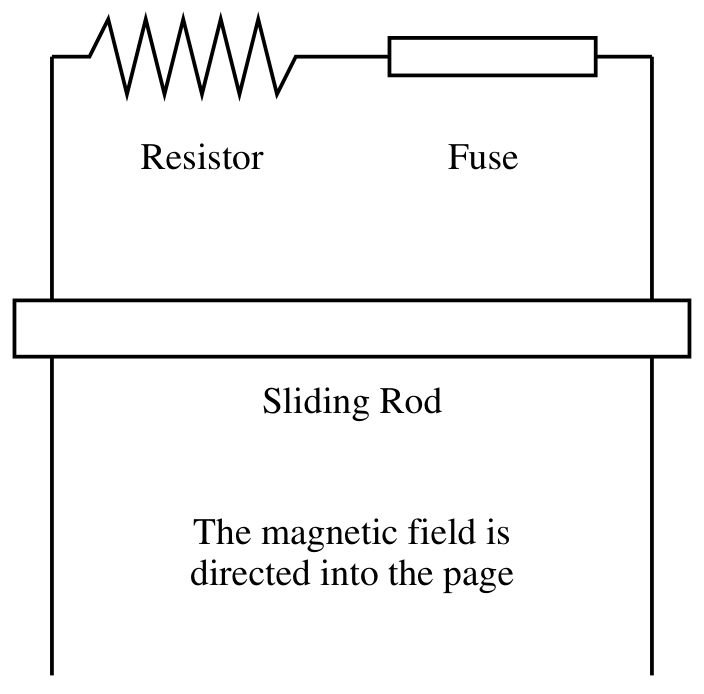
i. What is the smallest mass needed to break the fuse?
ii. How fast is the mass moving when the fuse breaks?
b.
A fuse is composed of a cylindrical wire with length and radius . The resistivity (not resistance!) of the fuse is small, and given by . Assume that a uniform current flows through the fuse. Write your answers below in terms of , , , , and any fundamental constants.
i. What is the magnitude and direction of the electric field on the surface of the fuse wire?
ii. What is the magnitude and direction of the magnetic field on the surface of the fuse wire?
iii. The Poynting vector, is a measure of the rate of electromagnetic energy flow through a unit surface area; the vector gives the direction of the energy flow. Since , where is the permeability of free space and and and are the electric and magnetic field vectors, find the magnitude and direction of the Poynting vector associated with the current in the fuse wire.
c.
A fuse will break when it reaches its melting point. We know from modern physics that a hot object will radiate energy (approximately) according to the black body law , where is the temperature in Kelvin, the surface area, and is the Stefan-Boltzmann constant. If is the melting point of the metal for the fuse wire, with resistivity , and is the desired breaking current, what should be the radius of the wire ?
Отговори
0.35 mm
Answer to part c.
a., i. 0.18 kg
a., ii. 3.5 m/s
b., i.
Directed along the fuse.
b., ii.
Points along the circumference.
b., iii.
Directed into the fuse wire.
Решение
a.
i. As the rod accelerates downward, the rate of change in flux increases, increasing the emf and hence the current through the fuse. This produces an upward force on the rod, so if the fuse were indestructible, the rod would eventually reach terminal velocity. Hence the smallest mass that can break the fuse is the one which breaks it just as it reaches terminal velocity.
The maximal possible force on the rod comes when the fuse is about to break,
This force must be exerted at terminal velocity, so its magnitude is , and
ii. We must relate the force on the rod to the rod’s velocity. The emf in the circuit is
where is the speed of the rod, so using Ohm’s law,
Rearranging to solve for , we have
b.
i. The electric field is responsible for pushing current through the fuse, so it must be directed along the fuse. The resistance of the fuse is
By the definition of the electric field, where is the voltage across the fuse. By Ohm’s law we have
ii. By Ampere’s law, the magnetic field is
and it points along the circumference.
iii. Since the electric and magnetic fields are perpendicular, the magnitude of the Poynting vector is
Using the right-hand rule, it is directed into the fuse wire, explaining why it heats up. Indeed, according to this analysis the total power delivered to the fuse is
which is precisely equal to .
c. At thermal equilibrium, we have
Setting to and to , and solving for ,
STOP: Do Not Continue to Part B
If there is still time remaining for Part A, you should review your work for Part A, but do not continue to Part B until instructed by your exam supervisor.
Оригинал в Архива: 2010_SemiFinal.pdf · официални решения: USAPhO-2010-Solutions.pdf