USAPhO 2014, Полуфинал — Задача 2. Question A2
USA Physics Olympiad Exam — Part A / Part B · 25 т.
Внимание: Бележка към темата
The printed key is retained with its source defects: A3(a)(i) has a factor 1/2 in the expanded cubic term; A3(b)(ii) switches from question distance d to h; A4(b)(ii) prints r < b before describing the exterior field; B2(a)(i) drops the subscript 0 in one denominator. These are source discrepancies, not silent editorial corrections.
Important Instructions for the Exam Supervisor — DO NOT DISTRIBUTE THIS PAGE
- This examination consists of two parts.
- Part A has four questions and is allowed 90 minutes.
- Part B has two questions and is allowed 90 minutes.
- The first page that follows is a cover sheet. Examinees may keep the cover sheet for both parts of the exam.
- The parts are then identified by the center header on each page. Examinees are only allowed to do one part at a time, and may not work on other parts, even if they have time remaining.
- Allow 90 minutes to complete Part A. Do not let students look at Part B. Collect the answers to Part A before allowing the examinee to begin Part B. Examinees are allowed a 10 to 15 minutes break between parts A and B.
- Allow 90 minutes to complete Part B. Do not let students go back to Part A.
- Ideally the test supervisor will divide the question paper into 4 parts: the cover sheet (page 2), Part A (pages 3–5), Part B (pages 7–8), and several answer sheets for two of the questions in part A (pages 10–13). Examinees should be provided parts A and B individually, although they may keep the cover sheet. The answer sheets should be printed single sided!
- The supervisor must collect all examination questions, including the cover sheet, at the end of the exam, as well as any scratch paper used by the examinees. Examinees may not take the exam questions. The examination questions may be returned to the students after April 15, 2014.
- Examinees are allowed calculators, but they may not use symbolic math, programming, or graphic features of these calculators. Calculators may not be shared, and their memory must be cleared of data and programs. Cell phones, PDA's or cameras may not be used during the exam or while the exam papers are present. Examinees may not use any tables, books, or collections of formulas.
Copyright ©2014 American Association of Physics Teachers.
USA Physics Olympiad Exam — Instructions
DO NOT OPEN THIS TEST UNTIL YOU ARE TOLD TO BEGIN
Work Part A first. You have 90 minutes to complete all four problems. Each question is worth 25 points. Do not look at Part B during this time.
After you have completed Part A, you may take a break.
Then work Part B. You have 90 minutes to complete both problems. Each question is worth 50 points. Do not look at Part A during this time.
Show all your work. Partial credit will be given. Do not write on the back of any page. Do not write anything that you wish graded on the question sheets.
Start each question on a new sheet of paper. Put your AAPT ID number, your name, the question number and the page number/total pages for this problem, in the upper right hand corner of each page. For example,
AAPT ID #
Doe, Jamie
A1 - 1/3
A hand-held calculator may be used. Its memory must be cleared of data and programs. You may use only the basic functions found on a simple scientific calculator. Calculators may not be shared. Cell phones, PDA's or cameras may not be used during the exam or while the exam papers are present. You may not use any tables, books, or collections of formulas.
Questions with the same point value are not necessarily of the same difficulty.
In order to maintain exam security, do not communicate any information about the questions (or their answers/solutions) on this contest until after April 15, 2014.
Possibly Useful Information. You may use this sheet for both parts of the exam.
| Information | Value |
|---|---|
| for | |
| for | |
| for |
Условие
A room air conditioner is modeled as a heat engine run in reverse: an amount of heat is absorbed from the room at a temperature into cooling coils containing a working gas; this gas is compressed adiabatically to a temperature ; the gas is compressed isothermally in a coil outside the house, giving off an amount of heat ; the gas expands adiabatically back to a temperature ; and the cycle repeats. An amount of energy is input into the system every cycle through an electric pump. This model describes the air conditioner with the best possible efficiency.
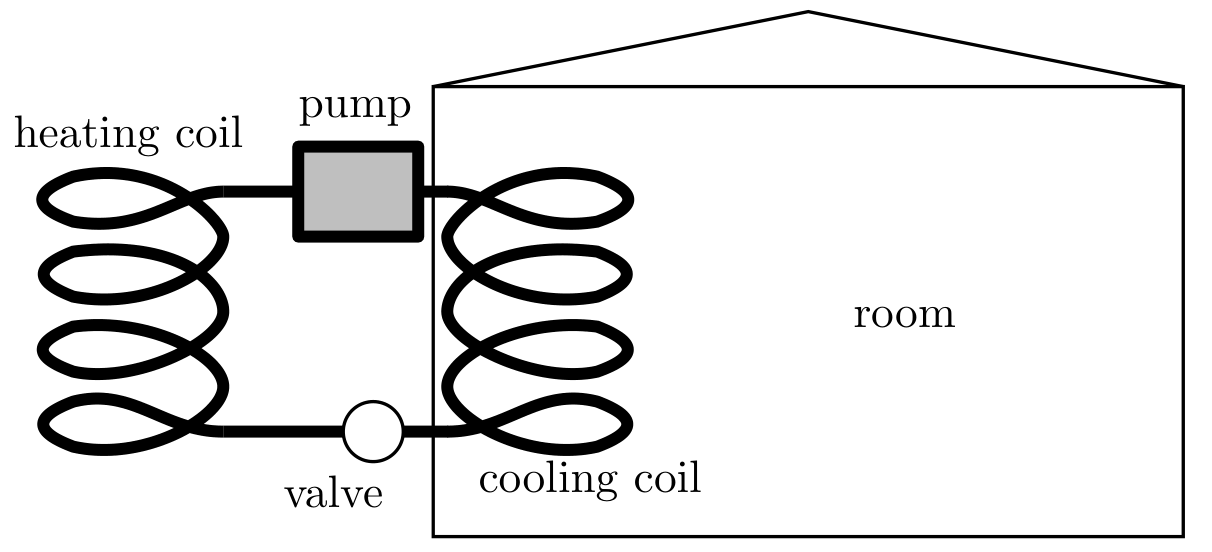
Assume that the outside air temperature is and the inside air temperature is . The air-conditioner unit consumes electric power . Assume that the air is sufficiently dry so that no condensation of water occurs in the cooling coils of the air conditioner. Water boils at 373 K and freezes at 273 K at normal atmospheric pressure.
a. Derive an expression for the maximum rate at which heat is removed from the room in terms of the air temperatures , , and the power consumed by the air conditioner . Your derivation must refer to the entropy changes that occur in a Carnot cycle in order to receive full marks for this part.
b. The room is insulated, but heat still passes into the room at a rate , where is the temperature difference between the inside and the outside of the room and is a constant. Find the coldest possible temperature of the room in terms of , , and .
c. A typical room has a value of . If the outside temperature is , what minimum power should the air conditioner have to get the inside temperature down to ?
Решение
a.
The optimal performance is attained by a Carnot cycle running in reverse. Since a Carnot cycle is reversible, it keeps the total entropy of the heat reservoirs constant. The change in entropy for a reservoir of temperature absorbing heat is , so
Energy conservation states . Eliminating and solving for ,
Finally, the rate of heat removal is , so dividing both sides by ,
b.
We equate with the cooling rate found in the previous section. Writing the equation in terms of and ,
Rearranging, we have
which is a quadratic in . Letting , we have
but only the positive root has physical significance. Therefore,
c.
From our work above,
A common mistake is to forget to convert Celsius to Kelvin.
Оригинал в Архива: USAPhO-2014.pdf · официални решения: USAPhO-2014-Solutions.pdf