USAPhO 2014, Полуфинал — Задача 3. Question A3
USA Physics Olympiad Exam — Part A / Part B · 25 т.
Внимание: Бележка към темата
The printed key is retained with its source defects: A3(a)(i) has a factor 1/2 in the expanded cubic term; A3(b)(ii) switches from question distance d to h; A4(b)(ii) prints r < b before describing the exterior field; B2(a)(i) drops the subscript 0 in one denominator. These are source discrepancies, not silent editorial corrections.
Important Instructions for the Exam Supervisor — DO NOT DISTRIBUTE THIS PAGE
- This examination consists of two parts.
- Part A has four questions and is allowed 90 minutes.
- Part B has two questions and is allowed 90 minutes.
- The first page that follows is a cover sheet. Examinees may keep the cover sheet for both parts of the exam.
- The parts are then identified by the center header on each page. Examinees are only allowed to do one part at a time, and may not work on other parts, even if they have time remaining.
- Allow 90 minutes to complete Part A. Do not let students look at Part B. Collect the answers to Part A before allowing the examinee to begin Part B. Examinees are allowed a 10 to 15 minutes break between parts A and B.
- Allow 90 minutes to complete Part B. Do not let students go back to Part A.
- Ideally the test supervisor will divide the question paper into 4 parts: the cover sheet (page 2), Part A (pages 3–5), Part B (pages 7–8), and several answer sheets for two of the questions in part A (pages 10–13). Examinees should be provided parts A and B individually, although they may keep the cover sheet. The answer sheets should be printed single sided!
- The supervisor must collect all examination questions, including the cover sheet, at the end of the exam, as well as any scratch paper used by the examinees. Examinees may not take the exam questions. The examination questions may be returned to the students after April 15, 2014.
- Examinees are allowed calculators, but they may not use symbolic math, programming, or graphic features of these calculators. Calculators may not be shared, and their memory must be cleared of data and programs. Cell phones, PDA's or cameras may not be used during the exam or while the exam papers are present. Examinees may not use any tables, books, or collections of formulas.
Copyright ©2014 American Association of Physics Teachers.
USA Physics Olympiad Exam — Instructions
DO NOT OPEN THIS TEST UNTIL YOU ARE TOLD TO BEGIN
Work Part A first. You have 90 minutes to complete all four problems. Each question is worth 25 points. Do not look at Part B during this time.
After you have completed Part A, you may take a break.
Then work Part B. You have 90 minutes to complete both problems. Each question is worth 50 points. Do not look at Part A during this time.
Show all your work. Partial credit will be given. Do not write on the back of any page. Do not write anything that you wish graded on the question sheets.
Start each question on a new sheet of paper. Put your AAPT ID number, your name, the question number and the page number/total pages for this problem, in the upper right hand corner of each page. For example,
AAPT ID #
Doe, Jamie
A1 - 1/3
A hand-held calculator may be used. Its memory must be cleared of data and programs. You may use only the basic functions found on a simple scientific calculator. Calculators may not be shared. Cell phones, PDA's or cameras may not be used during the exam or while the exam papers are present. You may not use any tables, books, or collections of formulas.
Questions with the same point value are not necessarily of the same difficulty.
In order to maintain exam security, do not communicate any information about the questions (or their answers/solutions) on this contest until after April 15, 2014.
Possibly Useful Information. You may use this sheet for both parts of the exam.
| Information | Value |
|---|---|
| for | |
| for | |
| for |
Условие
When studying problems in special relativity it is often the invariant distance between two events that is most important, where is defined by
where is the speed of light.
We are using the convention used by Einstein.
a.
Consider the motion of a projectile launched with initial speed at angle of above the horizontal. Assume that , the acceleration of free fall, is constant for the motion of the projectile.
i. Derive an expression for the invariant distance of the projectile as a function of time as measured from the launch, assuming that it is launched at . Express your answer as a function of any or all of , , , , and .
ii. The radius of curvature of an object's trajectory can be estimated by assuming that the trajectory is part of a circle, determining the distance between the end points, and measuring the maximum height above the straight line that connects the endpoints. Assuming that we mean “invariant distance” as defined above, find the radius of curvature of the projectile's trajectory as a function of any or all of , , , and . Assume that the projectile lands at the same level from which it was launched, and assume that the motion is not relativistic, so , and you can neglect terms with compared to terms without.
b.
A rocket ship far from any gravitational mass is accelerating in the positive direction at a constant rate , as measured by someone inside the ship. Spaceman Fred at the right end of the rocket aims a laser pointer toward an alien at the left end of the rocket. The two are separated by a distance such that ; you can safely ignore terms of the form .
i. Sketch a graph of the motion of both Fred and the alien on the space-time diagram provided in the answer sheet. The graph is not meant to be drawn to scale. Note that and are reversed from a traditional graph. Assume that the rocket has velocity at time and is located at position . Clearly indicate any asymptotes, and the slopes of these asymptotes.
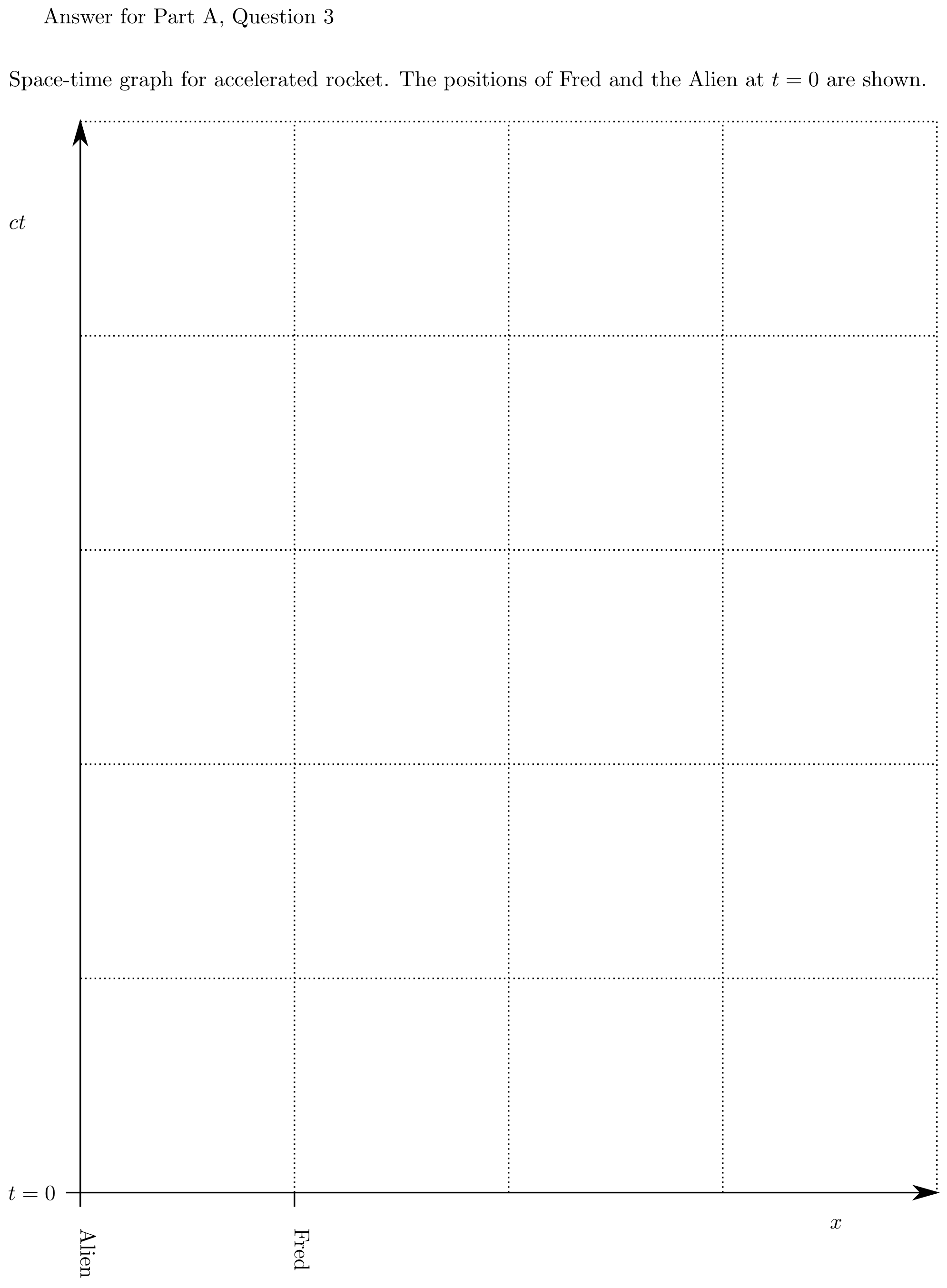
ii. If the frequency of the laser pointer as measured by Fred is , determine the frequency of the laser pointer as observed by the alien. It is reasonable to assume that .
Решение
a. i.
Let the particle start at the origin. Then its path satisfies
by ordinary kinematics. Then
which can be simplified to
a. ii.
Plugging in
the invariant distance between the endpoints is approximately
The maximum height above the ground is
Suppose this path subtends an angle of a circle of radius in spacetime. Then
and eliminating yields
Indeed, if we solved the problem exactly in relativity, we would find that the path of the projectile is a hyperbola in spacetime with semimajor axis . Here we just computed the radius of curvature near the vertex.
b. i.
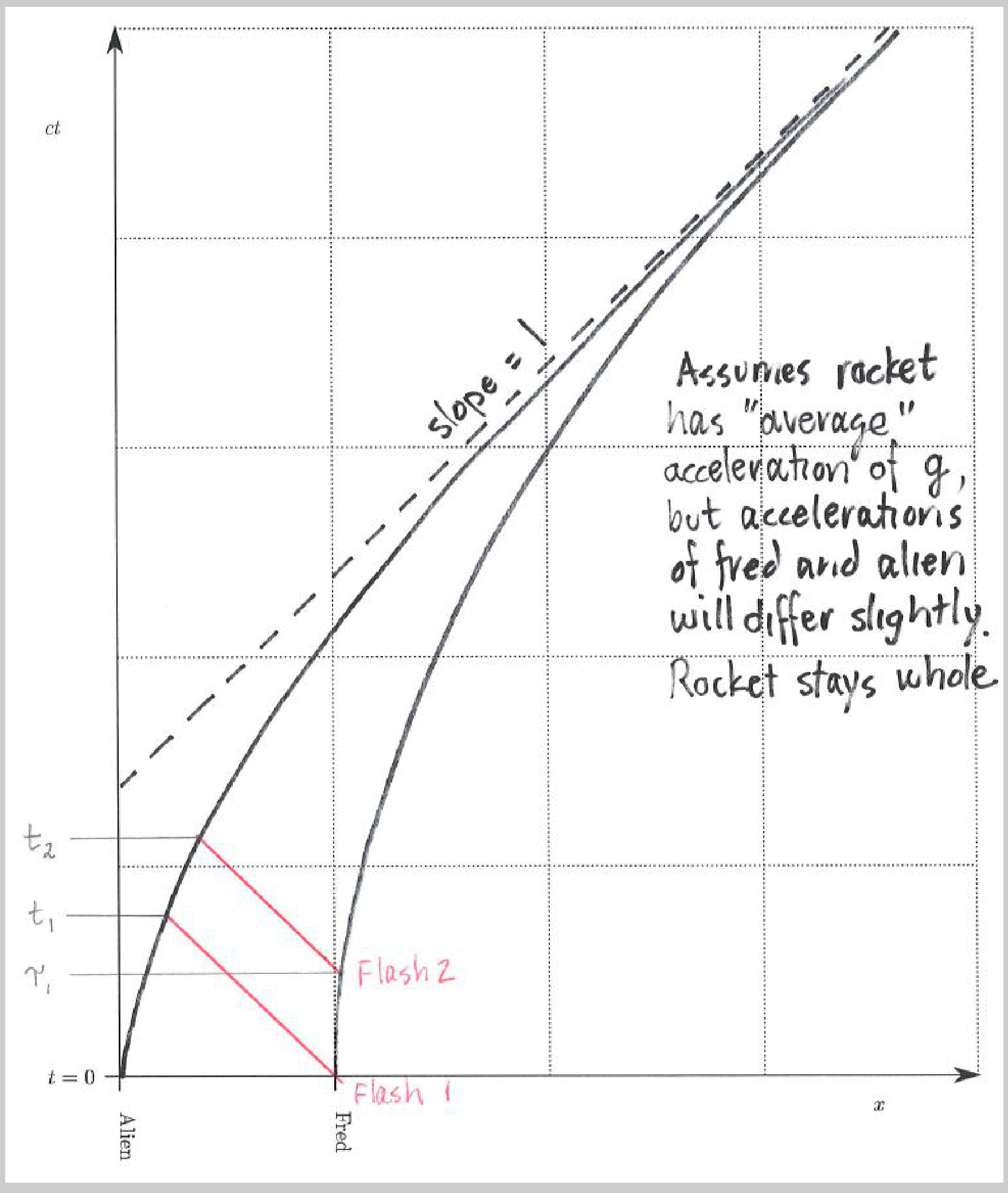
Since the rocket is constantly accelerating but cannot exceed the speed of light, the curves must asymptote with a slope of one; in an exact analysis we would find they are hyperbolas. However, there is a slight challenge to consider: do Fred and the alien approach the same asymptote, or two different asymptotes?
Since the rocket ship is solid, it maintains the same proper length. Since moving objects are length contracted, it must length contract in our diagram, approaching a length of zero. Indeed, if there were no length contraction, then in the instantaneous rest frame of the ship, the ship would be getting longer and longer, eventually breaking apart.
b. ii.
To solve this problem, we replace the light with a series of discrete flashes, then find how the frequencies of these flashes are seen by Fred and the alien. Let Fred emit a flash of light at time and a second flash of light at time , where is very small. Let the alien see the flashes at times and . Then by ordinary kinematics,
Note that we are ignoring time dilation effects because they are second order in the velocity, and hence second order in .
Now subtracting these equations, we have
Defining and simplifying, we have
since is extremely small, so
Since we are working to first order in , we may use on the right-hand side, so
By the equivalence principle, this is a derivation of gravitational redshift.
The problem can also be solved by thinking in terms of the ordinary Doppler effect. Consider Fred's frame at time . In this frame, the alien is also stationary. The light takes a time to reach the alien; at this point the alien has picked up a velocity of . Then using the ordinary Doppler shift formula gives a frequency shift of as seen above. This is valid, as all the effects we implicitly ignored were higher order in , but it harder to see this.
Оригинал в Архива: USAPhO-2014.pdf · официални решения: USAPhO-2014-Solutions.pdf