USAPhO 2014, Полуфинал — Задача 4. Question A4
USA Physics Olympiad Exam — Part A / Part B · 25 т.
Внимание: Бележка към темата
The printed key is retained with its source defects: A3(a)(i) has a factor 1/2 in the expanded cubic term; A3(b)(ii) switches from question distance d to h; A4(b)(ii) prints r < b before describing the exterior field; B2(a)(i) drops the subscript 0 in one denominator. These are source discrepancies, not silent editorial corrections.
Important Instructions for the Exam Supervisor — DO NOT DISTRIBUTE THIS PAGE
- This examination consists of two parts.
- Part A has four questions and is allowed 90 minutes.
- Part B has two questions and is allowed 90 minutes.
- The first page that follows is a cover sheet. Examinees may keep the cover sheet for both parts of the exam.
- The parts are then identified by the center header on each page. Examinees are only allowed to do one part at a time, and may not work on other parts, even if they have time remaining.
- Allow 90 minutes to complete Part A. Do not let students look at Part B. Collect the answers to Part A before allowing the examinee to begin Part B. Examinees are allowed a 10 to 15 minutes break between parts A and B.
- Allow 90 minutes to complete Part B. Do not let students go back to Part A.
- Ideally the test supervisor will divide the question paper into 4 parts: the cover sheet (page 2), Part A (pages 3–5), Part B (pages 7–8), and several answer sheets for two of the questions in part A (pages 10–13). Examinees should be provided parts A and B individually, although they may keep the cover sheet. The answer sheets should be printed single sided!
- The supervisor must collect all examination questions, including the cover sheet, at the end of the exam, as well as any scratch paper used by the examinees. Examinees may not take the exam questions. The examination questions may be returned to the students after April 15, 2014.
- Examinees are allowed calculators, but they may not use symbolic math, programming, or graphic features of these calculators. Calculators may not be shared, and their memory must be cleared of data and programs. Cell phones, PDA's or cameras may not be used during the exam or while the exam papers are present. Examinees may not use any tables, books, or collections of formulas.
Copyright ©2014 American Association of Physics Teachers.
USA Physics Olympiad Exam — Instructions
DO NOT OPEN THIS TEST UNTIL YOU ARE TOLD TO BEGIN
Work Part A first. You have 90 minutes to complete all four problems. Each question is worth 25 points. Do not look at Part B during this time.
After you have completed Part A, you may take a break.
Then work Part B. You have 90 minutes to complete both problems. Each question is worth 50 points. Do not look at Part A during this time.
Show all your work. Partial credit will be given. Do not write on the back of any page. Do not write anything that you wish graded on the question sheets.
Start each question on a new sheet of paper. Put your AAPT ID number, your name, the question number and the page number/total pages for this problem, in the upper right hand corner of each page. For example,
AAPT ID #
Doe, Jamie
A1 - 1/3
A hand-held calculator may be used. Its memory must be cleared of data and programs. You may use only the basic functions found on a simple scientific calculator. Calculators may not be shared. Cell phones, PDA's or cameras may not be used during the exam or while the exam papers are present. You may not use any tables, books, or collections of formulas.
Questions with the same point value are not necessarily of the same difficulty.
In order to maintain exam security, do not communicate any information about the questions (or their answers/solutions) on this contest until after April 15, 2014.
Possibly Useful Information. You may use this sheet for both parts of the exam.
| Information | Value |
|---|---|
| for | |
| for | |
| for |
Условие
A positive point charge is located inside a neutral hollow spherical conducting shell. The shell has inner radius and outer radius ; is not negligible. The shell is centered on the origin.
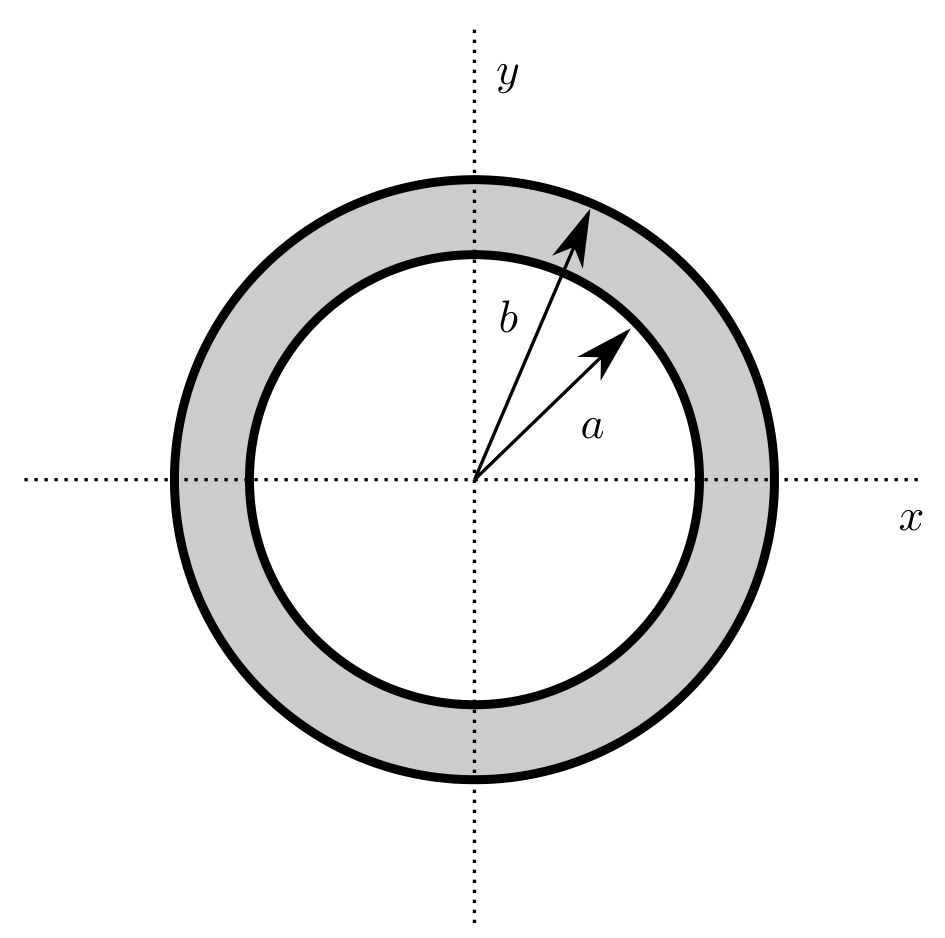
a.
Assume that the point charge is located at the origin in the very center of the shell.
i. Determine the magnitude of the electric field outside the conducting shell at .
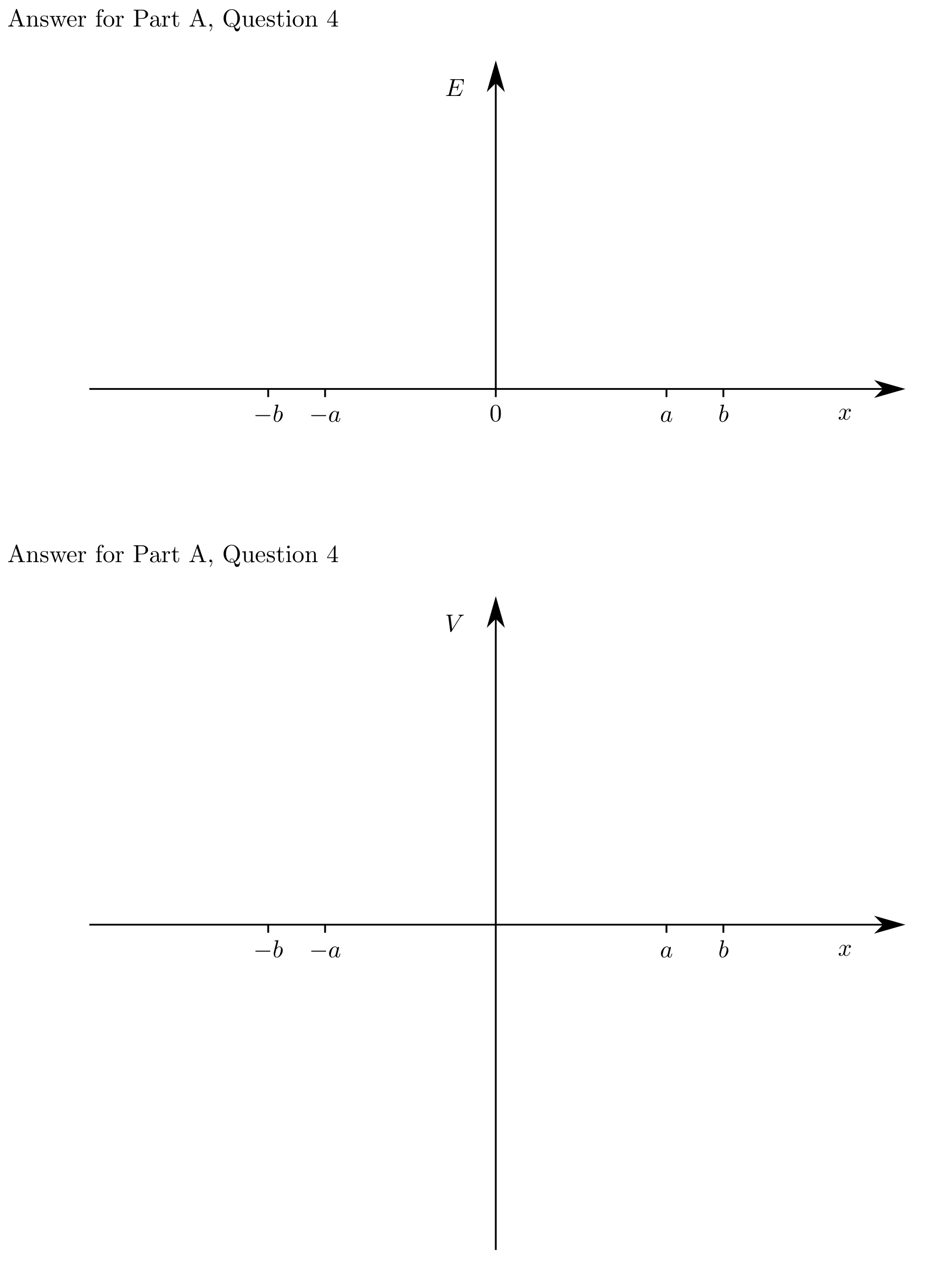
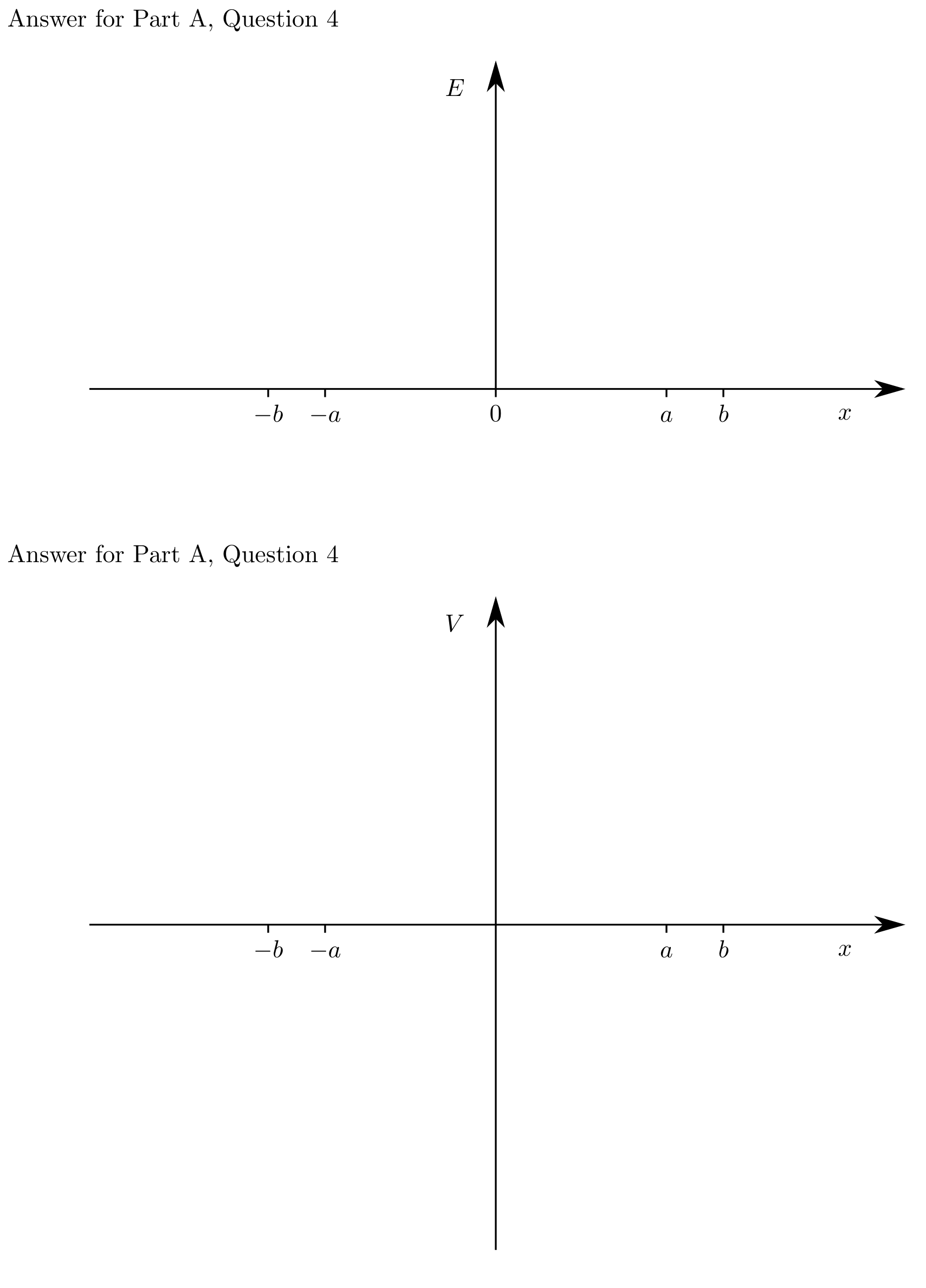
ii. Sketch a graph for the magnitude of the electric field along the axis on the answer sheet provided.
iii. Determine the electric potential at .
iv. Sketch a graph for the electric potential along the axis on the answer sheet provided.
b.
Assume that the point charge is now located on the axis at a point .
i. Determine the magnitude of the electric field outside the conducting shell at .
ii. Sketch a graph for the magnitude of the electric field along the axis on the answer sheet provided.
iii. Determine the electric potential at .
iv. Sketch a graph for the electric potential along the axis on the answer sheet provided.
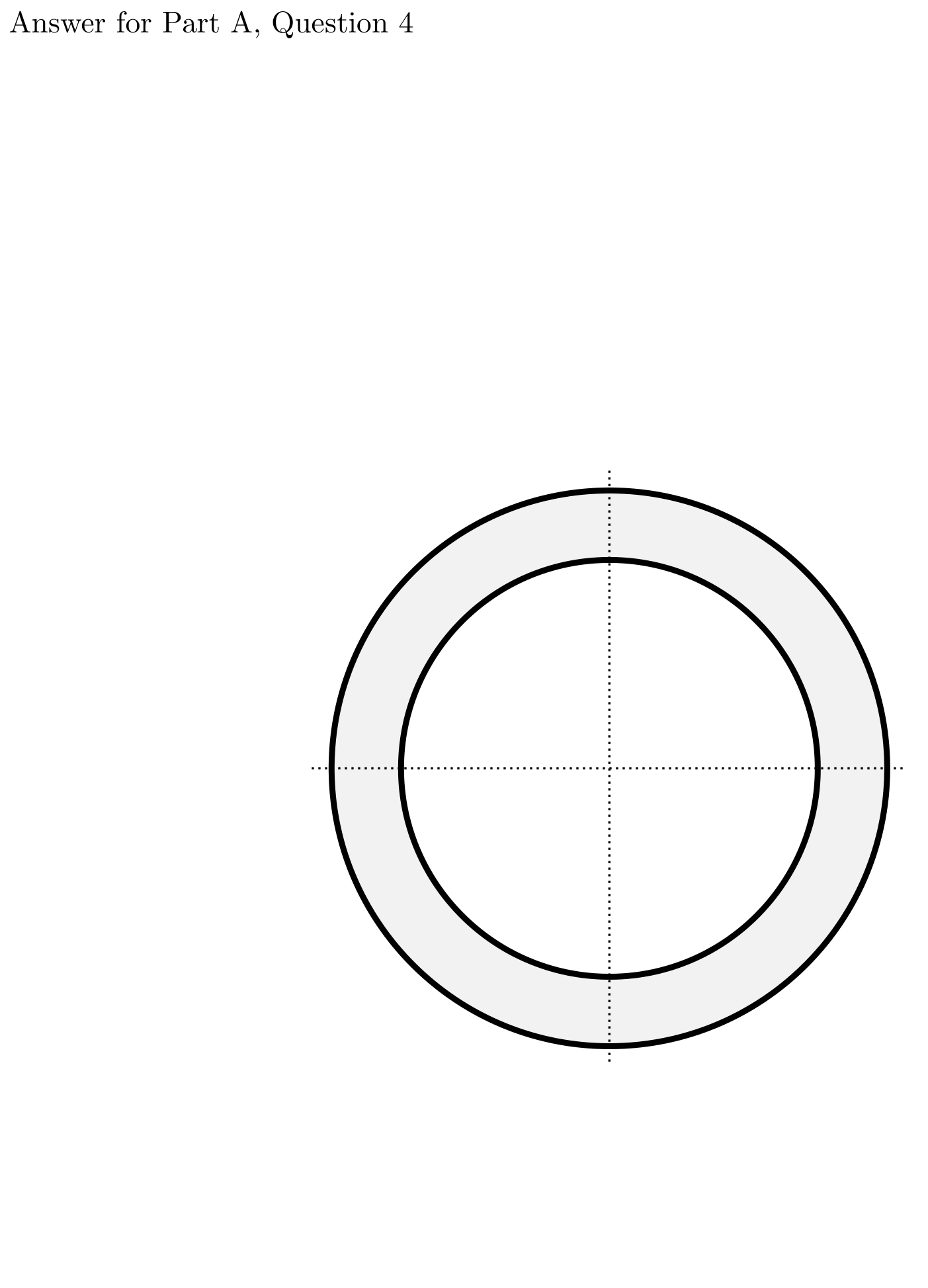
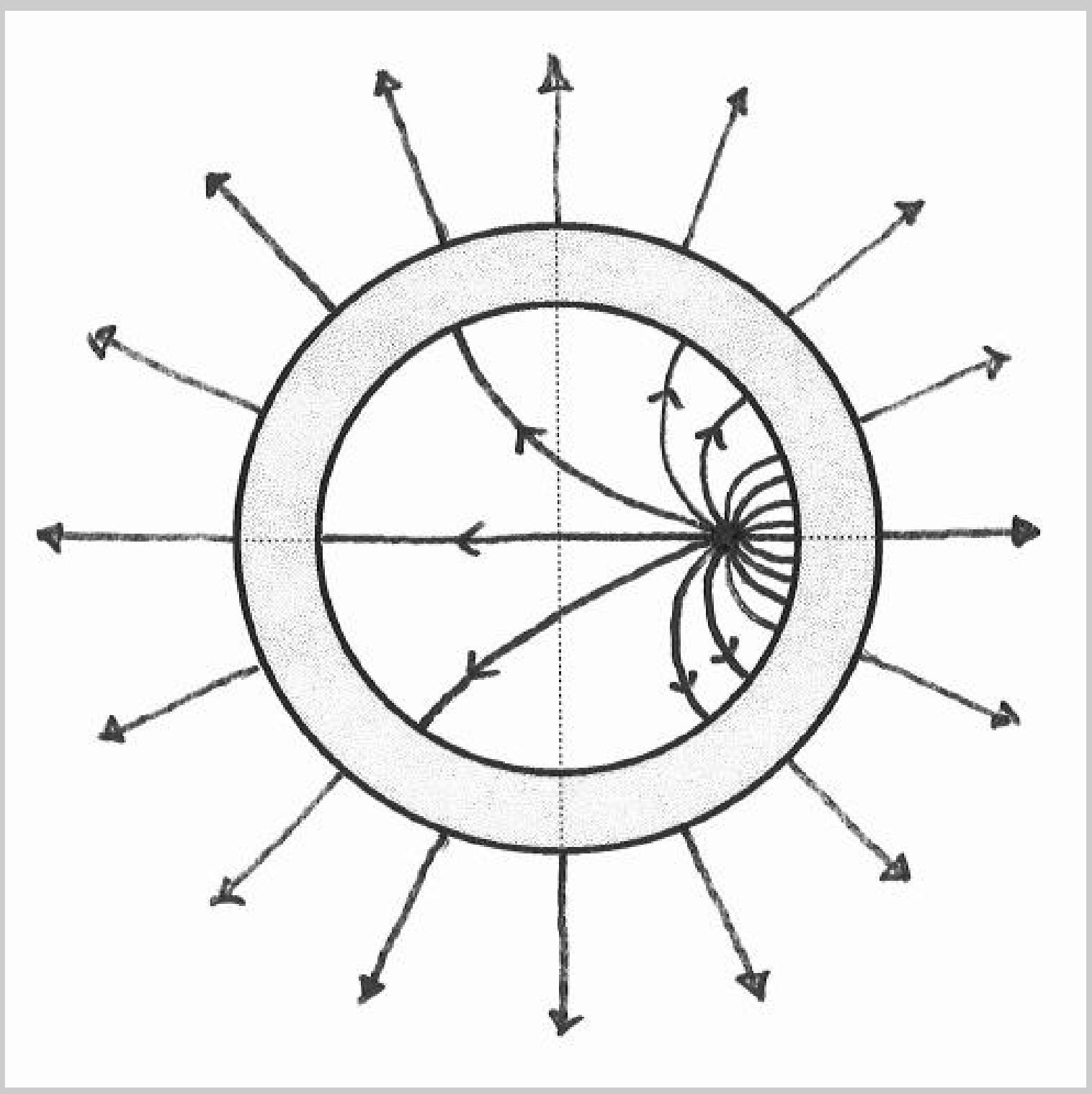
v. Sketch a figure showing the electric field lines (if any) inside, within, and outside the conducting shell on the answer sheet provided. You should show at least eight field lines in any distinct region that has a non-zero field.
Answer Sheets
Following are answer sheets for some of the graphical portions of the test.
STOP: Do Not Continue to Part B
If there is still time remaining for Part A, you should review your work for Part A, but do not continue to Part B until instructed by your exam supervisor.
Решение
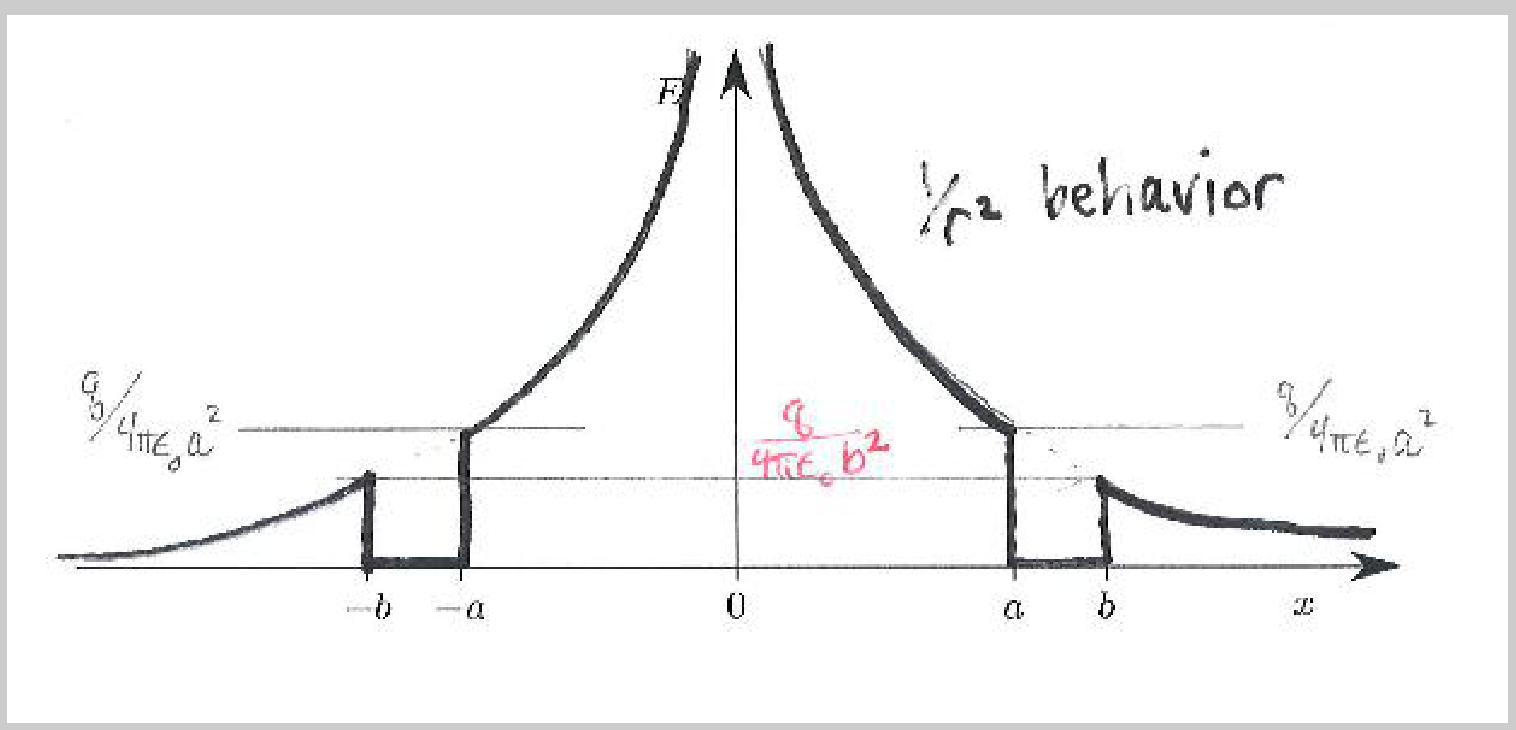
a. i.
We apply Gauss's law for a sphere with radius centered about the origin. Since the shell is neutral, the enclosed charge is , so by spherical symmetry
outside the shell. Just outside the shell, the field is .
a. ii.
Since the shell is conducting, the electrostatic field is zero inside it. By Gauss's law, this is achieved by having a charge of on the inner surface and a charge of on the outer surface , both uniformly distributed.
For , we can apply Gauss's law again to conclude , just as it is outside the shell.
a. iii.
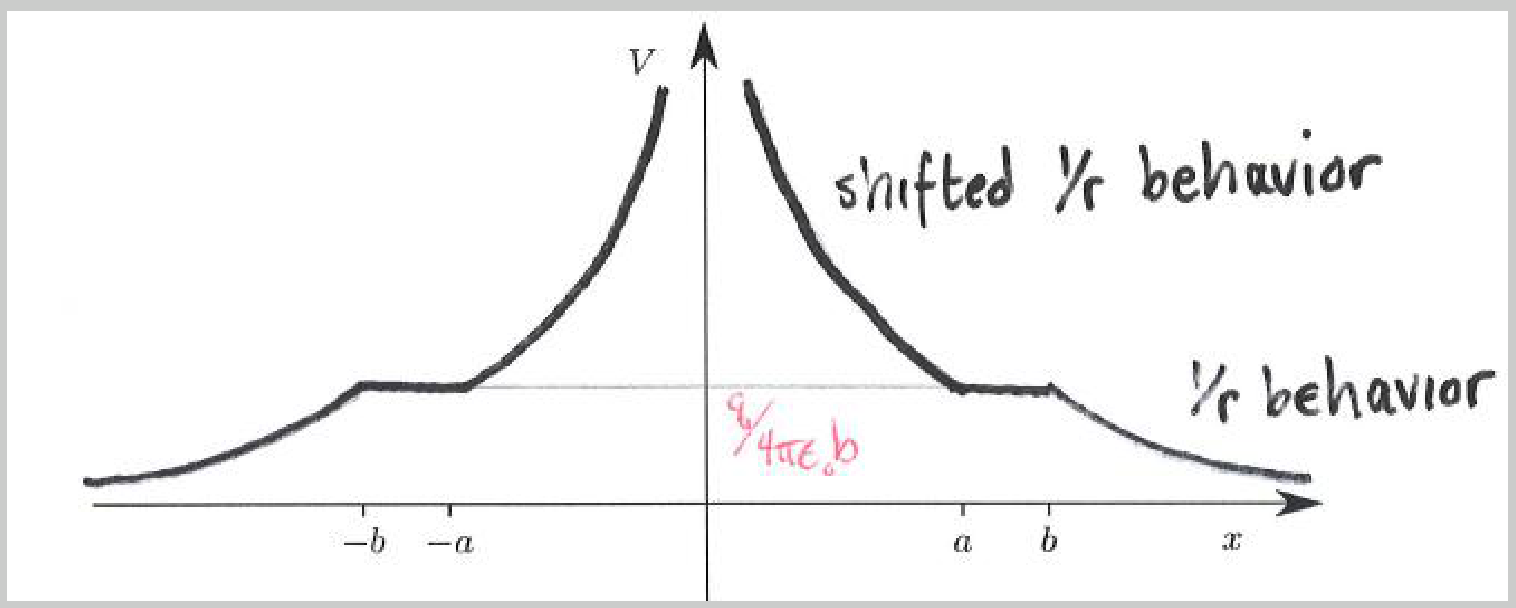
The shell is a conductor, so it is an equipotential surface. Then the potential at is same as the potential at . However, outside the shell the field looks just like that of a point charge at the origin, so
a. iv.
As we've shown above, the potential is proportional to outside , and is constant between and . Then the potential for is not proportional to . Instead, it is a curve shifted by a constant, so that the potential is continuous at .
b. i.
The conducting shell acts like a Faraday cage. As in the previous part, by Gauss's law, we must have a charge of on the inner surface, so a charge of on the outer surface. The charge on the inner surface is distributed non-uniformly to perfectly cancel out the asymmetric field of the point charge; these two contributions sum to exactly zero everywhere outside . Then by spherical symmetry, the charges on the outer surface are uniformly distributed.
One might wonder why the charges on the outer and inner surfaces can't both be non-uniformly distributed. A more rigorous argument would appeal to the uniqueness theorems for electrostatics: given the setup we've given, there is only one way to satisfy all the boundary conditions, so the configuration we gave above must be it. The general principle in that in electrostatics, the only information that can be seen across a shielding conducting shell is the total charge.
In any case, by the same logic as in part (a),
outside the shell. Just outside the shell, the field is .
b. ii.
For , the field is just that of a point charge at the origin, by the shell theorem. The field inside is more complicated because it depends on the distribution of charge on the inner surface; all that is required is that it diverges at and is higher at than .
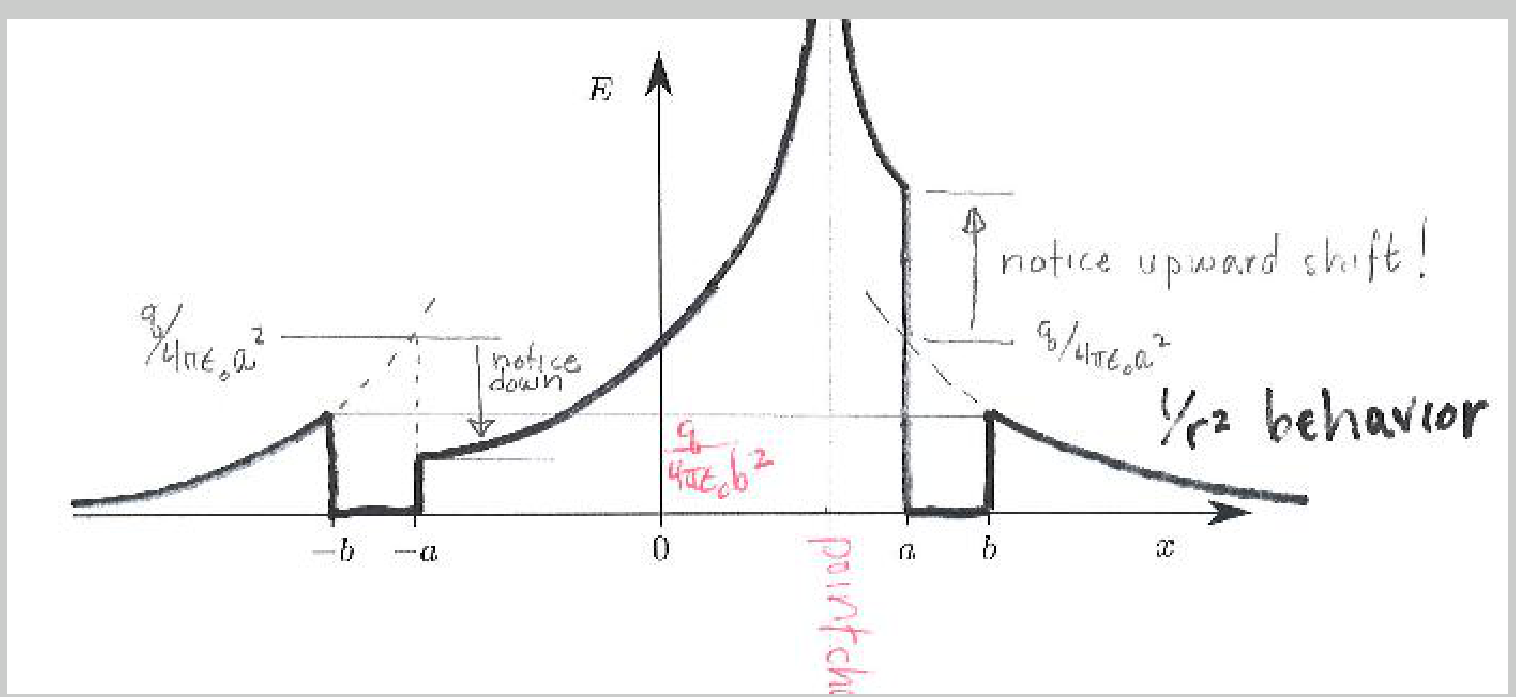
Incidentally, one can find the field for exactly using the method of image charges: for , the shielding charges on the inner surface produce the exact same field as a single point charge would. The location of this “image” charge can be found by inverting the original point charge about the circle .
b. iii.
By the same logic as in part (a),
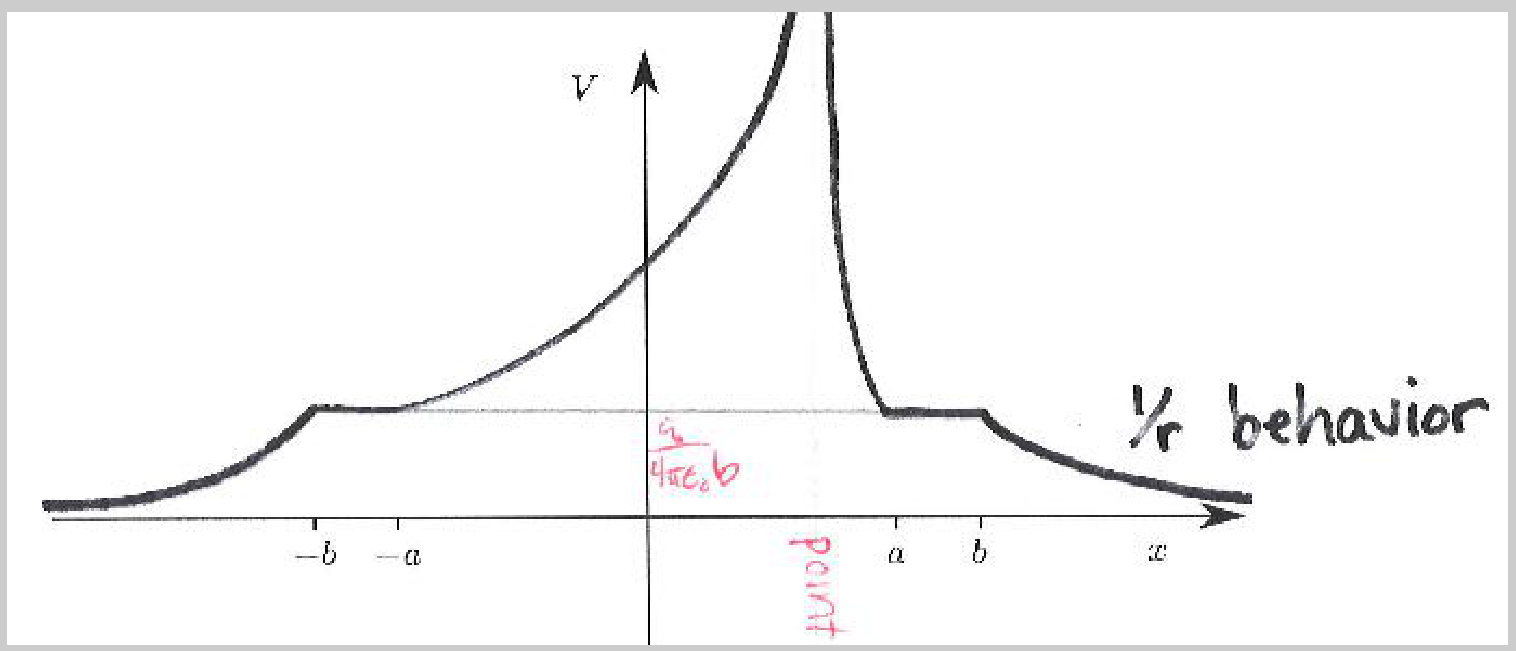
b. iv.
Again, the potential is proportional to outside , and is constant between and . The potential inside is more complicated, diverging at .
b. v.
The field should be spherically symmetric outside the shell, zero within the shell, and nonuniform inside. The field lines should terminate perpendicular to the conductor.
Оригинал в Архива: USAPhO-2014.pdf · официални решения: USAPhO-2014-Solutions.pdf