USAPhO 2017, Полуфинал — Задача 6. Question B2
USA Physics Olympiad Exam — Part A / Part B · 50 т.
Внимание: Бележка към темата
The source gives different exam-security dates on its supervisor and student pages. Printed key inconsistencies at A1, A4(b), B1(c) and B2(f)/(g) are retained with their native wording and mathematics; no silent corrected formula is substituted. Exact original PDFs and detailed source-defect evidence accompany this transcription.
Important Instructions for the Exam Supervisor — DO NOT DISTRIBUTE THIS PAGE
This examination consists of two parts: Part A has four questions and is allowed 90 minutes; Part B has two questions and is allowed 90 minutes.
The first page that follows is a cover sheet. Examinees may keep the cover sheet for both parts of the exam.
The parts are then identified by the center header on each page. Examinees are only allowed to do one part at a time, and may not work on other parts, even if they have time remaining.
Allow 90 minutes to complete Part A. Do not let students look at Part B. Collect the answers to Part A before allowing the examinee to begin Part B. Examinees are allowed a 10 to 15 minutes break between parts A and B.
Allow 90 minutes to complete Part B. Do not let students go back to Part A.
Ideally the test supervisor will divide the question paper into 3 parts: the cover sheet (page 2), Part A (pages 3-6), Part B (pages 8-10). Examinees should be provided parts A and B individually, although they may keep the cover sheet. The answer sheets should be printed single sided!
The supervisor must collect all examination questions, including the cover sheet, at the end of the exam, as well as any scratch paper used by the examinees. Examinees may not take the exam questions. The examination questions may be returned to the students after April 15, 2017.
Examinees are allowed calculators, but they may not use symbolic math, programming, or graphic features of these calculators. Calculators may not be shared and their memory must be cleared of data and programs. Cell phones, PDA’s or cameras may not be used during the exam or while the exam papers are present. Examinees may not use any tables, books, or collections of formulas.
Copyright ©2017 American Association of Physics Teachers.
USA Physics Olympiad Exam — Instructions
DO NOT OPEN THIS TEST UNTIL YOU ARE TOLD TO BEGIN - Work Part A first. You have 90 minutes to complete all four problems. Each question is worth 25 points. Do not look at Part B during this time. - After you have completed Part A you may take a break. - Then work Part B. You have 90 minutes to complete both problems. Each question is worth 50 points. Do not look at Part A during this time. - Show all your work. Partial credit will be given. Do not write on the back of any page. Do not write anything that you wish graded on the question sheets. - Start each question on a new sheet of paper. Put your proctor’s AAPT ID, your AAPT ID, your name, the question number and the page number/total pages for this problem, in the upper right hand corner of each page. For example, Doe, Jamie student AAPT ID # proctor AAPT ID # A1 - 1/3 - A hand-held calculator may be used. Its memory must be cleared of data and programs. You may use only the basic functions found on a simple scientific calculator. Calculators may not be shared. Cell phones, PDA’s or cameras may not be used during the exam or while the exam papers are present. You may not use any tables, books, or collections of formulas. - Questions with the same point value are not necessarily of the same difficulty. - In order to maintain exam security, do not communicate any information about the questions (or their answers/solutions) on this contest until after April 8, 2017.
Possibly Useful Information. You may use this sheet for both parts of the exam.
| for | |
| for | |
| for | |
| for |
Important Instructions for the Exam Supervisor — DO NOT DISTRIBUTE THIS PAGE
Ideally the test supervisor will divide the question paper into 3 parts: the cover sheet (page 2), Part A (pages 3-13), Part B (pages 15-23). Examinees should be provided parts A and B individually, although they may keep the cover sheet. The answer sheets should be printed single sided!
Условие
Beloit College has a “homemade” VanDeGraff proton accelerator, designed and constructed by the students and faculty.
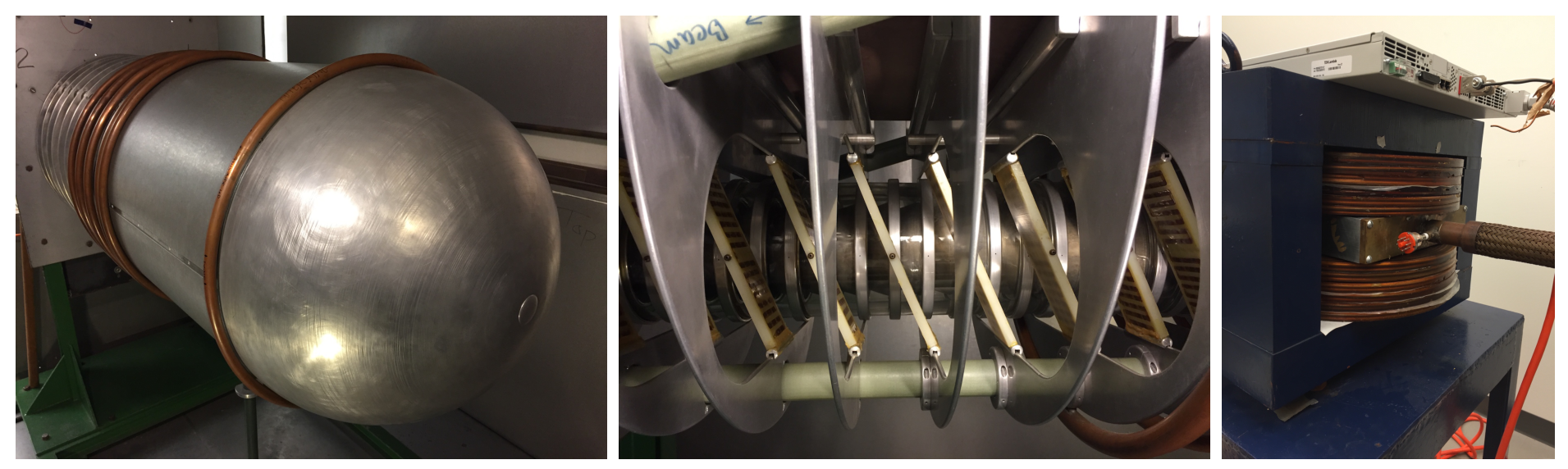
The accelerator dome, an aluminum sphere of radius meters, is charged by a rubber belt with width that moves with speed . The accelerating column consists of 20 metal rings separated by glass rings; the rings are connected in series with resistors. The proton beam has a current of and is accelerated through and then passes through a tuning electromagnet. The electromagnet consists of wound copper pipe as a conductor. The electromagnet effectively creates a uniform field inside a circular region of radius and zero outside that region.
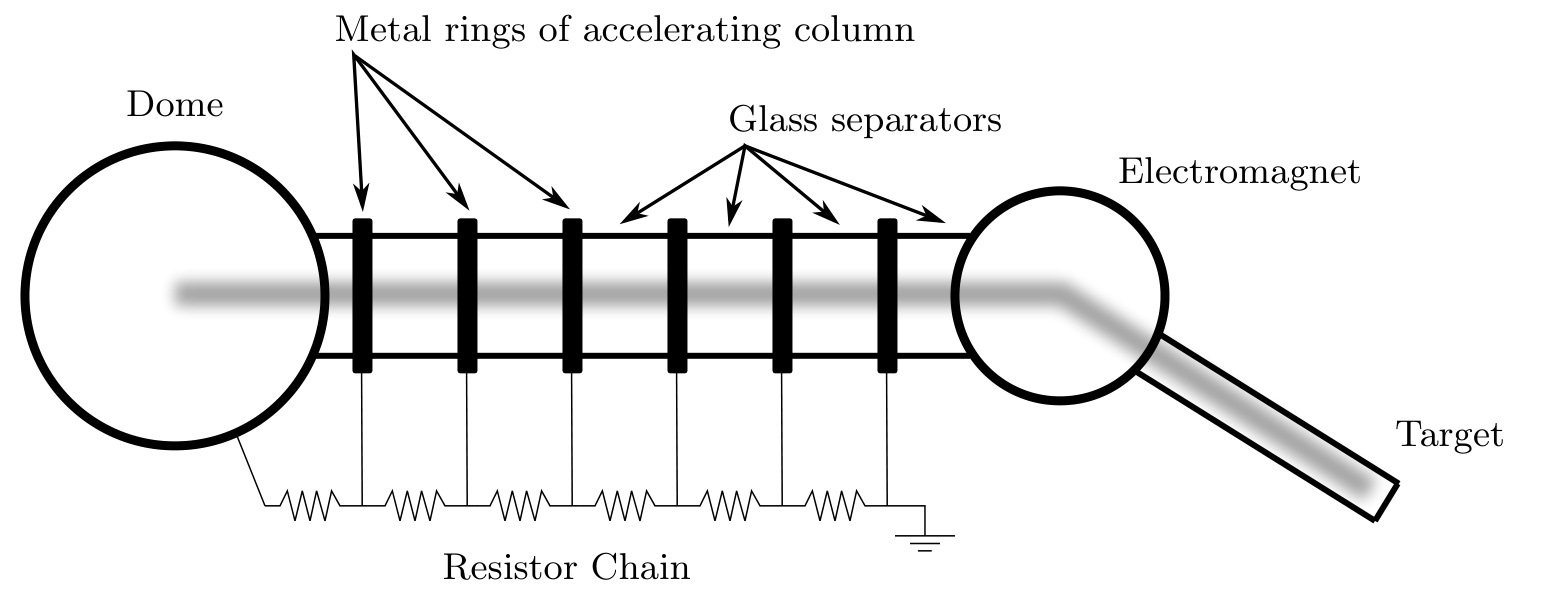
a. Assuming the dome is charged to , determine the strength of the electric field at the surface of the dome.
b. Assuming the proton beam is off, determine the time constant for the accelerating dome (the time it takes for the charge on the dome to decrease to of the initial value.
c. Assuming the proton beam is on, determine the surface charge density that must be sprayed onto the charging belt in order to maintain a steady charge of on the dome.
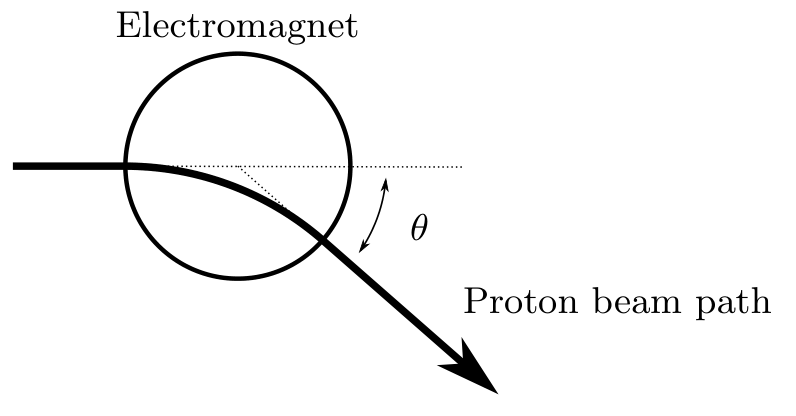
d. The proton beam enters the electromagnet and is deflected by an angle . Determine the magnetic field strength.
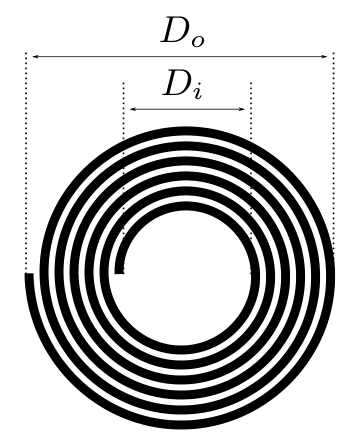
e. The electromagnet is composed of layers of spiral wound copper pipe; the pipe has inner diameter and outer diameter . The copper pipe is wound into this flat spiral that has an inner diameter and outer diameter . Assuming the pipe almost touches in the spiral winding, determine the length in one spiral.
f. Hollow pipe is used instead of solid conductors in order to allow for cooling of the magnet. If the resistivity of copper is , determine the electrical resistance of one spiral.
g. There are coils stacked on top of each other. Tap water with an initial temperature of enters the spiral through the copper pipe to keep it from over heating; the water exits at a temperature of . The copper pipe carries a direct 45 Amp current in order to generate the necessary magnetic field. At what rate must the cooling water flow be provided to the electromagnet? Express your answer in liters per second with only one significant digit. The specific heat capacity of water is ; the density of water is .
h. The protons are fired at a target consisting of Fluorine atoms (). What is the distance of closest approach to the center of the Fluorine nuclei for the protons? You can assume that the Fluorine does not move.
Решение
a.
The electric potential is given by
and the electric field is given by
so
b.
The time constant is given by
where
and
so
c.
There are several ways the dome can discharge, two of which are along the resistors and the proton beam. We will ignore any other path.
At 500kV, the current through the resistor chain is , from . So the total current needed to be supplied to the dome is . This is sprayed onto the belt, which moves at a rate of
so the necessary surface charge density is
d.
Start with where is the force on the protons, and the velocity. The protons are non-relativistic, so
They move in a circle of radius inside the field, given by
Combining these equations gives
Solving for the magnetic field strength,
To relate this to the angle, we need to do some geometry. Sketch two circles, one of radius , the other of radius , that intersect perpendicular to each other, as in the diagram above. Then drawing a triangle gives
Combining our results, the answer is
e.
Treat the problem as two dimensional. The area of the spiral is
The area of the pipe is
Equating and solving,
f.
We have
where is the cross sectional area of the pipe, or
Combining, we have
g.
The rate of heat generation in the coils is given by
This must be dissipated via the increase in water temperature,
where is the specific heat capacity in liters, and is the flow rate in liters per second. But since one liter of water is one kilogram, we can use either . Combining, we have
h.
Conservation of energy gives
where is the radius of closest approach. Then
Since this is about the size of a Fluorine nucleus, we can potentially get a nuclear reaction. Actually, the important reaction occurs at about 380 kV.
Exam Statistics
| Question | A1 | A2 | A3 | A4 | B1 | B2 | Total |
|---|---|---|---|---|---|---|---|
| Mean | 11 | 3 | 5 | 6 | 12 | 15 | 53 |
| Standard Deviation | 7 | 4 | 5 | 7 | 10 | 14 | 29 |
| Maximum | 25 | 21 | 25 | 25 | 42 | 50 | 163 |
| Upper Quartile | 18 | 4 | 9 | 8 | 18 | 26 | 73 |
| Median | 10 | 2 | 5 | 5 | 10 | 12 | 49 |
| Lower Quartile | 4 | 0 | 0 | 0 | 3 | 1 | 30 |
| Minimum | 0 | 0 | 0 | 0 | 0 | 0 | 5 |
Some Trivia:
- California had 121 test takers
- New Jersey had 42
- Texas had 38
- Florida, Illinois, Massachusetts, Maryland, New York, and Virginia each had between one dozen and two dozen test takers
- Alabama, Alaska, Colorado, Idaho, Iowa, Louisiana, Montana, North Dakota, South Dakota, and Wyoming did not have a test taker this year.
Оригинал в Архива: 2017-USAPhO-exam-2.pdf · официални решения: USAPhO-2017-Solutions.pdf