USAPhO 2020, Полуфинал — Задача 4. Question B1. String Cheese
USA Physics Olympiad Exam
Information about USAPhO Test
This examination consists of two parts and six problems. Ordinarily, you will be given 90 minutes to complete Part A, take a 10-15 minute break, and return to complete Part B in 90 minutes.
You may choose to observe the above guideline if you’d like to practice for future USAPhO tests.
Ordinarily, you are allowed calculators, but they are not allowed to use symbolic math, programming, or graphical features of these calculators. Calculators must not be shared and their memory must be cleared of data and programs. Cell phones, smart watches, PDAs, or cameras cannot be used during the exam or while the exam papers are present. Students are not allowed to bring any tables, books, or collections of formulas.
You may choose to observe the above guideline if you’d like to practice for future USAPhO tests.
Thank you for participating USAPhO this year under such extraordinary circumstances. We hope that you and your family stay safe, and that you continue to encourage more students like you to study physics and try out test hosted by AAPT.
We acknowledge the following people for their contributions to this year’s exam (in alphabetical order):
Ariel Amir, JiaJia Dong, Mark Eichenlaub, Abijith Krishnan, Kye W. Shi, and Mike Winer.
Условие
a. When a faucet is turned on, a stream of water flows down with initial speed at the spout. For this problem, we define to be the vertical coordinate with its positive direction pointing up.
Assuming the water speed is only affected by gravity as the water falls, find the speed of water at height . Define the zero of such that the equation for has only one term and find , the height of the spout.
b. Assume that the stream of water falling from the faucet is cylindrically symmetric about a vertical axis through the center of the stream. Also assume that the volume of water per unit time exiting the spout is constant, and that the shape of the stream of water is constant over time.
In this case, the radius of the stream of water is a function of vertical position . Let the radius at the faucet be . Using your result from part (a), find .
If is not constant, it implies that the water has some radial velocity during its fall, in contradiction to our assumptions in part (a) that the motion is purely vertical. You may assume throughout the problem that any such radial velocity is negligibly small.
c. The water-air interface has some surface tension, . The effect of surface tension is to change the pressure in the stream according to the Young-Laplace equation,
where is the difference in pressure between the stream and the atmosphere and is the radius of curvature of the vertical profile of the stream, visualized below. ( for the stream of water; the radius of curvature would be positive only if the stream profile curved inwards.)
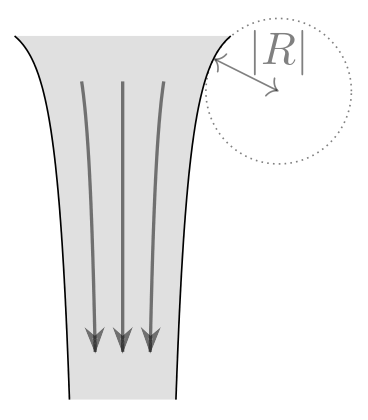
For this part of the problem, we assume that , so that the curvature of the vertical profile of the stream can be ignored. Also assume that water is incompressible.
Accounting for the pressure in the stream, find a new equation relating for in terms of , and , the density of water. You do not need to solve the equation for .
d. After falling for some distance, the water stream usually breaks into smaller droplets. This occurs because small random perturbations to the shape of the stream grow over time, eventually breaking the stream into apart.
For the rest of this problem we ignore the change in the radius of the stream due to changing speed of the water, as considered earlier. Instead, we examine small random variations in the radius of the stream.
Random variations can be broken down into a sum of sinusoidal variations in stream radius, each with a different wavenumber . We can analyze these different sinusoidal variations independently.
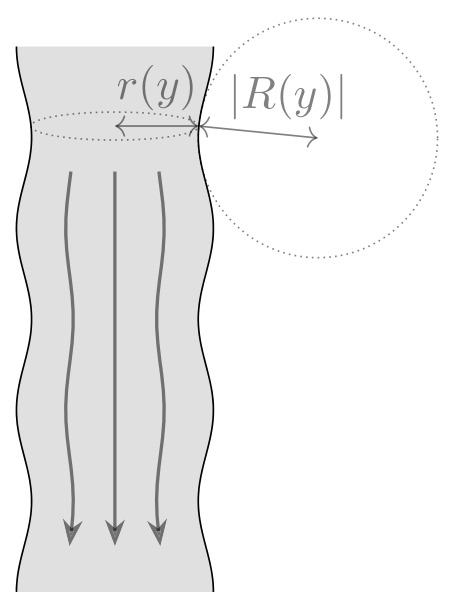
Consider a stream of water whose radius obeys
where is the perturbation amplitude. To analyze such a stream, it is sufficient to consider only the thickest and thinnest parts of the stream.
Accounting for both sources of curvature, find a condition on and such that the size of perturbations increases with time.
Отговори
- a.
- b.
- c.
- d.
Решение
a. We can use energy conservation to answer this question. For a bit of water with mass , the total energy is the sum of the kinetic and gravitational potential energies,
(With this sign convention, is positive. As decreases, so does the potential energy.)
As the bit of water falls, its energy remains constant, and is equal to the initial value of
Equating eliminating from equations B1-1 and B1-2, we have
and solving for , we get
The equation for has three terms, but we were asked to choose the zero of such that there is only one. Evidently, two of the terms must cancel, and these must be the two constant terms, since the final term varies with .
That means we need
Solving for , the vertical position of the spout is
With this choice of the zero of , the equation for simplifies to
We note that the result of this equation is real because at the spout, and decreases as the water falls, so this equation shows that is real and increases as the water falls.
b. The same volume of water must fall through any horizontal cross-section of the stream each second because water doesn’t disappear during its fall, and its density if constant. That volume per unit time is the cross-sectional area of the stream multiplied by the speed of the water in the vertical direction. As an equation,
is the same at all , and is equal to its initial value of
Eliminating from B1-4 and B1-5 and solving for gives
Plugging in our equation B1-3 for ,
c. Our conservation of energy approach from part (b) needs to be modified to account for the work done against pressure. As we look further down in the stream, the radius is smaller. This means the pressure is higher there, and the water is slowed compared to when we assumed only gravity acted on the water.
The result of accounting for changes in pressure in a flow where no energy is dissipated is the Bernoulli equation,
where is the pressure in the stream at the spout.
Using the Young-Laplace equation to replace and , we have
If we substitute in and , this becomes
This may be simplified to
d. If the size of the perturbation increases with time, water must be flowing from the thin parts of the stream to the thick parts. For that to happen, the pressure needs to be higher in the thin parts of the stream than in the thick parts of the stream so that the pressure gradient will force water towards the thick parts, eventually breaking the stream into droplets.
We consider a small patch with side lengths on the surface of the stream at the thinnest part of the stream. The pressure is
And at the thickest part of the stream,
We are looking for the wavenumbers such that
Using the Young-Laplace equation, this becomes
Dropping the common factor ,
To simplify this further, we will need to find and in terms of and , the variables given in the problem statement.
is the thickness of the stream, which from the equation given, varies sinusoidally. So
We are going to need to use in the Young Laplace equation, so we make the approximations
(To find these, recall for small .)
The inequality now becomes
This simplifies to
Next we need to determine the radius of curvature of the sinusoidal as a function of and .
To do this, we compare the sinusoidal function and a circle at small deviations from the thickest part of the stream.
Recall that, for small ,
which means that for small ,
Next we consider a circle of radius . If a particle moves along such a circle at speed , its acceleration is . This means that if the particle moves forward for a short time , it moves forward a distance and falls a distance . If we set , then the position of the particle is given by
Comparing and , they give the same motion if .
Then
Putting these into the inequality,
This simplifies to
So the perturbations will grow as long as they have a wavenumber greater than one over the radius, or equivalently when the wavelength of the perturbation is longer than the circumference of the stream.
This result was discovered experimentally by Plateau and derived theoretically by Rayleigh. The breaking up of a stream into droplets is called the Plateau-Rayleigh instability.
Оригинал в Архива: 2020_USAPhO.pdf · официални решения: 2020_USAPhO_solutions.pdf