USAPhO 2020, Полуфинал — Задача 5. Question B2. Mirror Mirror on the Wall
USA Physics Olympiad Exam
Information about USAPhO Test
This examination consists of two parts and six problems. Ordinarily, you will be given 90 minutes to complete Part A, take a 10-15 minute break, and return to complete Part B in 90 minutes.
You may choose to observe the above guideline if you’d like to practice for future USAPhO tests.
Ordinarily, you are allowed calculators, but they are not allowed to use symbolic math, programming, or graphical features of these calculators. Calculators must not be shared and their memory must be cleared of data and programs. Cell phones, smart watches, PDAs, or cameras cannot be used during the exam or while the exam papers are present. Students are not allowed to bring any tables, books, or collections of formulas.
You may choose to observe the above guideline if you’d like to practice for future USAPhO tests.
Thank you for participating USAPhO this year under such extraordinary circumstances. We hope that you and your family stay safe, and that you continue to encourage more students like you to study physics and try out test hosted by AAPT.
We acknowledge the following people for their contributions to this year’s exam (in alphabetical order):
Ariel Amir, JiaJia Dong, Mark Eichenlaub, Abijith Krishnan, Kye W. Shi, and Mike Winer.
Условие
Consider a square room with side length . The bottom wall of the room is a perfect mirror.* A perfect monochromatic point source with wavelength is placed a distance above the center of the mirror, where .
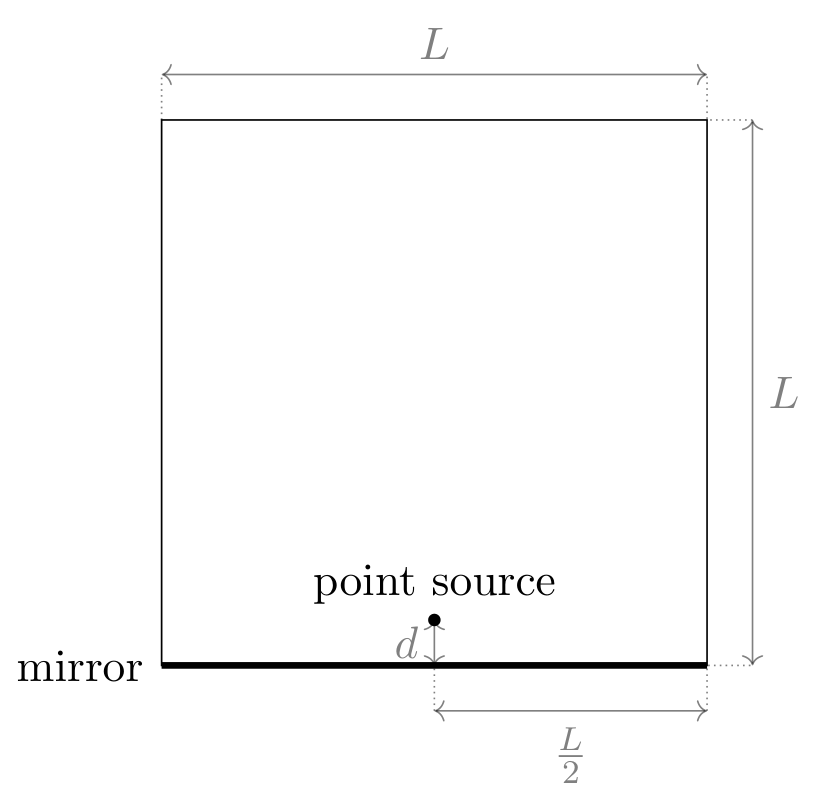
*Remember that the phase of light reflected by a mirror changes by .
a. On the right wall, an interference pattern emerges. What is the distance between the bottom corner and the closest bright fringe above it? Hint: you may assume as well.
b. You plan on running an experiment to determine in a room with m, and you know that is between 550 and 750 nm. You will measure and (the distance of the tenth fringe from the corner) with the same ruler (with markings of 1 mm). At what should you place the point source to minimize your error in your measurement? Roughly what is that minimum error?
c. Now suppose we place a transparent hemispherical shell of thickness and index of refraction over the source such that all light from the source that directly strikes the right wall passes through the shell, and all light from the source that strikes the mirror first does not pass through the shell.
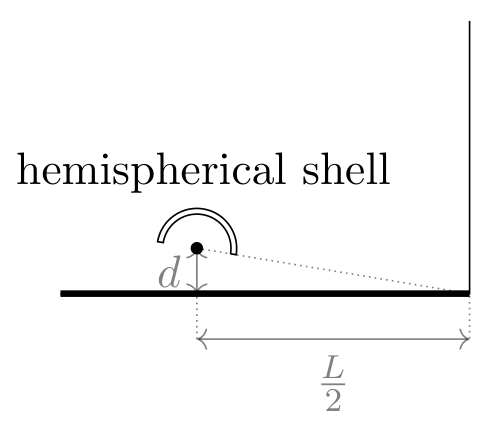
At what is the fringe closest to the bottom-most corner now? (You may find it convenient to use , the largest integer below .) What is the spacing between the fringes now? Ignore any reflections or diffraction from the hemispherical shell.
d. Now, suppose the hemispherical shell is removed, and we instead observe the interference pattern on the top wall. To the nearest integer, what is the total number of fringes that appear on the top wall? You may assume that .
Отговори
a.
b. d = y10 = 8 mm; Δλ ≈ 60 nm
The official solution accepts any reasonable uncertainty in tick spacing (~0.5 mm or ~1 mm).
c.
d.
Решение
a. This setup is essentially a double-slit experiment with the second slit being the image of the point source on the other side of the mirror, with the additional phase shift from the mirror. The distance between the source and a spot on the wall is given by and the distance between the image and a spot is given by . Subtracting the two distances and adding in the phase shift gives us approximately
This distance must be a multiple of for interference to occur. Then,
Substituting gives us .
b. Our error is given by
Note that mm. From earlier, note that after substituting , .
If we assume that nm, note that
Choosing minimizes our error, so we get that mm. Then, nm.
Note: Accept any reasonable uncertainty in tick spacing mm or mm.
c. Now the optical distance between the source and a spot on the wall is increased by . Then, we need
To minimize , we take to be . Then,
Because is just an offset, the spacing between the fringes does not change, i.e., the spacing is still .
d. Now, the distance between the source and a spot on the wall is given by and the distance between the image and a spot on the wall is . We do not assume this time. Subtracting the two distances gives us roughly
Taylor expanding gives us
Then,
For to be physical, we require that .
The maximum allowed is . Then,
so
Thus, we have that
Then, the number of fringes is
where the extra factor of 2 comes from there being two sides to the interference pattern.
Оригинал в Архива: 2020_USAPhO.pdf · официални решения: 2020_USAPhO_solutions.pdf