USAPhO 2021, Финален кръг · подбор на отбора — Задача 1. The Jet Stream
2021 USAPhO+ — Traveling Team Selection Exam · 8 май 2021 г.
Information About The 2021 USAPhO+
- The 2021 USAPhO+ is a 5-hour exam taking place on Saturday, May 8 from noon to 5 PM, Eastern time.
- The exam is hosted by AAPT on the platform provided by Art of Problem Solving. It will be proctored by the US Physics Team coaches via Zoom.
- Before you start the exam, make sure you are provided with blank paper, both for your answers and scratch work, writing utensils, graph paper and a ruler, a hand-held scientific calculator with memory and programs erased, and a computer for you to log into the USAPhO+ testing page.
- At the end of the exam, you have 20 minutes to upload solutions to all of the problems for that part. For each problem, scan or photograph each page of your solution, combine them into a single PDF file, and upload them on the testing platform.
- USAPhO+ graders are not responsible for missing pages or illegible handwriting. No late submissions will be accepted.
Congratulations again on your qualification for the USAPhO+. We wish you the best of luck on the challenging problems to follow.
We acknowledge the following people for their contributions to this year’s exam (in alphabetical order):
JiaJia Dong, Mark Eichenlaub, Abijith Krishnan, Kye W. Shi, Brian Skinner, Mike Winer, and Kevin Zhou.
Условие
The jet stream is an eastward wind current that moves over the continental United States at an altitude of to feet (the range of typical cruising altitudes of commercial airlines). This strong current affects flight times significantly: flights traveling eastward fly significantly faster than flights traveling westward.
This problem consists of two independent parts. In the first part, you will consider a simple model for airplane flight. In the second part, you will determine the jet stream speed on a fictitious planet called Orb.
1
The power that a plane expends is used both to combat drag and to generate lift. Throughout this part of the problem, you may assume that the plane travels with horizontal velocity relative to the air, the density of air is , the mass of the plane is , and the cross-sectional area of the plane is .
(a) The drag force on an airplane is given by
where is the drag coefficient (which depends on the shape of the plane). Write an expression for the power expended by the airplane to combat the drag force from the air.
(b) Airplanes generate lift by deflecting air downward.
i. Estimate the air mass per unit time which is deflected by the wings of the plain.
ii. Estimate the power expended by the plane for lift.
(c) Estimate the speed at which an airplane flies relative to the air by minimizing the power expended by the plane. To get a numeric answer, you may use the following parameters:
2
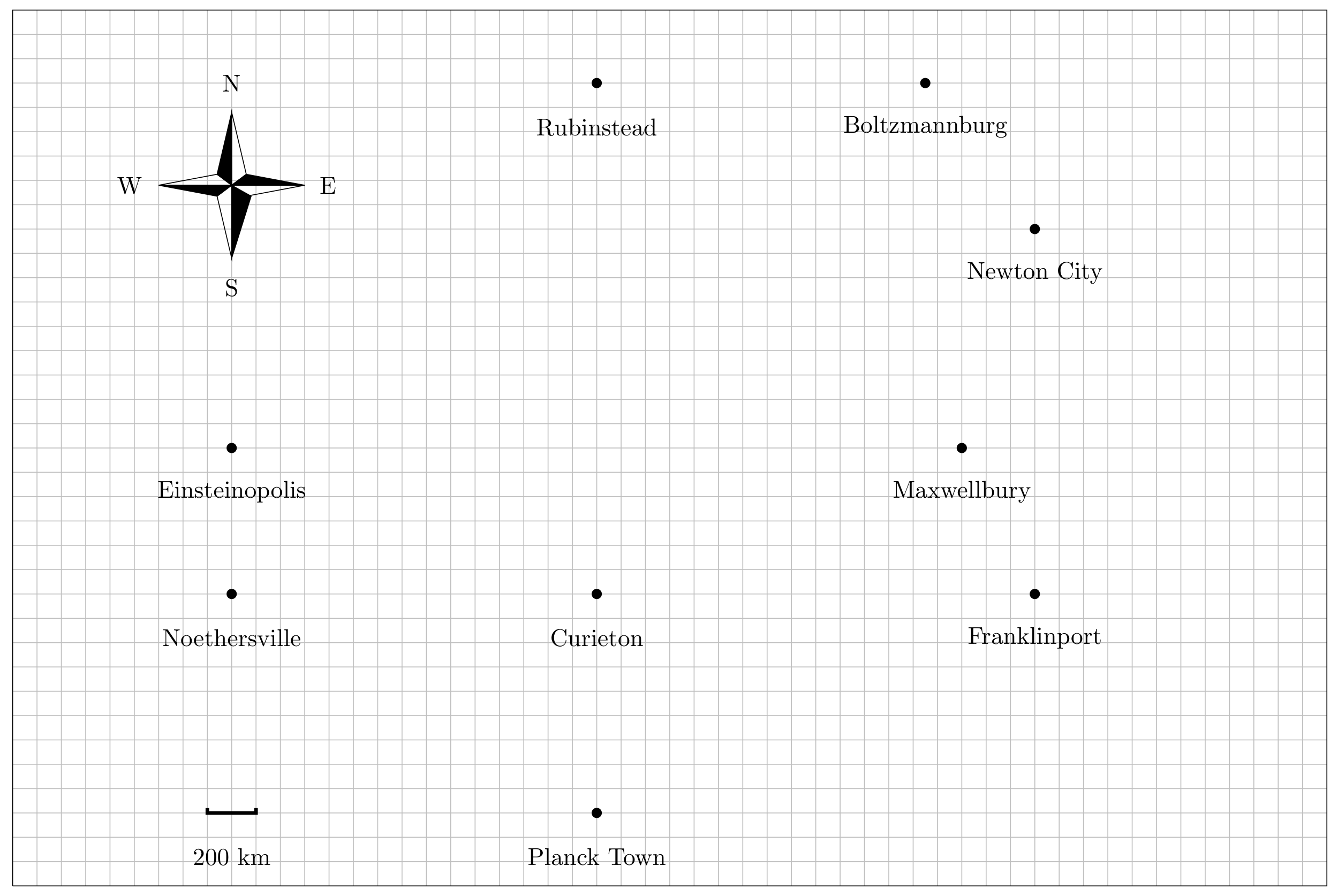
Next, we estimate the jet stream speed using flight times. Because the jet stream speed on Earth varies greatly with location, time of year, and climate effects (such as El Niño and La Niña), you will instead consider the fictitious planet Orb, where the jet stream is eastward and uniform in the region of interest. At the end of the problem is a map of the region, whose area is much smaller than the surface area of Orb (i.e., you can neglect the curvature of Orb).
At cruising altitude, we assume all airplanes travel at a fixed speed relative to the air. (This is not necessarily the same as your answer to 1(c), which was just a rough estimate.) Additionally, we assume that flights occur in three stages – (1) taxi and takeoff, (2) flight at cruising altitude, (3) landing and taxi – and that stages (1) and (3) take a fixed total time for every flight.
(a) Suppose a plane, at cruising altitude, is traveling at an angle away from due east relative to the ground. What is the speed of the plane relative to the ground? Give your answer in terms of , , and , the speed of the jet stream relative to the Earth’s surface.
(b) If the plane travels a distance , what is the total travel time , including taxi, takeoff, and landing?
(c) Below, we present some data on airplane flights on Planet Orb. Each of the flight times shown below has an independent uncertainty of . From the data and the map, determine and , giving your answers in km per hour with uncertainties. Indicate clearly what two quantities you are plotting against each other on each graph that you plot.
| Departure City | Arrival City | (min) |
|---|---|---|
| Noethersville | Rubinstead | 185 |
| Rubinstead | Noethersville | 286 |
| Curieton | Franklinport | 107 |
| Franklinport | Curieton | 244 |
| Planck Town | Maxwellbury | 143 |
| Maxwellbury | Planck Town | 256 |
| Rubinstead | Boltzmannburg | 92 |
| Boltzmannburg | Rubinstead | 190 |
| Einsteinopolis | Maxwellbury | 160 |
| Maxwellbury | Einsteinopolis | 384 |
| Planck Town | Franklinport | 128 |
| Franklinport | Planck Town | 266 |
| Einsteinopolis | Franklinport | 188 |
| Franklinport | Einsteinopolis | 431 |
| Boltzmannburg | Maxwellbury | 135 |
| Maxwellbury | Boltzmannburg | 150 |
| Departure City | Arrival City | (min) |
|---|---|---|
| Noethersville | Einsteinopolis | 68 |
| Einsteinopolis | Noethersville | 74 |
| Franklinport | Newton City | 144 |
| Newton City | Franklinport | 129 |
| Curieton | Rubinstead | 186 |
| Rubinstead | Curieton | 175 |
| Planck Town | Curieton | 95 |
| Curieton | Planck Town | 102 |
| Planck Town | Rubinstead | 249 |
| Rubinstead | Planck Town | 250 |
Отговори
1, (a)
1, (c) 300 m/s
Order-of-magnitude estimate: .
2, (a)
2, (b)
2, (c) vrel = 860 ± 50 km/h, vw = 370 ± 30 km/h
Решение
1
(a) We have that , so
(b) i. The mass flux is given by , so the rate is
ii. Suppose the deflected air has velocity downward. Then the lift force is given by
The power is given by
This is the power that goes into accelerating the air downward, so by energy conservation it must have come from the plane’s engine.
(c) The total power is given by
The minimum power occurs when the derivative vanishes, which roughly gives
2
(a) The velocity of the plane relative to the ground, , the velocity of the plane relative to the air, , and the jet stream velocity, , all form a triangle under tip-tail addition. Then, from law of cosines,
Solving gives us
Of course, we assumed , as otherwise flying westward would not even be possible.
(b) The answer is given by
where is our answer to the previous part.
(c) Note that the pairs of cities given in the second table are directly north/south of each other. For such cities, we expect the times in either direction to be equal, up to the timing uncertainty, and the expression for the time simplifies to
We can read off the second table, and calculate from the figure. The unknown quantity goes into the intercept, while the slope is
Next, consider the pairs of cities given in the second table. We can cancel out the effect of by considering the difference in flight times in the two directions,
After some simplification, we find
Therefore, plotting the time difference versus , where can also be measured from the graph, gives
Combining these results gives the answers,
Uncertainty on the times should be propagated through the calculation using the usual rules, while the uncertainties on the slopes are found by drawing the steepest and shallowest fit lines.
Оригинал в Архива: 2021-USAPhO_plus.pdf · официални решения: 2021-USAPhO_plus_Solutions_v2.pdf