USAPhO 2021, Финален кръг · подбор на отбора — Задача 3. Great Hall
2021 USAPhO+ — Traveling Team Selection Exam · 8 май 2021 г.
Information About The 2021 USAPhO+
- The 2021 USAPhO+ is a 5-hour exam taking place on Saturday, May 8 from noon to 5 PM, Eastern time.
- The exam is hosted by AAPT on the platform provided by Art of Problem Solving. It will be proctored by the US Physics Team coaches via Zoom.
- Before you start the exam, make sure you are provided with blank paper, both for your answers and scratch work, writing utensils, graph paper and a ruler, a hand-held scientific calculator with memory and programs erased, and a computer for you to log into the USAPhO+ testing page.
- At the end of the exam, you have 20 minutes to upload solutions to all of the problems for that part. For each problem, scan or photograph each page of your solution, combine them into a single PDF file, and upload them on the testing platform.
- USAPhO+ graders are not responsible for missing pages or illegible handwriting. No late submissions will be accepted.
Congratulations again on your qualification for the USAPhO+. We wish you the best of luck on the challenging problems to follow.
We acknowledge the following people for their contributions to this year’s exam (in alphabetical order):
JiaJia Dong, Mark Eichenlaub, Abijith Krishnan, Kye W. Shi, Brian Skinner, Mike Winer, and Kevin Zhou.
Условие
The classical Hall effect was first measured by Edwin Hall in 1879, shortly after the publication of Maxwell’s equations. In all parts of this problem, materials contain electrons per unit volume, and each electron has charge and mass . You may use these quantities in all of your answers. We will begin by investigating the implications of the classical Hall effect.
1
An infinite plate in the plane, with thickness in the direction, is placed in a uniform magnetic field as shown. An electric field is applied in the plane of the plate and the system is allowed to reach a steady state.
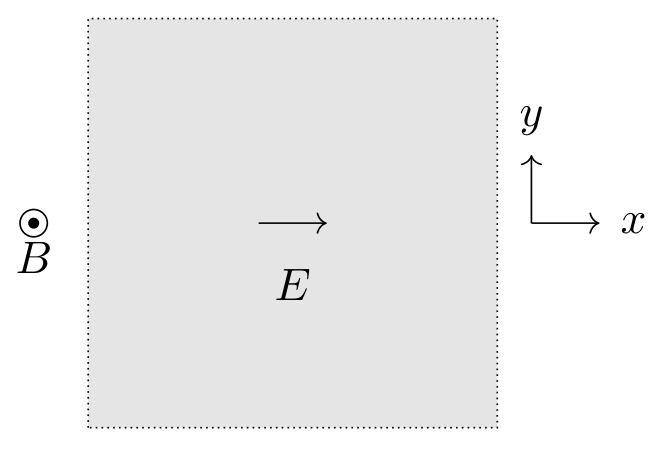
(a) If the electrons have velocity at steady state, what is the current density ? Recall that is defined as the total flow of charge through a unit cross-section area per unit time.
(b) In the Drude model, electrons are subject to both the Lorentz force and a damping force , where is a constant that depends on the material. In the above system, what is the current density in the steady state? Give both the magnitude and direction of , e.g. in polar coordinates.
(c) Compute the electrical resistivity,
and the transverse Hall resistivity
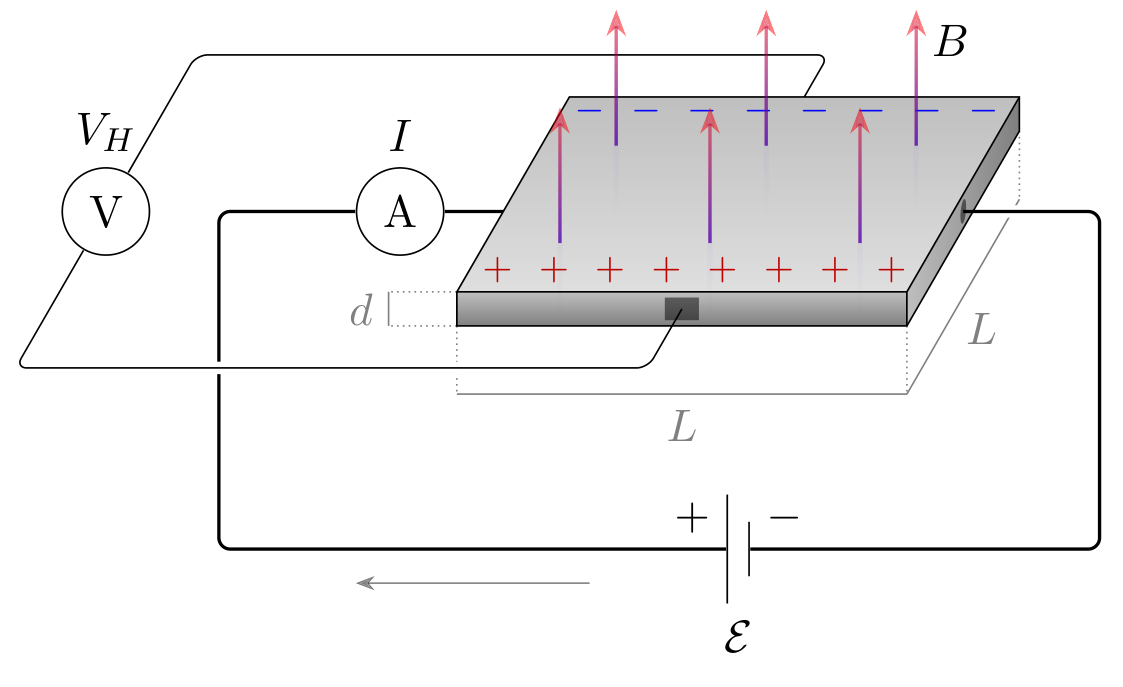
(d) A Hall effect sensor detects the strength of magnetic fields. Consider the following circuit consisting of a square plate of side length and thickness in a perpendicular uniform magnetic field .
A longitudinal emf is applied to the plate. At steady state, a Hall voltage is measured across the plate due to the buildup of charge on either side of the plate. If the electrical resistivity of the plate at zero magnetic field is , what is the Hall voltage and the current through the plate? Express your answer in terms of , , , and the dimensions of the plate.
2
Experiments in the 20th century revealed that in many materials, the Hall resistivity could only take certain discrete values. We will now show how this follows from Bohr quantization. (These next parts are independent of the first part of the problem.)
A zero-resistance loop of wire of radius and cross-sectional area carries a counterclockwise current . A solenoid through the middle of the loops carries magnetic flux out of the page, which we define to be the positive direction.
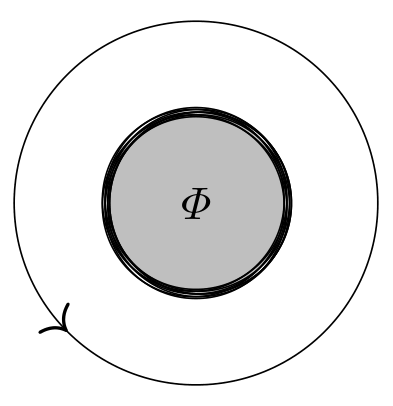
(a) If the electrons all have the same speed, what is the angular momentum of each electron?
(b) If we allow the flux in the solenoid to change, the usual, “mechanical” angular momentum of each electron is not conserved. Instead, a quantity called the canonical angular momentum, , for some constant , is conserved. Find .
(c) The Bohr quantization condition says that for a closed circular orbit, an integer number of de Broglie wavelengths must fit in its circumference. The de Broglie wavelength is
where is Planck’s constant, and is the canonical momentum. For a given solenoid flux , what is the set of allowed mechanical angular momenta ?
(d) What is the minimum possible change in the magnetic flux for which the same set of mechanical angular momenta is allowed? This is known as the flux quantum.
3
Now, consider an annulus held perpendicular to a fixed, uniform external magnetic field , and suppose an additional, tunable magnetic flux threads the center of the annulus, with both pointing out of the page. The annulus has a transverse Hall resistance (i.e., an EMF of around the annulus generates a perpendicular current via the Hall effect) and you may neglect its self-inductance.
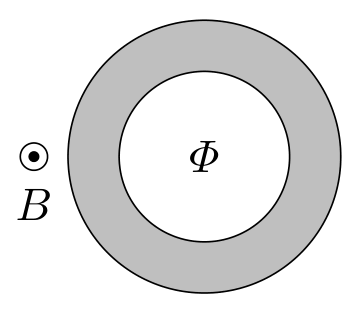
(a) Suppose begins to increase slowly and steadily in time. After a short time, the electrons will begin flowing steadily from one side of the annulus to the other. Do the electrons move inward or outward? Justify your answer.
(b) If the threaded flux increases by , how many electrons pass from one edge of the annulus to the other? You may use , among other variables, in your answer.
(c) As we showed in 2(d), if the magnetic flux changes by the flux quantum , the allowed orbits from Bohr quantization are unchanged. Quantum mechanics thus tells us that in conventional materials, if the magnetic flux changes by , an integer number of electrons must pass from one edge to another. What constraint does this place on the Hall resistance?
Отговори
1, (a)
1, (b)
1, (c)
1, (d)
2, (a)
2, (b)
2, (c)
is an integer.
2, (d)
3, (a) Inward (electrons flow radially inward).
3, (b)
3, (c)
Решение
1
(a) The current density is given by .
(b) The equation of motion for an electron is
Solving the system of equations gives us
Then,
As requested, we compute the magnitude and direction:
(c) The two resistivities are
(d) The Hall voltage is such that the electric field from the external EMF and from the charge buildup causes the current to flow in the direction. Our equation of motion is thus
Then, we have the two equations
Substituting gives us
2
(a) The current is , where is the speed of each electron. Then the angular momentum is
Note that the angular momentum points into the page, because the electrons have negative charge.
(b) We compute the change in angular momentum associated with a change in flux . By Faraday’s Law, there is an induced electric field resulting from the change in magnetic flux.
The electric field results in a force on each electron, and thus we find that
Then, the rate of change in angular momentum is
Therefore,
Then, for to be conserved,
(c) The circumference of such an orbit is . A de Broglie wavelength is given by
Then,
or where . Then the allowed mechanical momenta satisfy
where is an integer.
(d) We require such that we get the same set of allowed mechanical angular momenta. Then,
Note that for a superconducting ring, the flux quantum is because the electrons come in Cooper pairs, but this wasn’t part of this problem.
3
(a) The increasing flux induces a clockwise EMF. The Lorentz force on an electron is
Then, must oppose . Therefore, must point radially inward by the right hand rule. Therefore, electrons must be flowing radially inward.
(b) We have that
Therefore, the number of electrons that pass from one edge to another is
(c) We set
This is known as the integer quantum Hall effect, and it applies to any material shape.
Оригинал в Архива: 2021-USAPhO_plus.pdf · официални решения: 2021-USAPhO_plus_Solutions_v2.pdf